Applying the HSI Method: A Full Worked Case
From picture to plan — the five steps under real-case conditions
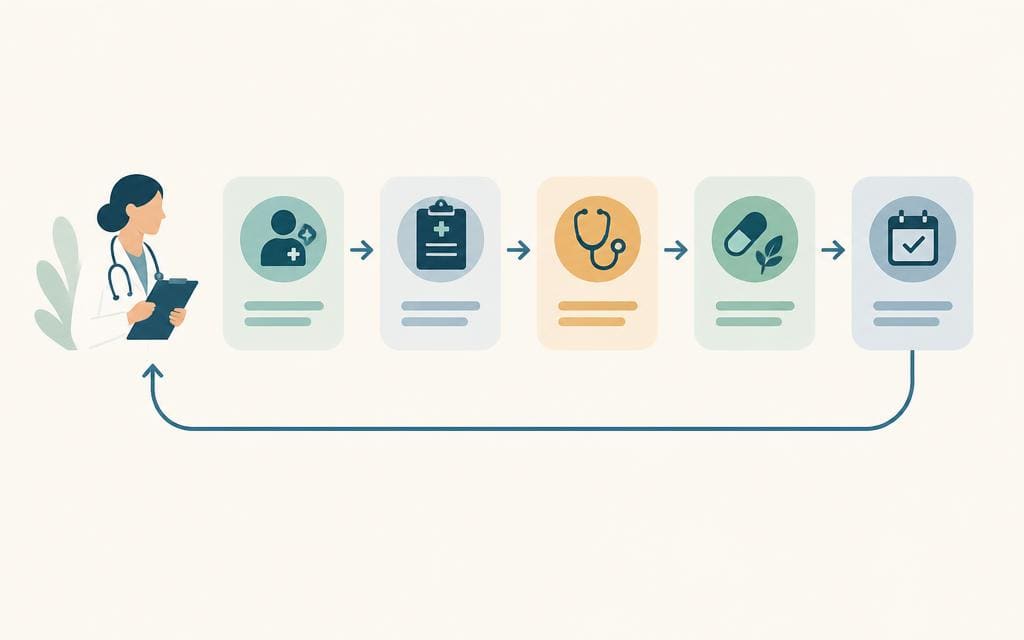
Learning objective: Apply all five steps of the HSI Method, in sequence, to a realistic case from initial assessment through to a personalised plan and a measurement point — building the practical skill of moving from “picture” (the Healthspan Model) to “plan” (the Method).
“You've just completed a full five-domain Assess on a client and found six things worth addressing. They have capacity for one.”
Which one — and how do you decide?
Watch alongside this lesson
The Longevity Clinic Experiment: What We Are Learning from Real Patients
NUS Medicine
A medical-school webinar on translating longevity evidence into structured clinical learning from patient trajectories, complementing this lesson's worked-case method.
Lesson 1.4 introduced the HSI Method's five steps and applied them briefly to a short example. This lesson slows down and works through a single, more complete case end to end, because knowing the five steps in theory and actually sequencing them under the messiness of a real case are different skills — and the second one is the one that actually matters in practice.
The case — Aisha, 45, coaching client
Aisha books a session saying she “just wants more energy.” She works full-time in a demanding sales role, has two teenage children, and describes herself as “wired but tired” — struggling to switch off at night but exhausted all day. She mentions, almost in passing, that she stopped her regular Pilates class eight months ago “when things got busy” and hasn't seen her closest friend, who moved away, in over a year.
Step 1Assess — the full five-domain picture
Rather than jumping straight to “improve her sleep,” a full Healthspan Model assessment is taken across all five domains:
Biological State
No recent bloodwork; family history of type 2 diabetes on her mother’s side; reports increasingly heavy, irregular periods (possible perimenopause).
Regimen
Stopped Pilates eight months ago and hasn’t replaced it with any movement; describes “grazing” on snacks through the day rather than proper meals; goes to bed late but wakes frequently.
The Exposome
Long commute, open-plan office with little natural light, limited control over her working hours.
Mind
Describes herself as “wired but tired” — a classic marker of dysregulated stress physiology: chronically elevated cortisol interfering with the normal evening cortisol drop that allows sleep onset.
Connection & Purpose
Lost regular in-person contact with her closest friend a year ago; the Pilates class, now stopped, was also her main non-work social contact — two separate sources of connection disappeared around the same time, not just one.
Steps 2–5 — turning the picture into a plan
Step 2Integrate
Taken separately, “poor sleep,” “no exercise,” and “less social contact” look like three unrelated lifestyle gaps. Integrated, a clearer picture emerges: the loss of Pilates eight months ago removed both her only regular movement and a chunk of her social contact simultaneously, which likely compounded the effect of losing her friend around the same time — plausibly contributing to the chronic stress state now showing up as “wired but tired” sleep disruption, which itself likely worsens the perimenopausal symptom picture. One change had knock-on effects across Regimen, Mind, and Connection & Purpose at once — the systems-thinking payoff of doing Integrate as a distinct step, rather than treating each domain as a separate to-do list.
Step 3Prioritise
Not everything can be addressed at once, and trying to would overwhelm a client already describing herself as exhausted. Two things stand out as both high-leverage and realistic: reintroducing a regular, sociable movement habit (addresses Regimen and Connection & Purpose simultaneously) and a basic evening wind-down routine to support cortisol’s natural evening decline (addresses Mind and, indirectly, sleep-dependent Biological State markers). The perimenopause question is flagged for a GP conversation rather than tackled as a coaching intervention.
Practitioner-track learners: this is also where a referral point is identified.
Step 4Personalise
A generic “join a gym” or “do yoga” recommendation ignores what actually made Pilates work for Aisha: it was social and scheduled, which is exactly what her current life lacks. The personalised plan rebuilds those same two properties — reconnecting with the previous Pilates class or a similar scheduled, group-based activity, timed early evening as a hard boundary between work and home — rather than prescribing an abstract “exercise more.”
Step 5Measure
Rather than a vague “let’s see how you feel,” two concrete markers are set: self-rated energy (1–10) tracked daily for four weeks, and sleep-onset time (roughly, using a simple diary rather than requiring a wearable). At four weeks, the plan loops back into Assess — not as a failure if things haven’t fully resolved, but because a case like Aisha’s is expected to evolve, and the Method is built to be revisited, not completed once.
Myth vs Reality
The most thorough plan is the one that addresses everything you found.
Aisha's case shows the opposite — the effective plan came from Prioritise deliberately narrowing six findings down to two, and Personalise fitting the plan to what actually worked for her before, not from comprehensiveness.
Dr Haq’s 30 Seconds
A short personal take from your course director
Recording to come — 20–40 seconds in Dr Haq’s own words. Suggested angle: A case where you got Prioritise wrong first — tried to address too much at once — and what you'd do differently now.
Evidence framing
This worked case demonstrates a process (the HSI Method), not a set of clinical findings — the case itself is illustrative and constructed for teaching purposes, not drawn from a real client file. The underlying claims it draws on (evening cortisol/sleep-onset physiology, exercise and social contact as joint drivers of stress regulation) are separately evidence-based and covered in Lessons 1.2 and 1.4.
Patient Journey — Checkpoint 5
You now have Richard’s complete five-domain Assess from Checkpoint 4 — his bloods, his 5.5 hours of sleep, his “always on” working pattern, and his fading social contact. After working Aisha’s case above, run the same five Method steps on Richard yourself.
Integrate his findings into a connected picture, Prioritise down to one or two starting points, Personalise around his actual life — and set the markers you’d Measure.
Reflective question
Look back at your own Lesson 1.4 mapping exercise. Now run it through all five Method steps, the way this lesson just did for Aisha. Did Integrate surface a connection between domains that Assess alone didn't show you?
Sources
Applies the HSI Method introduced in Lesson 1.4; the stress/cortisol–sleep mechanism draws on the same evidence base cited for Lesson 1.2's sleep example.
Module 1 complete — what's next
You've finished the Foundations module: the mindset, the biology, the distinction and the framework. Module 2: Gut & Microbiome begins the subject modules — teaching content is currently in development.
Key Points
- Knowing the five steps in theory and sequencing them under the messiness of a real case are different skills — the second is what matters in practice.
- Integrate is a distinct step: one change (stopping Pilates) had knock-on effects across Regimen, Mind, and Connection & Purpose at once.
- Prioritise narrows six findings to two high-leverage, realistic starting points — comprehensiveness is not the goal.
- Personalise rebuilds what actually worked for the client before: social and scheduled, not “exercise more.”
- Measure sets concrete markers (daily energy 1–10, sleep-onset diary) and loops back to Assess at four weeks.