Introducing the HSI Healthspan Model
Two tools you'll use in every module: where to look, and what to do next
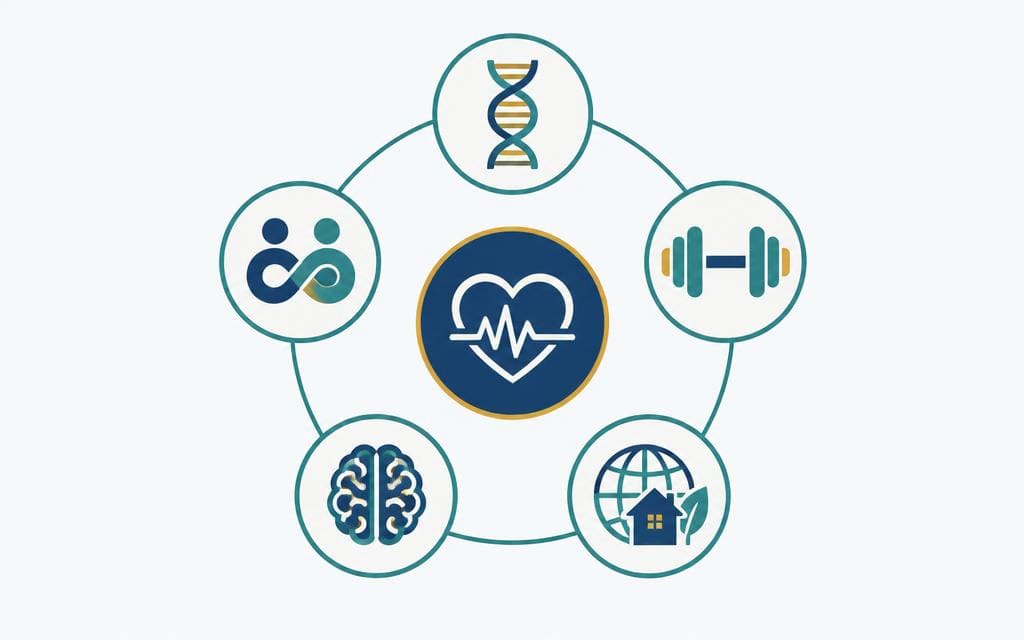
Learning objective: Describe the HSI Healthspan Model and the HSI Method — the two organising tools used throughout this course — explain what each domain covers and what each step of the Method does, and apply both to a simple case vignette.
“A client presents with “just fatigue.” List the first three questions you'd ask.”
Now check them against the five domains you're about to learn — how many domains did your instinct actually cover?
Watch alongside this lesson
Connectedness 101 — The Six Pillars of Lifestyle Medicine
American College of Lifestyle Medicine
A focused medical-education discussion of social connection and its health effects, supporting why Connection & Purpose has its own domain in the HSI model.
Every module in this course, from gut health to hormones to clinical case-work, is organised through two consistent, complementary tools: the HSI Healthspan Model, which tells you where to look, and the HSI Method, which tells you how to act on what you find. Rather than treating a client's symptoms as a list of unconnected complaints, the Model groups relevant factors into five interacting domains around a single outcome — Healthspan — and the Method gives a repeatable process for turning that picture into a plan.
The Healthspan Model — five domains, one outcome
1.Biological State
The underlying cellular and physiological processes at play: biomarkers, genetics and family history, metabolic and cardiovascular health, endocrine health, inflammation, organ function, body composition and biological age.
Connects directly to the 12 Hallmarks of Aging from Lesson 1.2 — covered in full in Module 5, Longevity Science.
2.Regimen
The modifiable, structured practices a person follows: nutrition, movement, strength, sleep, recovery, sedentary behaviour, alcohol and smoking, and daily routines.
3.The Exposome
External exposures across a person's environment: physical, occupational and socioeconomic environment, pollution, light, noise, access to nature, food environment and healthcare access.
4.Mind
Stress physiology, emotional wellbeing, cognition, coping, beliefs, motivation and self-efficacy.
5.Connection & Purpose
Social relationships, community and belonging, together with meaning and purpose — kept as its own domain rather than folded into Mind.
Separate because the evidence for social connection and purpose as independent drivers of health outcomes is substantial enough to warrant its own attention.
Each domain isn't isolated — a client's poor sleep (Regimen) might be driven by chronic work stress (Mind), worsened by a noisy urban living environment (The Exposome) and a lack of supportive relationships to buffer that stress (Connection & Purpose), while contributing biologically to several of the hallmarks of ageing covered in Lesson 1.2. Learning to trace these cross-domain connections is the core practical skill this course is building toward.
Why Connection & Purpose stands alone
A landmark meta-analysis of 148 studies covering over 300,000 participants found that stronger social relationships were associated with a 50% increased likelihood of survival — an effect size comparable in magnitude to well-established risk factors like smoking and alcohol consumption, and exceeding that of physical inactivity and obesity. This is a genuinely independent finding, not simply a proxy for mood or stress — which is why it earns separate billing rather than being absorbed into Mind.
Worth citing carefully: the popular comparison that loneliness “is as harmful as smoking 15 cigarettes a day” is a widely repeated summary of this body of work's effect size, not a literal sentence from the research — useful as a memorable framing, but not a precise clinical equivalence.
The HSI Method — five steps, applied as a loop
Knowing where to look isn't the same as knowing what to do next. The HSI Method is the repeatable process for turning a Healthspan Model picture into action — and it's a loop, because a client's picture changes over time, not a one-off sequence you complete and file away.
- 1
Assess. Build a whole-person picture across all five domains.
- 2
Integrate. Identify relationships between findings — how domains are influencing one another (for example, how poor Regimen and disrupted Mind might be jointly driving a Biological State marker).
- 3
Prioritise. Identify the most important risks, client priorities and modifiable drivers — not everything at once.
- 4
Personalise. Develop an evidence-informed plan fitted to the individual's picture, circumstances, preferences and goals.
- 5
Measure. Track meaningful outcomes, reassess, and loop back into Assess.
Measure loops back into Assess the picture changes, so the process repeats.
Worked example — fatigue and brain fog
A client presents with fatigue and brain fog. Step 1 is to Assess across all five domains:
- Biological State: Possible mitochondrial dysfunction or chronic inflammation contributing to low energy.
- Regimen: Skipping meals, poor sleep routine, minimal exercise.
- The Exposome: High-stress open-plan office, poor natural light exposure.
- Mind: Ongoing work stress, disrupted sense of control.
- Connection & Purpose: Recently moved city, limited social support network, mostly remote work with little in-person contact.
Steps 2–5 — apply the Method
- Integrate: Poor sleep, isolation and work stress are plausibly reinforcing one another — not acting independently.
- Prioritise: Sleep and social contact stand out as the two most modifiable, highest-leverage starting points.
- Personalise: Build a plan around the client's actual schedule and preferences, not a generic protocol.
- Measure: Track energy and sleep quality over 4 weeks, then loop back to Assess.
Mapped this way, “fatigue” stops being one symptom to treat and becomes a set of interacting, addressable factors across five domains, worked through a defined process — exactly the systems-thinking habit this course is designed to build. Note how Connection & Purpose surfaces something the other four domains would miss entirely in this example: the fatigue may be as much about isolation as about biology or workload.
Myth vs Reality
A framework like this is just a fancy checklist — tick five boxes and you're done.
The Model tells you where to look; on its own it changes nothing. Most of the value sits in the Method — the five-step process of actually integrating, prioritising and acting on what the Model surfaces, then looping back rather than filing the assessment away.
HSI Healthspan Model — Case Mapping Template
A blank, printable one-page template: all five domains with space to write, a cross-domain connections strip, and the five Method steps. Use it to map your next real case end to end.
Dr Haq’s 30 Seconds
A short personal take from your course director
Recording to come — 20–40 seconds in Dr Haq’s own words. Suggested angle: which of the five domains you personally had to learn to stop underweighting early in your own practice.
A note on the evidence
The Healthspan Model and the HSI Method are original teaching tools created for this course — pedagogical tools for organising well-established individual findings, not themselves peer-reviewed clinical instruments. Biological State, Regimen, the Exposome and Mind draw on broad, well-established bodies of evidence; Connection & Purpose rests on a smaller but robust and increasingly influential evidence base (social epidemiology and longevity research specifically). Understand the Model as a thinking scaffold and the Method as a working process — not a diagnostic tool.
Patient Journey — Checkpoint 4
Richard's full five-domain Assess is now complete — see the tutor's note for the whole picture.
Number to remember for this lesson: 5.5 hours — his average sleep. Where does that number sit in the Model, and which other domains does it plausibly connect to?
Richard's Assess — the full five domains
- Biological State: As per Checkpoint 2 — fasting glucose 5.6 mmol/L (high-normal), hs-CRP 2.1 mg/L (mildly elevated), resting heart rate 72 bpm.
- Regimen: Skips breakfast most days, trains twice a week but inconsistently, averages 5.5 hours of sleep.
- The Exposome: Hybrid working — three days in a high-pressure office, two from home.
- Mind: Describes work as “always on”; checks email until bed.
- Connection & Purpose: Close relationship with his wife, but says he “hasn’t seen mates properly in months.”
Reflect before you move on
Using the worked example as a template, map one symptom you've personally experienced across all five domains, then talk yourself through the five Method steps. Which domain do you tend to overlook — for yourself or with clients — and why might that be?
Sources: original framework; underlying domain content draws on sources cited throughout the course, particularly [1] and [2] for Biological State, and [24] for Connection & Purpose.
Key Points
- The Healthspan Model tells you where to look — five interacting domains around one outcome: Healthspan.
- The five domains: Biological State, Regimen, the Exposome, Mind, and Connection & Purpose.
- Connection & Purpose earns its own domain: stronger social relationships are associated with a 50% increased likelihood of survival across 148 studies.
- The HSI Method is the five-step loop: Assess → Integrate → Prioritise → Personalise → Measure — then back to Assess.
- The core skill is tracing cross-domain connections, not ticking five boxes.