Lifespan vs. Healthspan
Why adding years is not the same as adding life to them
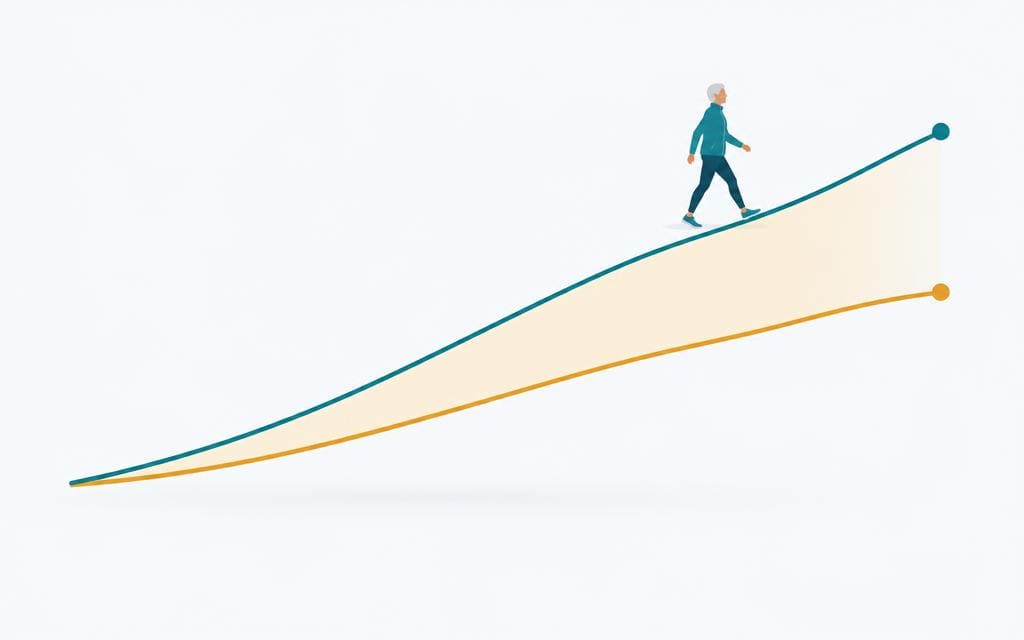
Learning objective: Distinguish lifespan from healthspan, explain the concept of the “morbidity gap” using current global data, and articulate why this distinction should drive clinical priorities in functional and longevity practice.
“A client tells you their goal is “to live to 100.””
Before you teach this lesson — what's the one follow-up question that matters more than the number 100 itself?
Watch alongside this lesson
Living Better, Longer: The New Science of Healthspan
Aspen Ideas, presented by Mount Sinai Health System
A clinical discussion of the shift from extending total years to preserving disease-free, independent years — the distinction at the centre of this lesson.
Lifespan is simply how long someone lives — age at death. Healthspan is a different question entirely: how many of those years are spent with preserved function, independence, cognition, and mobility, rather than managing chronic disease or disability. A person can live to 90 and spend the final 15 years of that life managing multiple chronic conditions; another person might live to 85 but remain fully independent and active until close to the end. Same rough lifespan, very different healthspan.
The gap between these two measures is real, measurable, and — this is the important part for practice — currently widening, not shrinking.
The morbidity gap, in numbers
A major global analysis published in The Lancet Public Health found that between 1990 and 2023, global life expectancy rose faster than healthy life expectancy. In practical terms: we are extending how long people live faster than we are extending how long they stay well.
1990
- Life expectancy
- 64.6 years
- Healthy life expectancy
- 55.9 years
- Share of life in poor health
- 13.6% of life in poor health
2023
- Life expectancy
- 73.8 years
- Healthy life expectancy
- 63.1 years
- Share of life in poor health
- 14.5% of life in poor health
High-income countries have it worse, not better — the US has one of the widest gaps of any country, with Americans spending around 14 years of life, on average, in poor health.
This is often called the “morbidity gap” — a term borrowed from a much older idea in gerontology, the compression of morbidity hypothesis, first proposed in 1980. It held that if prevention and healthcare improved, illness would compress into a brief window right before death rather than being spread out earlier in life. The uncomfortable finding from recent large-scale data is that, so far, this hasn't happened at a population level — instead of a brief period of illness before death, unhealthy years are accumulating steadily across adulthood, not just at the very end of life.
Why this drives clinical priorities
Conventional medicine, and to some extent public health policy, has historically been measured against lifespan — did the intervention help people live longer. Functional and longevity medicine's implicit goal is different: not simply adding years, but adding functional years. This reframes what “success” looks like in practice. A treatment that extends survival by two years but leaves someone bedbound is a very different outcome from one that helps someone remain independently mobile into their 80s, even if the pure lifespan numbers look similar.
Practically, this also gives you a client-facing way to explain why lifestyle-focused, root-cause work matters, even to people who aren't worried about early death: most people are far more motivated by staying independent, active, and cognitively sharp than by abstract mortality statistics. Healthspan is the more emotionally resonant, and arguably more clinically actionable, target.
Myth vs Reality
Living longer automatically means more healthy years.
Global data shows the opposite trend over the past three decades — life expectancy is rising faster than healthy life expectancy, meaning the average unhealthy period before death is actually growing, not shrinking.
Dr Haq’s 30 Seconds
A short personal take from your course director
Recording to come — 20–40 seconds in Dr Haq’s own words. Suggested angle: a real (anonymised) moment where reframing a client's goal from lifespan to healthspan changed how they engaged with a plan.
A note on the evidence
The existence and rough scale of the lifespan–healthspan gap is well established using multiple independent large-scale datasets (the Global Burden of Disease study, and a WHO member-state analysis in JAMA Network Open). What's genuinely still debated among researchers is how modifiable this gap is at a population level, and which specific interventions best “compress morbidity” for an individual — that's contested and evolving territory, which is exactly why root-cause, individualised practice (rather than one-size-fits-all guidance) has real value here.
Patient Journey — Checkpoint 3
Richard's family history arrives: his father had a stroke at 61 and was otherwise independent until 78. Richard's stated goal, in his own words: “I just don't want to end up like my dad, stuck in a chair.”
Reframe Richard's goal in healthspan language rather than lifespan language — using his own words.
Mini case — apply it yourself
Two clients, both 68. Margaret still teaches a weekly pottery class, walks her dog daily, and lives independently. David, also a retired teacher, has been managing type 2 diabetes for a decade, uses a walking stick, and moved in with his daughter last year after a fall.
Their life expectancy estimates, based on population averages for their age and sex, are similar. What does the lifespan vs. healthspan distinction tell you about why “similar life expectancy” is close to meaningless as a way of comparing these two people's actual health status — and what would you want to know about each of them to intervene meaningfully?
Reflect before you move on
Think of someone you know (or a client) who is “old” by the calendar but functionally young — or vice versa. What factors do you think are driving that difference?
Sources: see references [4], [5] and [6] in the course document.
Key Points
- Lifespan is how long someone lives; healthspan is how many of those years are functional, independent and well.
- The global morbidity gap is widening: life expectancy rose from 64.6 to 73.8 (1990–2023) while healthy life expectancy rose more slowly, 55.9 to 63.1.
- The 1980 “compression of morbidity” hypothesis has not held at population level — unhealthy years are accumulating across adulthood.
- Longevity-focused practice targets functional years, not just survival.
- Healthspan is the more motivating, client-facing goal: independence, activity and cognition.