The 12 Hallmarks of Aging
One biological map behind many separate diagnoses
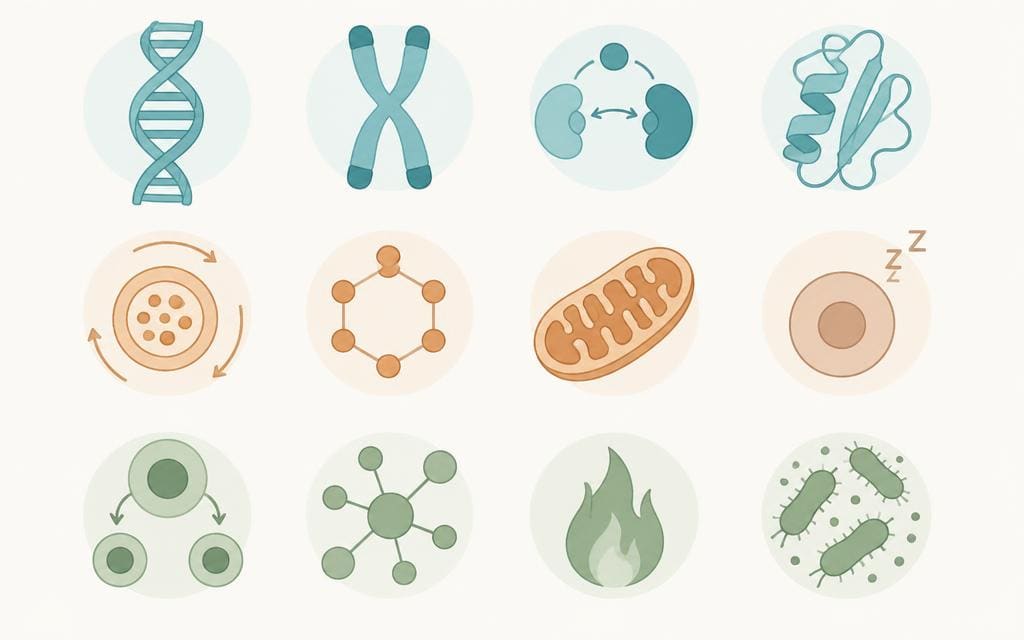
Learning objective: Describe the 12 Hallmarks of Aging, explain the logic behind their three-category grouping (primary, antagonistic, integrative), and identify why this framework — rather than a disease-by-disease model — is a more useful lens for longevity-focused practice.
“Two 55-year-olds, same BMI, same normal annual check-up. One will have a heart attack within ten years; the other won't.”
What's different about them that a BMI and a basic panel can't show you?
Ageing was, for decades, studied disease by disease — heart disease, dementia, cancer, each investigated largely in isolation. In 2013, a landmark paper proposed a different approach: identifying a shared set of biological mechanisms that underlie ageing itself, mechanisms that show up across virtually all age-related diseases. This became known as the Hallmarks of Aging. In 2023, the original authors published an update expanding the list from nine to twelve hallmarks, reflecting a decade of further research.
The 12 hallmarks are organised into three categories that describe how ageing damage happens and accumulates.
Primary hallmarks
The initial causes of damage — the earliest molecular-level changes that begin the ageing process.
Genomic instability
Accumulating DNA damage over a lifetime.
Telomere attrition
Shortening of the protective caps on chromosomes with each cell division.
Epigenetic alterations
Changes in how genes are switched on or off, without changing the DNA sequence itself.
Loss of proteostasis
Declining ability to maintain properly folded, functional proteins.
Disabled macroautophagy
Reduced capacity to clear out damaged cellular components (added in the 2023 update).
Memory aid: Damage the DNA → shorten the Ends → mess with the Switches → ruin the Proteins → stop taking out the Rubbish.
Antagonistic hallmarks
The body's responses to damage — helpful in the short term, harmful when they become chronic.
Deregulated nutrient-sensing
Pathways that respond to food intake (for example insulin signalling) becoming dysfunctional.
Mitochondrial dysfunction
Declining efficiency of the cell's energy-producing structures.
Cellular senescence
Cells stop dividing as a protective anti-cancer measure, but accumulate and secrete inflammatory signals if not cleared.
Memory aid: Can't sense the food, can't make the energy, can't clear the old cells.
Integrative hallmarks
Where accumulated damage translates into visible functional decline — the ageing phenotype we observe clinically.
Stem cell exhaustion
Declining capacity for tissue repair and renewal.
Altered intercellular communication
Disrupted signalling between cells, including hormonal and inflammatory signalling.
Chronic inflammation
Persistent, low-grade inflammatory activity — “inflammaging” — added in the 2023 update.
Dysbiosis
Imbalance in the gut microbiome, also newly added in 2023, reflecting evidence that the microbiome actively influences systemic ageing.
Why three hallmarks were added in 2023 — and why it matters
These weren't new discoveries so much as recognition that existing categories were too broad to be clinically useful. The original authors explained their reasoning directly.
Disabled macroautophagy used to be lumped in with loss of proteostasis (protein quality control). But autophagy doesn't just clear out damaged proteins — it also clears entire damaged organelles and other non-protein cellular waste. The authors judged this mechanism important and distinct enough to earn its own category rather than remaining a sub-point.
Chronic inflammation and dysbiosis were both carved out of a single 2013 category, “altered intercellular communication,” which the authors themselves came to see as too vast a bucket — it was trying to cover everything from hormone signalling to immune activity to gut-microbiome effects under one heading. Splitting it gave each mechanism room for its own evidence base and its own targeted interventions.
The significance for practice is bigger than a taxonomy update. Both new inclusions put the immune system and the gut explicitly onto the core biological map of ageing, rather than treating them as peripheral or disease-specific concerns. This lines up with a decade of research showing that low-grade, persistent inflammation and microbiome imbalance are active drivers of ageing across multiple organ systems, not just downstream symptoms of it. For a functional and lifestyle medicine course specifically, the 2023 revision is a validating moment — mainstream ageing biology formally catching up with what gut- and inflammation-focused practice has emphasised for years. It is a good example of evidence catching up with clinical intuition, not the other way around.
Why this framework matters clinically
Rather than treating twelve separate conditions in twelve separate specialities, this model shows that upstream biological processes are shared across many downstream conditions — which means a single lifestyle intervention can influence several hallmarks at once, rather than only addressing one symptom at a time. Take sleep as an example and follow the chain.
One behaviour, three hallmarks
- 1
Chronic inflammation (integrative). Poor sleep raises circulating cortisol and inflammatory markers overnight.
- 2
Disabled macroautophagy (primary). It disrupts the cellular clean-up that clears damaged proteins and organelles during rest.
- 3
Mitochondrial dysfunction (antagonistic). It reduces the efficiency of mitochondrial repair processes that largely occur during deep sleep.
So one changed behaviour is plausibly acting on three separate hallmarks through three distinct, traceable mechanisms, not just correlating with “feeling better.” This is the biological justification for why lifestyle-focused, root-cause practice can be so effective: it targets shared upstream mechanisms rather than downstream, disease-specific symptoms.
Myth vs Reality
Aging is one single process, so one “anti-aging” intervention could address it.
Ageing is at least twelve distinct, interacting biological mechanisms — which is exactly why single-target interventions (one supplement, one biomarker fix) rarely move the needle much on their own, and why lifestyle interventions that touch multiple hallmarks at once tend to outperform narrow ones.
Dr Haq’s 30 Seconds
A short personal take from your course director
Recording to come — 20–40 seconds in Dr Haq’s own words. Suggested angle: which single hallmark you find yourself explaining most often to clients, and why it tends to be the one people are least aware of.
A note on the evidence
The 12 hallmarks framework itself is well-established, peer-reviewed academic consensus, published in Cell, one of the most rigorously reviewed journals in the life sciences. The clinical interventions for each hallmark, however, vary enormously in evidence quality — some, such as exercise's effect on mitochondrial function, are extremely well supported; others, such as specific senolytic compounds, remain early-stage research. Each hallmark is evidence-graded individually when covered in depth in Module 5 (Longevity Science).
Patient Journey — Checkpoint 2
Richard's first numbers arrive: fasting glucose 5.6 mmol/L (high-normal), hs-CRP 2.1 mg/L (mildly elevated), resting heart rate 72 bpm.
Which hallmark or hallmarks do these three numbers most plausibly point toward — and why does “all normal” from Lesson 1.1 not hold up against them?
Mini case — apply it yourself
Tom, 58, has been told his recent blood work is “all within normal range” and that his increasing forgetfulness and slower recovery from exercise are “just ageing.” His fasting glucose sits at the high end of normal, he's had two colds this winter that took longer than usual to clear, and he needs more recovery days between gym sessions than he did five years ago.
Using the three hallmark categories, which hallmarks might plausibly be involved in each of Tom's three observations — the high-normal glucose, the slower immune recovery, and the reduced exercise tolerance?
Reflect before you move on
Pick one hallmark that resonates with something you've noticed in your own health or a client's. Which category does it fall into — primary, antagonistic, or integrative — and why might that affect how you'd approach it?
Sources: see references [1] and [2] in the course document. A one-page reference chart of all 12 hallmarks with their category groupings accompanies this lesson.
Key Points
- Twelve shared biological mechanisms underlie ageing across nearly all age-related disease.
- Primary hallmarks cause damage; antagonistic hallmarks are protective responses that turn harmful; integrative hallmarks are where decline becomes visible.
- The 2023 update added disabled macroautophagy, chronic inflammation and dysbiosis.
- That update put the immune system and the gut onto the core map of ageing.
- One lifestyle change — sleep — plausibly acts on three hallmarks through three distinct mechanisms.