
Abstract
Background: Bruxism, temporomandibular disorders, neck pain and headache overlap clinically, while screen-based work may combine sustained cervical demand, reduced movement and psychological load.
Methods: This narrative perspective examines published observational studies, systematic reviews and bruxism assessment literature alongside an author-reported, uncontrolled clinical observation. It is not a systematic review or a validated causal model.
Results: The author reports 215 consecutive symptomatic patients, excluding migraine presentations; more than 70% reported computer or laptop use exceeding six hours daily. Records and the exact exposed count were not supplied for independent verification. Published studies associate sedentary behaviour with neck pain, stress with bruxism, and cervical symptoms with temporomandibular disorders, with substantial uncertainty.
Conclusion: The proposed screen–stress–jaw–neck axis supports integrated, diagnosis-led assessment and prospective investigation. Association does not establish causation, a treatment indication, or a universal six-hour threshold.
Scope and evidence-review method
Article type: narrative evidence review and hypothesis/perspective, incorporating an author-reported clinical observation. Evidence-source checks completed 6 October 2026. Targeted checks used PubMed-indexed records, PubMed Central full texts and indexed abstract records for the cited studies; no registered systematic search, exhaustive retrieval, formal new risk-of-bias assessment or original meta-analysis was performed.
An independent AI reviewer and a separate evidence-checking review were used to challenge attribution, numerical claims and causal language. Their suggestions were checked against identifiable sources rather than accepted automatically. The first AI response incorrectly assumed a 2024 date and was rerun with the current date; its chronology objection was rejected. AI assistance is not external human peer review or verification of patient records.
The >6-hour observation, published ≥6-hour exposure categories, sedentary time and device-specific time are deliberately kept distinct. All figures are educational illustrations, not patient imaging, measured causal networks or injection maps.
1. Introduction
The clinical separation of jaw pain, neck pain and headache is convenient but anatomically artificial.
Patients with masticatory-muscle pain may be assessed in dental settings, patients with cervical pain in musculoskeletal services and patients with headache in neurological practice. Yet temporomandibular disorders frequently coexist with cervical dysfunction, headache populations demonstrate cervical musculoskeletal abnormalities, and jaw-muscle behaviours are influenced by psychological and behavioural factors.
At the same time, working behaviour has changed profoundly.
For a substantial proportion of adults, work now consists of prolonged periods of computer use with relatively little variation in visual target, head position or upper-limb activity. Portable devices add a further constraint because the screen and keyboard cannot be positioned independently.
The resulting clinical hypothesis is not that a particular posture directly causes bruxism or headache. Rather, prolonged screen-based work may create an environment in which sustained cervical loading, reduced movement variability, cognitive concentration, psychological stress and repetitive jaw-muscle activity coexist.
This paper describes a clinical observation from 215 symptomatic patients and examines whether the published literature supports further investigation of such a model.
2. Clinical observation
During assessment of the most recent 215 patients presenting with bruxism, neck pain and/or headache, excluding patients presenting with migraine, more than 70% reported using computers or laptops for more than six hours daily.
Data provenance: the 215-patient total and “more than 70%” are reported by Dr Ahmed Haq in the supplied manuscript. Patient records, the exact exposed numerator, collection dates, diagnostic criteria, missing-data handling and an occupational breakdown were not supplied for independent verification. No precise exposed count or occupational independence is inferred. This is an uncontrolled author observation, not a peer-reviewed dataset or a population-prevalence estimate.
Heavy digital exposure occurred across occupational groups.
This observation immediately raises two different questions.
The first is epidemiological:
Is screen exposure more common in this symptomatic population than in a comparable asymptomatic population?
The present data cannot answer that question because no control group was collected.
The second is mechanistic:
Is it biologically plausible that prolonged screen-based work could contribute to, maintain or amplify symptoms within the jaw–neck–head complex?
For this question, the existing literature is considerably more informative.
3. Screen exposure and neck pain
A cross-sectional investigation of 740 office workers reported that computer use of six hours or more per working day was independently associated with neck pain after adjustment for age, sex and BMI: adjusted odds ratio (OR) 1.61, 95% confidence interval (CI) 1.06–2.46. Psychological distress was also associated with neck pain in this population. These are odds, not absolute risks or proof of temporal causation. [1]
The similarity between that previously published threshold and the exposure reported by the present clinical cohort is notable.
More recent pooled evidence strengthens the association.
A 2025 systematic review and meta-analysis involving 25 studies and 43,184 participants found sedentary behaviour associated with neck pain overall (OR 1.46, 95% CI 1.33–1.60). Computer use was associated with neck pain (OR 1.23, 95% CI 1.08–1.40); sedentary exposure of ≥6 hours/day had OR 1.88 (95% CI 1.42–2.48). The last estimate concerns sedentary behaviour, not specifically six hours of laptop use. Mobile-phone use had a larger pooled association than computer use (OR 1.82, 95% CI 1.27–2.61). Duration analyses suggested increasing association with longer exposure, but cannot establish a universal causal threshold. [2]
A separate meta-analysis published in 2023 similarly found associations between sedentary behaviour, computer use, mobile-phone use and adult neck pain, although the authors highlighted heterogeneity, publication bias and the need for longitudinal research to address causality. Sitting time alone was not significantly associated with neck pain, and the office-worker subgroup estimate also crossed the null. These findings discourage treating all sedentary behaviours or populations as equivalent. [3]
Prospective investigation remains necessary to determine temporal ordering and whether modifying screen exposure changes symptoms. The uploaded manuscript mentioned a prospective review using a four-hour computer/mouse threshold without an identifiable reference; that threshold is not used here as verified evidence.
The available literature therefore supports an exposure association while stopping short of demonstrating a universal causal threshold.
4. Why laptops may matter
Duration is only part of the exposure.
The geometry of the device changes cervical mechanics.
In a controlled motion-analysis study of 30 participants, laptop use resulted in approximately 10.9° more neck flexion than seated desktop use (95% CI 7.86–13.97°); tablet use increased flexion by approximately 16.9° (95% CI 12.79–21.04°). Both portable-device conditions also increased right shoulder elevation. These were measured kinematic differences during a task, not demonstrated causes of pain. [4]
In a separate motion-analysis study of 22 participants with chronic neck pain, laptop and tablet use produced greater neck and upper-trunk flexion than seated desktop use. The reported neck-flexion difference was approximately 7.2° for laptops and 14.4° for tablets; these magnitudes should not be equated to the earlier study. Neither experiment established that posture correction prevents headache or bruxism. [5]
These findings should not be misinterpreted as proving that neck flexion itself causes pain.
A clinical study of 154 participants found reduced cervical muscle endurance and an association between neck and jaw disability in people with TMD. A statistically significant craniocervical postural difference was small and judged not clinically relevant by the authors. This supports examination of function rather than diagnosing symptoms from a static posture alone. [6]
A more useful hypothesis may therefore concern sustained mechanical demand and reduced movement variability, rather than an arbitrary division between “good” and “bad” posture.
5. Awake bruxism and cognitive work
Bruxism should not be reduced to nocturnal tooth grinding.
Contemporary consensus describes awake bruxism as repetitive or sustained tooth contact and/or mandibular bracing or thrusting during wakefulness. Sleep bruxism is distinct. Bruxism is not invariably a disorder in otherwise healthy people; its clinical consequences need assessment. [7] Smartphone-based ecological momentary assessment records these behaviours repeatedly during ordinary activity rather than relying only on retrospective recall. A comparative study in 100 healthy young adults found weak-to-moderate correspondence between questionnaire and real-time reports; neither method independently proves tooth damage, muscle pathology or causation. [8]
This distinction has potential relevance to screen-based work.
An individual concentrating intensely on a digital task may maintain low-level masticatory-muscle activity or mandibular bracing without recognising the behaviour as clenching and without displaying overt tooth grinding.
Consequently, conventional questions such as “Do you grind your teeth?” may underestimate daytime jaw-muscle loading.
Future research examining digital exposure should therefore distinguish awake bruxism from sleep bruxism, and ideally separate clenching, sustained tooth contact and mandibular bracing.
6. Psychological stress as an amplifier
Psychological stress provides another potential link.
A systematic review and meta-analysis reported an association between stress and bruxism: OR 2.07 (95% CI 1.51–2.83). Six observational studies were included, with three entering the quantitative synthesis; certainty was low. This supports a possible association, not a diagnosis of stress-induced bruxism in an individual. [9]
Stress-related sleep disturbance should be explored as a separate clinical domain rather than inferred from daytime screen behaviour. The supplied draft also referred to a sleep-bruxism biomarker review without a specific citation; no biomarker claim from that unidentified review is relied upon here.
The appropriate interpretation is therefore not that stress invariably causes bruxism.
Instead, stress may act as a modifier of muscle activity, parafunctional behaviour, sleep quality and pain perception.
The combination of high cognitive demand, prolonged screen exposure and reduced physical variation may be more clinically relevant than any one component in isolation.
7. The cranio-cervico-mandibular relationship
There is substantial evidence that TMD and cervical dysfunction coexist.
Evidence supports assessing cervical mobility, muscle endurance and neck disability alongside jaw symptoms; the clinical study above demonstrates coexistence, not a single causal direction. [6]
A systematic review published online in December 2025 in the 2026 journal volume included nine cross-sectional studies (eight neck-pain studies and one cervicogenic-headache study). Neck-pain populations had greater odds of TMD than asymptomatic controls (OR 3.64, 95% CI 1.35–9.84). Reduced jaw mobility and lower masseter and temporalis pressure-pain thresholds were also reported. Certainty was very low. The wide CI indicates substantial imprecision; the OR is not a validated prediction for the present mixed cohort or for every headache phenotype. [10]
Bruxism itself is associated with TMD. A 2023 meta-analysis of 20 studies reported an overall OR of 2.25 (95% CI 1.94–2.56), with awake bruxism OR 2.51 (95% CI 2.02–2.99). Assessment definitions and observational designs limit causal interpretation: these estimates do not show that treating bruxism will prevent TMD. [11]
These findings do not establish a unidirectional sequence from bruxism to TMD to cervical dysfunction. They instead suggest substantial clinical overlap.
8. Headache completes the clinical phenotype
Headache provides a further dimension.
The present clinical observation deliberately excluded migraine presentations in order to focus more closely on patients in whom musculoskeletal, tension-type or cervicogenic mechanisms might plausibly contribute.
Headache assessment must distinguish tension-type headache, cervicogenic headache, headache attributed to TMD and other secondary causes. Excluding migraine presentations from an observation is not equivalent to applying documented diagnostic criteria to all remaining headaches.
An updated review published in 2025 included 77 studies and 2,551 participants across both migraine and tension-type headache. Many newly identified impairments were in the migraine subgroup; tension-type headache showed reduced extensor strength. Active trigger points and tenderness were reported, particularly in chronic headache, but certainty was very low. This mixed-headache review must not be presented as evidence obtained solely from non-migraine patients. [12]
A separate systematic review found associations between painful TMD and primary headaches, with low-to-very-low certainty and imprecise subgroup estimates. Articular TMD without pain did not show the same pattern in the two studies assessing it. Diagnostic overlap supports assessment across anatomical boundaries, not diagnostic substitution. [13]
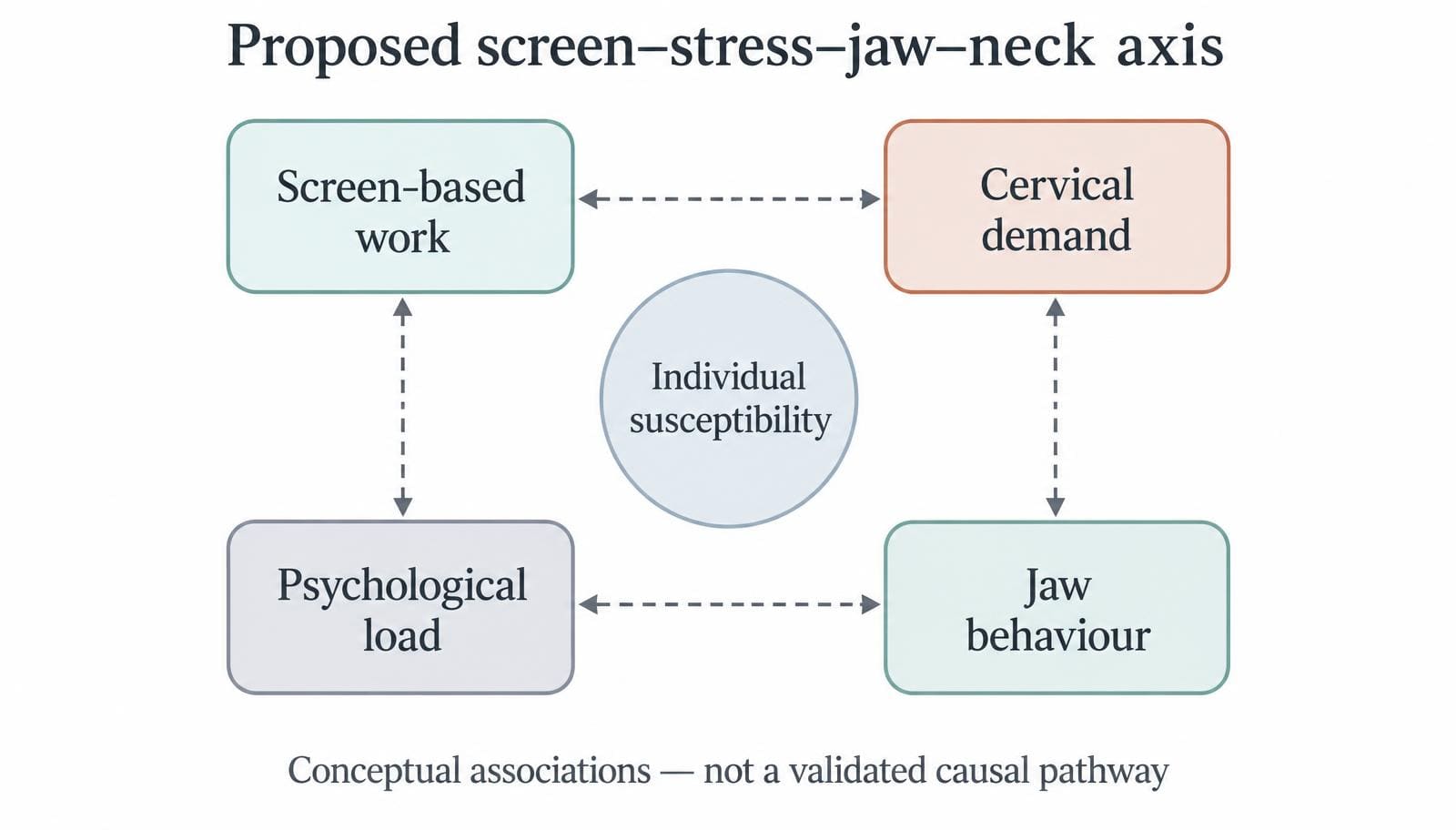
9. A proposed screen–stress–jaw–neck model
The available literature allows a testable model to be proposed.
Prolonged screen use may increase sustained cervical demand and decrease movement variability. Laptop geometry can increase cervical flexion. Cognitive workload and psychological stress may increase jaw bracing or clenching in susceptible individuals. Masticatory and cervical dysfunction commonly coexist. Pain arising within either region may then interact with headache symptoms and pain sensitisation.
The model should therefore be considered a multifactorial loop, not a linear causal chain.
Screen exposure does not inevitably lead to bruxism.
Bruxism does not inevitably produce TMD.
TMD does not inevitably produce headache.
But in a susceptible patient, these factors may accumulate.
The clinically relevant variable may ultimately prove to be not “posture” alone, but:
duration × mechanical load × movement variability × awake jaw behaviour × psychological load × individual susceptibility. This is an author-proposed conceptual expression, not a measured equation, validated score or prediction model; no mathematical direction or clinical cut-off is established.
10. Limitations of the present observation
Several limitations prevent causal or epidemiological conclusions from the 215-patient series.
There is no asymptomatic control group.
Screen exposure is currently represented by a broad duration threshold rather than objective digital-use measurement.
Device type, break frequency, workstation configuration, exercise, sleep, stress, sex, age and previous cervical or temporomandibular pathology require formal adjustment.
The three presenting phenotypes — bruxism, neck pain and non-migraine headache — should also be analysed separately as well as collectively.
Finally, occupational independence cannot be formally claimed until occupational categories are coded and compared statistically.
The current observation should therefore be viewed as hypothesis-generating.
11. Proposed prospective study
The next stage should be a controlled prospective observational study.
Patients presenting with bruxism, neck pain and non-migraine headache could be compared with age- and sex-matched aesthetic patients without those symptoms.
Daily screen exposure should be recorded in categories such as <2, 2–4, 4–6, 6–8 and >8 hours, with separate recording of desktop, laptop, tablet and smartphone exposure.
Relevant covariates should include validated measures of stress, sleep quality, physical activity, cervical disability, TMD symptoms, headache phenotype and awake-bruxism behaviour.
This design would allow multivariable modelling of the independent contribution of screen exposure and, importantly, investigation of an interaction between screen duration and psychological stress.
A particularly interesting question would be whether the ≥6-hour threshold persists after adjustment for these variables.
Practical insights: integrated assessment before treatment
Screen and workstation history: record approximate daily computer/laptop time separately from smartphone, tablet and total sedentary time. Ask about uninterrupted bouts, breaks, external keyboard/screen options, task intensity and symptom timing. A duration category is an enquiry prompt, not a diagnostic test.
Jaw assessment: distinguish awake tooth contact, bracing and clenching from sleep grinding; examine pain reproduction, opening and function, dental causes, joint symptoms and tooth wear. Tooth wear alone cannot confirm current sleep bruxism. Use diagnosis-appropriate dental or orofacial pain referral when indicated.
Neck and shoulder assessment: examine cervical movement and function, relevant muscle tenderness, trapezius symptoms and reproduction of familiar pain within the examiner’s competence. A tender point is not automatically an injection target or evidence of a single causal mechanism.
Headache and safety: obtain headache phenotype, frequency, onset, associated symptoms and examination findings. Sudden severe headache, new neurological or visual symptoms, fever/systemic illness, trauma, progressive atypical headache or new concerning unilateral neck pain require appropriate urgent assessment. Do not attribute these to screen use or stress. NICE headache guidance informs assessment and referral. [14]
Psychological load and sleep: enquire non-judgementally about stress, anxiety, recovery, sleep quality and physical activity. Pain can itself increase distress and sedentary time, so reverse causation and bidirectional influences must remain possible.
Initial management: consider individually agreed movement variation, tolerable workstation changes, awareness of daytime jaw behaviour and diagnosis-led conservative care, with review of symptoms and function. This synthesis does not demonstrate that a particular break interval, posture correction or injection protocol treats the proposed axis. It does not establish a new botulinum-toxin indication.
12. Conclusion
A clinical series of 215 patients presenting with bruxism, neck pain or non-migraine headache identified computer or laptop exposure exceeding six hours per day in more than 70% of patients.
On its own, this observation cannot establish causality or increased risk.
However, it can be considered alongside published associations between computer exposure and neck pain, measured device-related differences in cervical flexion, stress and bruxism, and temporomandibular–cervical–headache overlap. The clinical observation uses >6 hours, whereas the cited occupational/sedentary categories use ≥6 hours; they are not identical. Similar categorisation does not validate the author’s observation, demonstrate excess risk or establish the proposed axis.
These convergent findings support further investigation of a screen–stress–jaw–neck axis and suggest a broader clinical question for patients presenting with craniofacial and cervical pain:
In addition to locating the pain and establishing a diagnosis, clinicians can ask about daily head, neck and jaw activity, screen use and psychological load, without presuming that these explain the symptoms.
Declarations and data availability
Author: Dr Ahmed Haq. The clinical series is supplied as an author observation; source patient records were not provided to the independent reviewers or used to manufacture additional statistics. The exact exposed count, collection period and formal occupational comparisons require author confirmation.
Patient-data governance: ethics/research-governance classification, applicable approval or exemption, consent/waiver arrangements and permission to publish aggregate observations were not supplied. No approval, exemption or consent is asserted. These details require author/editorial confirmation before the series can be presented as formal original research.
Editorial status: prepared with AI-assisted critical review and source checking. External human peer review and editorial acceptance have not been verified. This page must not be represented as an independently validated clinical protocol.
Conflict-of-interest and funding declarations were not supplied in the manuscript and require author confirmation. Dr Ahmed Haq is affiliated with HSI, whose related training is linked separately as institutional education, not evidence supporting the proposed model.
Figure provenance: purpose-made AI-generated educational illustration and conceptual diagram; no actual patient photographs, diagnostic imaging or measured cohort chart is shown. No missing patient counts were inferred.
References
- Chen X, O'Leary S, Johnston V. Modifiable individual and work-related factors associated with neck pain in 740 office workers: a cross-sectional study. Braz J Phys Ther. 2018;22(4):318-327. doi:10.1016/j.bjpt.2018.03.003. PMID:29606511.
- Meng Y, Xue Y, Yang S, Wu F, Dong Y. The associations between sedentary behavior and neck pain: a systematic review and meta-analysis. BMC Public Health. 2025;25(1):453. doi:10.1186/s12889-025-21685-9. PMID:39905389.
- Mazaheri-Tehrani S, Arefian M, Abhari AP, Riahi R, Vahdatpour B, Baradaran Mahdavi S, Kelishadi R. Sedentary behavior and neck pain in adults: A systematic review and meta-analysis. Prev Med. 2023;175:107711. doi:10.1016/j.ypmed.2023.107711. PMID:37775083.
- Yu Z, James C, Edwards S, Snodgrass SJ. Differences in posture kinematics between using a tablet, a laptop, and a desktop computer in sitting and in standing. Work. 2018;61(2):257-266. doi:10.3233/wor-182796. PMID:30373975.
- Lee R, James C, Edwards S, Snodgrass SJ. Posture during the use of electronic devices in people with chronic neck pain: A 3D motion analysis project. Work. 2021;68(2):491-505. doi:10.3233/wor-203245. PMID:32925156.
- Armijo-Olivo S, Magee D. Cervical musculoskeletal impairments and temporomandibular disorders. J Oral Maxillofac Res. 2013;3(4):e4. doi:10.5037/jomr.2012.3404. PMID:24422022.
- Lobbezoo F, Ahlberg J, Raphael KG, Wetselaar P, Glaros AG, Kato T, Santiago V, Winocur E, De Laat A, De Leeuw R, Koyano K, Lavigne GJ, Svensson P, Manfredini D. International consensus on the assessment of bruxism: Report of a work in progress. J Oral Rehabil. 2018;45(11):837-844. doi:10.1111/joor.12663. PMID:29926505.
- Saracutu OI, Manfredini D, Bracci A, Val M, Ferrari M, Colonna A. Comparison Between Ecological Momentary Assessment and Self-Report of Awake Bruxism Behaviours in a Group of Healthy Young Adults. J Oral Rehabil. 2025;52(3):289-295. doi:10.1111/joor.13895. PMID:39548672.
- Chemelo VDS, Né YGS, Frazão DR, de Souza-Rodrigues RD, Fagundes NCF, Magno MB, da Silva CMT, Maia LC, Lima RR. Is There Association Between Stress and Bruxism? A Systematic Review and Meta-Analysis. Front Neurol. 2020;11:590779. doi:10.3389/fneur.2020.590779. PMID:33424744.
- Bizzarri P, Giusti A, Pernici M, Bulzacca P, Asquini G, Maselli F, Mourad F, Balli E, Pisacane G, Bagnoli C, Manzari A, Pompi M, Scafoglieri A. Temporomandibular Disorders and Orofacial Outcomes in Subjects with Neck Pain and/or Cervicogenic Headache: A Systematic Review with Meta-Analysis. J Clin Med. 2026;15(1):266. doi:10.3390/jcm15010266. PMID:41517515. Published online 29 December 2025.
- Mortazavi N, Tabatabaei AH, Mohammadi M, Rajabi A. Is bruxism associated with temporomandibular joint disorders? A systematic review and meta-analysis. Evid Based Dent. 2023;24(3):144. doi:10.1038/s41432-023-00911-6. PMID:37474733.
- Pensri C, Liang Z, Treleaven J, Jull G, Thomas L. Cervical musculoskeletal impairments in migraine and tension-type headache and relationship to pain related factors: An updated systematic review and meta-analysis. Musculoskelet Sci Pract. 2025;76:103251. doi:10.1016/j.msksp.2024.103251. PMID:39756244.
- Réus JC, Polmann H, Souza BDM, Flores-Mir C, Gonçalves DAG, de Queiroz LP, Okeson J, De Luca Canto G. Association between primary headaches and temporomandibular disorders: A systematic review and meta-analysis. J Am Dent Assoc. 2022;153(2):120-131.e6. doi:10.1016/j.adaj.2021.07.021. PMID:34649707.
- National Institute for Health and Care Excellence. Headaches in over 12s: diagnosis and management. Clinical guideline CG150. https://www.nice.org.uk/guidance/cg150. Accessed 6 October 2026.
Office-worker study: full text · Sedentary behaviour meta-analysis · NICE headache assessment guidance