
Clinical bottom line
Do not routinely combine botulinum toxin and corticosteroid in one syringe for trigger-point management. No dedicated trial supports the mixture, toxin labelling specifies saline reconstitution, and the 2024 multi-society guidance favours local anaesthetic alone for most trigger-point injections.
1. Clinical question and scope
This review asks a deliberately narrow question: for a patient with clinically diagnosed myofascial pain centred on the upper trapezius or shoulder girdle, does adding corticosteroid to botulinum toxin type A improve outcomes enough to justify the additional exposure? The answer from the available evidence is no. There is no randomised trial of a same-syringe botulinum toxin–corticosteroid mixture, no guideline endorsement of the combination, and no compatibility or stability evidence that would make such an admixture defensible as routine practice.
The absence of evidence for a combination should not be mistaken for evidence that every injection is ineffective. Needling, local anaesthetic injection and, in selected refractory phenotypes, botulinum toxin may each have a role. The clinically important task is to identify the pain generator, begin with lower-risk care, define a measurable treatment goal and escalate only when the expected benefit exceeds the functional risk.
This is a narrative clinical review for qualified healthcare professionals. Published doses are reported to describe trials, not to prescribe treatment. Product licences, local governance, competency requirements and current guidance must be checked before any intervention.
2. What is a myofascial trigger point?
A myofascial trigger point is commonly described as a hyperirritable spot within a palpable taut band of skeletal muscle. Compression may reproduce local pain, referred pain or a familiar symptom pattern. An active trigger point reproduces the patient’s spontaneous complaint; a latent trigger point is tender but does not reproduce the presenting pain. Restricted range, altered recruitment and a local twitch response may support the examination, but no single physical sign is perfectly reliable between observers.
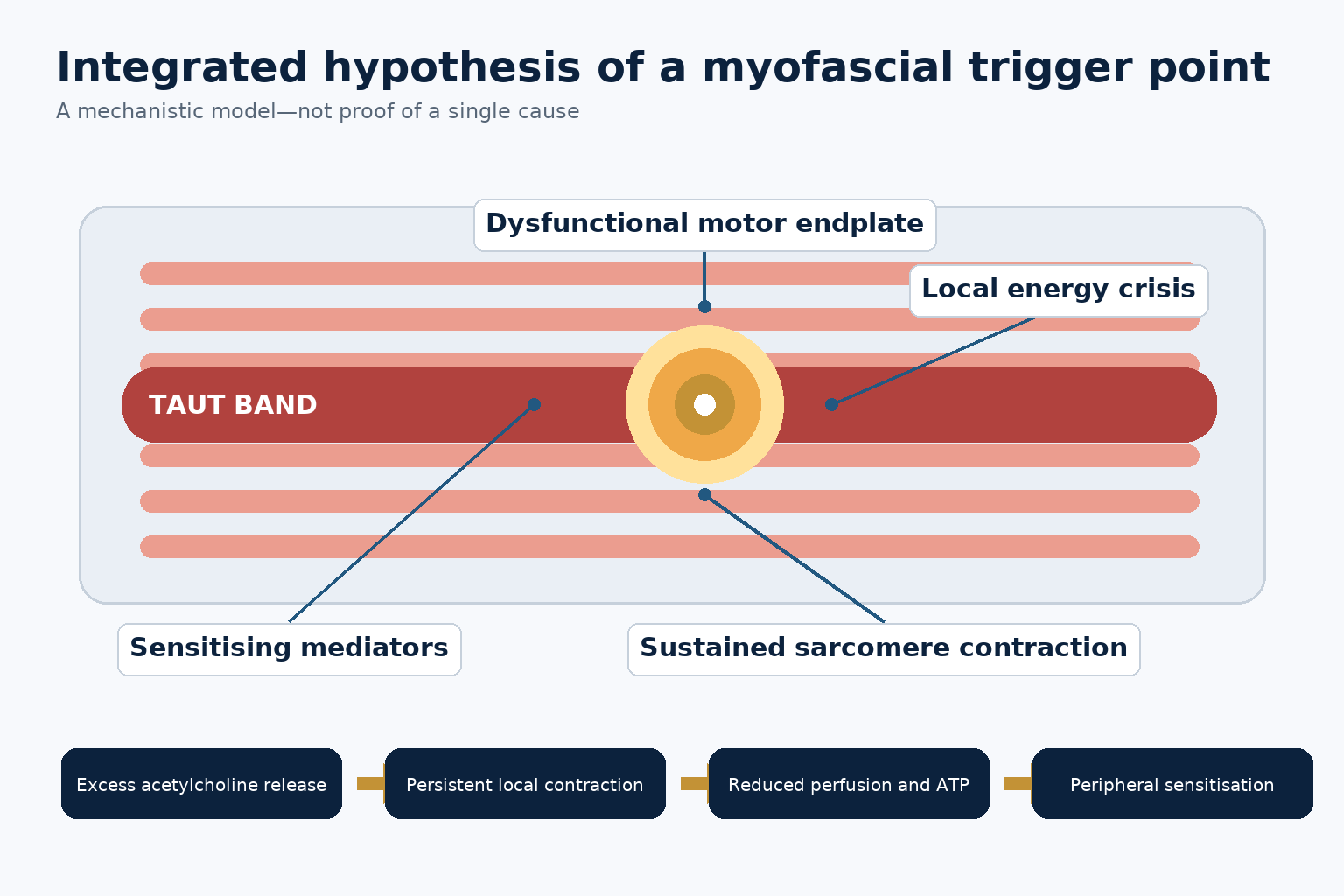
The integrated hypothesis proposes excessive acetylcholine release at a dysfunctional motor endplate, sustained local sarcomere contraction, impaired perfusion, an energy crisis and accumulation of sensitising mediators. Microdialysis studies have identified altered local biochemical environments around active trigger points, but the model remains a synthesis rather than proof of one universal lesion. Contemporary pain science also recognises that peripheral nociception, sleep, stress, workload, fear, central sensitisation and comorbidity can all influence the clinical presentation.
That uncertainty matters. If the key therapeutic event is mechanical disruption of a taut band, accurate needling may explain improvement regardless of injectate. If peripheral motor overactivity dominates, chemodenervation may be relevant. If inflammation is not the principal driver, adding corticosteroid has weak biological justification.
3. Upper trapezius anatomy and diagnostic localisation
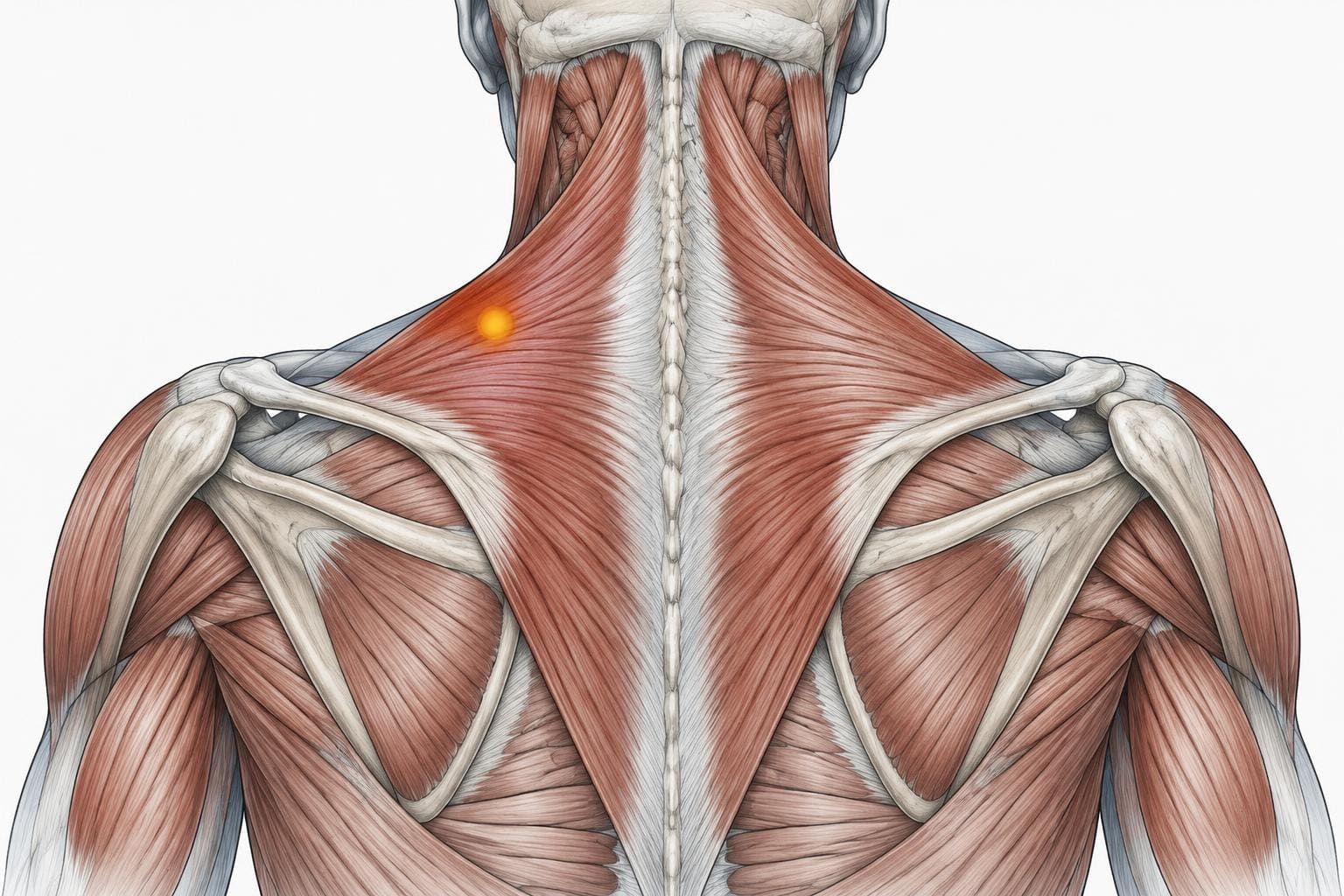
The trapezius is a broad superficial muscle extending from the occiput and nuchal ligament to the clavicle, acromion and scapular spine. Its upper fibres elevate and upwardly rotate the scapula and contribute to cervical positioning. The spinal accessory nerve supplies motor innervation, with cervical sensory and proprioceptive contributions. The upper trapezius lies near structures whose inadvertent treatment can matter functionally, including the levator scapulae, supraspinatus region and cervical extensor complex.
A visually obvious shoulder contour or a tender point is not, by itself, a diagnosis. Examination should reproduce the patient’s familiar pain, assess cervical and shoulder movement, strength and neurological status, and consider whether symptoms fit a regional myofascial pattern. Ultrasound can confirm muscle boundaries, depth and adjacent anatomy, especially in smaller patients, altered anatomy, deep targets or when the proposed site is close to pleura or neurovascular structures; it does not independently prove that a sonographic feature is the pain generator.
Red flags or discordant findings should redirect assessment. Important alternatives include cervical radiculopathy or myelopathy, rotator-cuff or acromioclavicular disease, inflammatory rheumatic disease, infection, fracture, tumour, thoracic outlet pathology, dystonia, medication-related myopathy and referred visceral pain. New neurological deficit, constitutional symptoms, trauma, severe night pain or cardiopulmonary symptoms require appropriate escalation rather than a trigger-point injection.
4. Why botulinum toxin and corticosteroid are not interchangeable
Botulinum toxin type A cleaves proteins involved in synaptic vesicle release and reduces acetylcholine transmission at the neuromuscular junction. It can also reduce peripheral release of substance P, glutamate and calcitonin gene-related peptide. The clinical effect is delayed, prolonged and intrinsically linked to dose-dependent weakness. Units are product-specific and cannot be converted by a universal ratio.
Corticosteroids act through glucocorticoid pathways to suppress inflammatory signalling. That is compelling for selected inflammatory lesions but less clearly matched to a trigger point defined principally by motor-endplate dysfunction, local contraction and sensitisation. Local corticosteroid exposure can cause dermal or subcutaneous atrophy and pigment change; repeated or higher systemic exposure may affect glucose, the hypothalamic–pituitary–adrenal axis and bone health.
Using two drugs with different mechanisms does not automatically create synergy. For a combination to be justified, it should outperform each component alone, have acceptable safety and have known physicochemical compatibility. None of those conditions has been demonstrated for botulinum toxin plus corticosteroid in trapezius trigger points.
5. Evidence for needling and local anaesthetic injection
Across the trigger-point literature, dry needling, saline and local anaesthetic frequently improve pain, but comparative superiority is inconsistent. This pattern supports a substantial contribution from needle placement, mechanical stimulation, regression to the mean, contextual effects and the rehabilitation that accompanies the procedure. It also argues against beginning with a costly, longer-acting or higher-risk injectate.
Garvey and colleagues compared lidocaine, lidocaine plus corticosteroid, dry needling and vapocoolant with acupressure in low-back trigger points. The injected drug was not the critical determinant of response, and adding steroid did not establish a durable advantage. Venâncio and colleagues found improvement with dry needling, lidocaine and lidocaine plus corticosteroid in headache-associated trigger points, with no persuasive global superiority for steroid. In an emergency-department trial, Roldan and colleagues found normal saline non-inferior to lidocaine plus triamcinolone for short-term myofascial pain outcomes.
For upper trapezius pain specifically, trials comparing lidocaine approaches and saline or physical modalities generally show that precise treatment and follow-up rehabilitation matter more than an elaborate injectate. A local anaesthetic may reduce immediate procedural soreness and facilitate movement, but repeated injection without reassessment risks treating tenderness while missing the driver.
6. Does corticosteroid add benefit?
The best available answer is that corticosteroid has not shown consistent additional benefit in trigger-point injection. Most comparative prospective studies reviewed in the literature did not demonstrate clinically important superiority over local anaesthetic, saline or needling alone. The 2024 multi-society guideline on corticosteroid use in chronic pain interventions therefore advises that local anaesthetic alone should be considered for trigger-point injection.
This does not mean corticosteroid has no place anywhere in musculoskeletal medicine. It means a myofascial trigger point should not be treated as though it were an inflamed bursa, tendon sheath or joint. If examination identifies a separate steroid-responsive diagnosis, that diagnosis should be named and treated on its own evidence rather than using corticosteroid as a routine ingredient in a trigger-point mixture.
The risk–benefit imbalance is particularly relevant in the posterior shoulder. Skin depigmentation or fat atrophy can be visible, while systemic effects are undesirable in patients with diabetes, osteoporosis risk, repeated steroid exposure or endocrine vulnerability. An intervention with unproven incremental benefit should not acquire incremental risk by habit.
7. Evidence for botulinum toxin type A
Botulinum toxin evidence is heterogeneous. Trials differ in diagnostic criteria, muscle selection, toxin preparation, dose, number of points, comparator and follow-up. A Cochrane review found inconclusive evidence for botulinum toxin in adult myofascial pain, and later systematic reviews have continued to describe conflicting, generally low-certainty findings.
In an upper-trapezius randomised trial, Kwanchuay and colleagues compared 20 units of onabotulinumtoxinA with saline. Pressure-pain threshold improved, but visual analogue pain scores did not differ significantly at three or six weeks. Ferrante and colleagues tested 10, 25 or 50 units per cervicothoracic trigger point and found no dose-specific advantage over saline. Qerama and colleagues demonstrated the expected electrophysiological effect after infraspinatus injection without corresponding analgesic superiority.
Not all studies were negative. A multicentre Dysport trial in upper-back myofascial pain reported a greater responder proportion and improved pain at selected time points. Porta compared botulinum toxin plus bupivacaine with methylprednisolone plus bupivacaine in chronic muscle spasm and found a later advantage for the toxin arm. Crucially, that study compared toxin against steroid; it did not test their combination.
The defensible interpretation is not that botulinum toxin never works. It is that average benefit over simpler treatment is uncertain, while weakness is predictable. A carefully selected patient with recurrent focal symptoms, demonstrable motor overactivity, temporary response to accurate needling and failed rehabilitation may reasonably enter a shared off-label decision. Routine first-line use is not supported.
8. Evidence for combining botulinum toxin and corticosteroid
No high-quality randomised controlled trial has compared botulinum toxin plus corticosteroid with botulinum toxin alone, corticosteroid alone and a simpler control for trapezius trigger points. No trial establishes same-syringe compatibility, stability or clinical synergy. No major guideline recommends the combination as routine practice.
Same-session use is not equivalent to same-syringe mixing, but it still requires a clear rationale for each drug. If a clinician believes two distinct diagnoses coexist, each intervention should have its own target, indication, expected outcome and consent discussion. Injecting both agents into one vaguely defined painful point makes attribution impossible: improvement, non-response and adverse effects cannot be assigned to either treatment.
Botulinum toxin product information specifies reconstitution with sterile preservative-free sodium chloride. In the absence of validated compatibility data, corticosteroid should not be used as a diluent or mixed into the toxin syringe. Separation does not manufacture evidence of benefit; it merely avoids an unsupported admixture.
Same syringe is not evidence-based. Separate decisions and documentation are required if distinct indications are being treated; separation does not itself prove that both treatments are needed.
9. Evidence table and clinical interpretation
Garvey et al. (1989): lidocaine, lidocaine plus corticosteroid, dry needling and non-injection treatment; improvement was not dependent on injected medication and steroid did not establish superiority.
Porta (2000): botulinum toxin plus bupivacaine versus methylprednisolone plus bupivacaine; later outcomes favoured toxin in chronic muscle spasm, but the agents were comparators, not combined.
Wheeler et al. (2001): botulinum toxin versus saline in chronic neck pain; no clear toxin-specific clinical benefit and more treatment-related effects.
Kamanli et al. (2005): lidocaine, dry needling and botulinum toxin; all improved, with lidocaine offering at least comparable benefit and lower cost.
Ferrante et al. (2005): saline versus 10, 25 or 50 units of onabotulinumtoxinA per cervicothoracic point; no significant dose-response advantage for toxin.
Qerama et al. (2006): 50 units of onabotulinumtoxinA versus saline in infraspinatus; electrophysiological denervation occurred without superior analgesia.
Göbel/Benecke multicentre study: abobotulinumtoxinA across upper-back points versus placebo; positive responder signal at selected intervals, illustrating possible subgroup benefit.
Kwanchuay et al. (2015): 20 units of onabotulinumtoxinA versus saline in upper trapezius; pressure threshold improved, but pain scores did not separate.
Roldan et al. (2020): saline versus lidocaine plus triamcinolone; saline was non-inferior for short-term pain, arguing against routine steroid addition.
Leonardi et al. (2024): systematic review of botulinum toxin for head, neck and shoulder myofascial pain; heterogeneous and conflicting evidence prevented a confident claim of superiority.
10. A stepwise clinical decision framework
Step 1 — verify the diagnosis. Reproduce the familiar pain, document location and referral, assess cervical and shoulder function, and exclude neurological, articular, systemic and visceral alternatives. A tender point without a coherent clinical syndrome is not enough.
Step 2 — define baseline outcomes. Record pain interference, a patient-specific functional task, range where relevant and analgesic use. A treatment that changes tenderness but not function may not be worthwhile.
Step 3 — address modifiable drivers. Load management, sleep, workstation factors, graded exercise, physiotherapy, stress and comorbid headache or widespread pain deserve active management. Injection should complement rehabilitation, not replace it.
Step 4 — if an injection is justified, begin with the least complex evidence-consistent option. Accurate dry needling or local anaesthetic injection is more proportionate than routinely adding corticosteroid or toxin.
Step 5 — reserve botulinum toxin for a narrow refractory phenotype after diagnostic review. Agree the functional trade-off, because reducing trapezius activity can produce shoulder heaviness, neck fatigue or altered scapular control. Use image guidance where anatomy, depth or adjacent structures make palpation insufficient.
Step 6 — review at a pre-specified interval. Do not repeat an intervention merely because its pharmacological effect has worn off. Repeat only after a meaningful, reproducible benefit and renewed consideration of cumulative risk.
11. Published dosing is not a universal protocol
Published upper-quarter studies have used materially different regimens: 20 units of onabotulinumtoxinA at one upper-trapezius point; 10, 25 or 50 units per cervicothoracic point with up to five points; 50 units in the infraspinatus; and 400 units of abobotulinumtoxinA distributed across multiple upper-back sites. These are trial descriptions, not interchangeable recommendations.
A unit of one botulinum toxin preparation is not equivalent to a unit of another. Dose should not be copied across brands. Total exposure, muscle volume, bilateral treatment, previous toxin, neuromuscular comorbidity and the functional contribution of the target muscle all alter risk. The correct clinical question is not “how many units treat a trigger point?” but “is toxin justified for this patient, this muscle and this measurable goal?”
There is no evidence-based corticosteroid dose for combination with botulinum toxin in a trapezius trigger point because the combination itself is unvalidated. Quoting a dose would give false precision to an unsupported protocol.
12. Technique, imaging and anatomical safety
Palpation can be adequate for a superficial, clearly identified upper-trapezius target in an appropriately trained clinician’s hands. Ultrasound becomes more valuable when the muscle is thin, anatomy is altered, the proposed target is deep, previous landmark treatment failed, or pleura and neurovascular structures are a concern. Guidance can verify where the needle is; it cannot correct a wrong diagnosis.
The figure in this article identifies the posterior upper trapezius as a region, not a universal injection coordinate. Trigger points are clinical findings, not fixed dots on an atlas. Safe treatment requires individual examination and awareness of muscle thickness, scapular position and the structures deep to the proposed trajectory.
Aseptic technique, traceable product documentation and emergency preparedness are mandatory. Avoid treatment through infection and review bleeding risk, allergy history, pregnancy considerations, neuromuscular disease, medicines affecting neuromuscular transmission and prior toxin exposure.
13. Adverse effects and follow-up
Botulinum toxin can cause injection-site pain, bruising, unintended local weakness, shoulder heaviness, neck fatigue, asymmetry and compensatory recruitment. Rare systemic spread can cause dysphagia, dysphonia, generalised weakness or respiratory compromise. Patients must know which symptoms require urgent assessment.
Corticosteroid may cause post-injection flare, infection, skin hypopigmentation, dermal or subcutaneous atrophy and local tissue injury. Systemic effects include transient hyperglycaemia and, with cumulative exposure, hypothalamic–pituitary–adrenal suppression and adverse bone effects. Combining treatments can add liabilities without demonstrating additional efficacy.
Follow-up should measure the outcome chosen before treatment and screen for weakness, altered scapular mechanics and skin change. Lack of meaningful functional improvement should trigger diagnostic reconsideration, not automatic dose escalation.
14. Consent, governance and documentation
Botulinum toxin treatment of trapezius trigger-point pain is generally off-label. Valid consent should state that status, the uncertainty of benefit, reasonable alternatives, expected duration, region-specific weakness and rare spread-of-toxin effects. A patient’s request or previous cosmetic toxin experience does not substitute for a clinical indication.
The record should include the working diagnosis, examination findings, failed conservative measures, baseline outcome, product and batch, diluent, dose by site, laterality, anatomical or ultrasound method, adverse-event advice and review plan. If corticosteroid is used for a separately defined indication, its drug, dose, target and rationale should be independently documented.
Governance should also address prescriber responsibility, competency, indemnity and local policy. The most defensible practice is transparent about uncertainty and does not present an untested combination as an established protocol.
15. Research priorities
Future trials should use reproducible diagnostic criteria, stratify upper trapezius from other muscles, and distinguish local myofascial pain from dystonia, headache and widespread pain. A factorial design could compare needling or local anaesthetic, corticosteroid, botulinum toxin and a pre-specified separate-treatment combination without unsafe or unvalidated admixture.
Outcomes should extend beyond pain intensity to function, patient-specific goals, pressure-pain threshold, duration of benefit, return to activity, weakness, scapular control, skin change, repeat-treatment burden and cost. Follow-up beyond three months is necessary to assess recurrence and cumulative harm.
Until such evidence exists, the burden of proof remains with the more complex treatment. Biological plausibility and anecdotal response are hypotheses, not a licence to combine drugs routinely.
16. Conclusion
For upper-trapezius and shoulder-girdle myofascial trigger points, the evidence does not support routine botulinum toxin plus corticosteroid injection. Corticosteroid has not consistently improved outcomes over simpler injectates, botulinum toxin has mixed trial results, and the combination lacks direct efficacy and compatibility evidence.
Clinical care should begin with diagnostic precision, rehabilitation and lower-risk interventions. Botulinum toxin may be considered only for carefully selected refractory patients after shared off-label decision-making, with a defined functional goal and acceptance of weakness. If corticosteroid is indicated for a separate inflammatory diagnosis, it should be treated as a separate decision—not an automatic addition to a trigger-point syringe.
References
- Benzon HT, et al. Use of corticosteroids for adult chronic pain interventions: sympathetic and peripheral nerve blocks and trigger point injections. Reg Anesth Pain Med. 2024. doi:10.1136/rapm-2024-105593.
- Leonardi G, et al. Botulinum toxin type A for myofascial pain in the head, neck and shoulder region: a systematic review. Eur J Pain. 2024. doi:10.1002/ejp.2198.
- Soares A, et al. Botulinum toxin for myofascial pain syndromes in adults. Cochrane Database Syst Rev. 2014;CD007533.
- Garvey TA, Marks MR, Wiesel SW. A prospective, randomised, double-blind evaluation of trigger-point injection therapy for low-back pain. Spine. 1989;14:962–964.
- Porta M. A comparative trial of botulinum toxin type A and methylprednisolone for the treatment of myofascial pain syndrome and pain from chronic muscle spasm. Pain. 2000;85:101–105.
- Wheeler AH, Goolkasian P, Gretz SS. A randomised, double-blind, prospective pilot study of botulinum toxin injection for refractory, unilateral, cervicothoracic, paraspinal myofascial pain syndrome. Spine. 2001;26:105–112.
- Kamanli A, Kaya A, Ardicoglu O, et al. Comparison of lidocaine injection, botulinum toxin injection, and dry needling to trigger points in myofascial pain syndrome. Rheumatol Int. 2005;25:604–611.
- Ferrante FM, Bearn L, Rothrock R, King L. Evidence against trigger point injection technique for the treatment of cervicothoracic myofascial pain with botulinum toxin type A. Anesthesiology. 2005;103:377–383.
- Qerama E, Fuglsang-Frederiksen A, Kasch H, et al. A double-blind, controlled study of botulinum toxin A in chronic myofascial pain. Neurology. 2006;67:241–245.
- Benecke R, Heinze A, Reichel G, Hefter H, Göbel H. Botulinum type A toxin complex for the relief of upper back myofascial pain syndrome. Pain Med. 2011;12:903–908.
- Kwanchuay P, Petchnumsin T, Yiemsiri P, Pasuk N, Srikanok W, Hathaiareerug C. Efficacy and safety of single botulinum toxin type A injection for upper trapezius myofascial trigger point. J Med Assoc Thai. 2015;98:1231–1236.
- Roldan CJ, Chung M, Deroos F, et al. Normal saline trigger point injections compared with conventional active drug mix for myofascial pain syndromes. Am J Emerg Med. 2020;38:311–316.
- Bautista A, et al. Role of intramuscular corticosteroids in trigger point injections: a narrative review. J Anesth Clin Care. 2020.
- Dommerholt J, Fernández-de-las-Peñas C. Trigger Point Dry Needling: An Evidence and Clinical-Based Approach. 2nd ed. Elsevier; 2018.
- NICE. Chronic pain (primary and secondary) in over 16s: assessment and management of chronic primary pain. NG193. 2021, updated 2024.
Practical conclusion: diagnosis and rehabilitation come first. Use corticosteroid only for a separately justified steroid-responsive condition, and consider botulinum toxin only for a selected refractory phenotype after explicit off-label consent.