
1. Scope and clinical question
Orofacial pain rarely respects an anatomical border. A patient may describe clenching, dental wear, masseter fatigue, pre-auricular pain, temporal headache, occipital discomfort and upper-trapezius tightness in the same history. These complaints can share perpetuating factors, but they are not one diagnosis. The useful clinical question is therefore not simply whether botulinum toxin can reduce pain; it is which structure and pain mechanism are dominant, what should be treated first, and whether reducing muscular force is appropriate for this particular patient.
This narrative clinical review addresses muscle-dominant temporomandibular disorder (TMD), awake or sleep bruxism-associated symptoms, masseter and temporalis overactivity, headache overlap, cervical and upper-trapezius myofascial pain, and relevant aesthetic consequences of reducing masticatory muscle bulk. It does not treat every headache as migraine, every click as muscular pain, or every tender point as an indication for injection.
Chronic migraine is deliberately kept separate. It has a defined diagnostic framework and an established onabotulinumtoxinA protocol. Readers requiring the fixed-site, fixed-dose PREEMPT evidence should consult the dedicated HSI chronic migraine review. The present paper instead examines the head–jaw–neck interface and the more uncertain evidence for off-label treatment of myogenous TMD and related muscular pain.
Evidence review updated 30 September 2026. The HSI clinical framework in Section 8 is identified as expert practice wherever it extends beyond validated evidence.
2. Assessment before treatment: head, jaw and neck
Assessment begins with the patient's own pattern: site, onset, duration, daily variation, aggravating and relieving factors, and functional effect. Ask about grinding or clenching awareness, whether a partner hears nocturnal grinding, morning jaw fatigue, headache on waking, locking, reduced opening, altered bite, tooth sensitivity, fractured restorations, previous splints, dental treatment and prior physiotherapy. Stress, sleep quality, stimulant use and repetitive oral habits may influence symptoms but should not be used to dismiss pain as psychological.
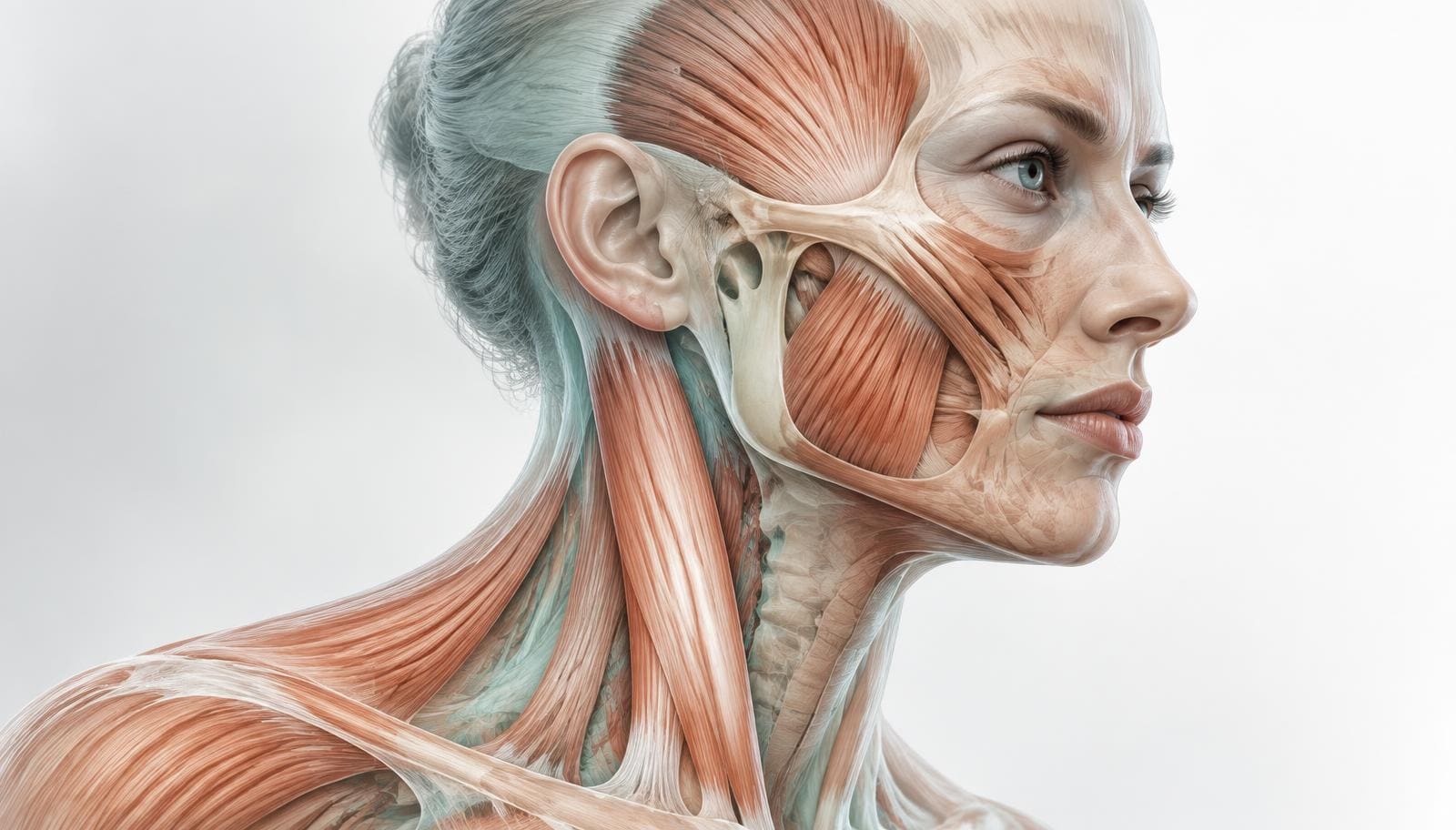
Examination should distinguish muscle pain from joint and dental disease. Observe opening, deviation and range; listen and palpate for joint clicks or crepitus; inspect for tooth wear, linea alba and tongue scalloping; and palpate masseter and temporalis during rest and clench. Reproduction of the patient's familiar pain is more informative than tenderness alone. The uploaded HSI bruxism questionnaire informs this practical history structure, but it is a clinical aide-mémoire rather than a validated diagnostic or dosing instrument.
Extend the examination beyond the mandible. Record temporal and occipital headache, neck movement, cervical posture, sternocleidomastoid and upper-trapezius tenderness, taut bands and whether palpation reproduces the recognised symptom. A neck trigger point can coexist with TMD, but coexistence does not establish causation. Trigger points, cervical joint pain, migraine, tension-type headache and referred dental pain require different reasoning.
Red flags include new neurological deficit, thunderclap or progressively changing headache, fever, unexplained weight loss, temporal-artery symptoms, trauma, suspected infection or malignancy, persistent unilateral sensory change, true trismus, new visual symptoms and jaw claudication. These findings require investigation or referral rather than routine toxin treatment.
3. Classifying the dominant contributor
Dental and periodontal pain should be excluded before labelling pain as TMD. Arthrogenic TMD is suggested by joint-line pain, locking, crepitus, restricted movement or inflammatory features. Myogenous TMD is supported when palpation or resisted function reproduces familiar pain in a masticatory muscle. Neuropathic pain is suggested by burning, electric-shock quality, allodynia or sensory change and should not be managed as simple muscle overactivity.
Bruxism is a behaviour, not a diagnosis of pain. Sleep bruxism and awake bruxism can increase loading, but tooth wear records cumulative exposure and does not prove current activity. Likewise, a large masseter may reflect anatomy, training, habitual function or parafunction. Muscle size should be considered alongside pain reproduction, function and the patient's goal.
Headache requires phenotype. Temporalis tenderness may accompany TMD, tension-type headache or migraine; it does not convert one condition into another. Chronic migraine should meet recognised criteria before PREEMPT treatment is considered. Cervicogenic headache and cervical myofascial pain require neck assessment, while persistent or atypical headache may require neurological review.
The practical output of assessment is a problem list: for example, masseter-dominant myalgia with awake clenching; mixed masseter–temporalis pain with morning headache; joint-dominant TMD with secondary guarding; or upper-trapezius myofascial pain accompanying, but not necessarily causing, headache. Treatment follows that list rather than a universal injection pattern.
4. Evidence review: what botulinum toxin can and cannot claim
BoNT-A reduces acetylcholine release at the neuromuscular junction and therefore reduces force in an injected muscle. Peripheral effects on nociceptive transmitter release are biologically plausible, but mechanistic plausibility is not proof of durable clinical benefit. The treatment discussed here is off-label for TMD, bruxism and non-dystonic cervical myofascial pain; product licences vary by country and toxin units are not interchangeable between formulations.
Systematic reviews of painful myogenous TMD reach inconsistent conclusions because trials differ in diagnosis, toxin product, dose, muscle selection, comparator and outcome timing. Some small trials report short-term improvement, while pooled analyses and the 2024 umbrella review judge the overall certainty low to moderate and do not establish durable superiority over placebo or conservative care. A 2023 guideline for chronic TMD pain prioritised supported conservative and behavioural options and did not endorse routine botulinum toxin treatment.
The defensible interpretation is narrow: BoNT-A may be considered for selected adults with clearly muscle-dominant, functionally important symptoms that persist despite appropriate conservative management. It is not first-line treatment, not a correction for every click or headache, and not evidence-based as blanket treatment of all palpable muscles.
For sleep bruxism, toxin can reduce measured contraction intensity and bite force, but evidence that it eliminates the central bruxism behaviour or prevents all dental consequences is insufficient. A splint may protect teeth without reducing central motor events. These are different therapeutic aims and should be explained during consent.
5. Conservative-first and trigger-point-first reasoning
Initial management should address the identified contributors: education, reduction of daytime clenching, sleep and stress review, avoidance of sustained overload, appropriate dental care, physiotherapy and jaw or cervical rehabilitation. An occlusal appliance may be appropriate when dental protection is required, although it is not a universal treatment for every TMD presentation. Medication decisions depend on diagnosis, contraindications and local guidance.
Where a discrete, reproducible trigger point dominates the presentation, HSI practice is to address that focal problem and reassess before weakening a whole muscle. Depending on training and diagnosis, this may involve manual therapy, needling or another targeted intervention within the clinician's scope. This trigger-point-first sequence is a conservative clinical heuristic: no head-to-head trial was identified showing that it is superior to broader muscle treatment.
Evidence for BoNT-A in neck and shoulder myofascial pain is conflicting. Recent synthesis suggests that any average statistical improvement over saline may be too small to be clinically persuasive. This evidence must not be borrowed from PREEMPT: including trapezius sites in a chronic migraine protocol does not prove efficacy for isolated trapezius trigger-point pain.
Reassessment matters because a focal intervention can clarify the residual pattern. If familiar pain resolves, broader toxin exposure may be unnecessary. If substantial muscle-dominant symptoms persist, the clinician can reconsider diagnosis, rehabilitation adherence and whether an off-label BoNT-A trial is proportionate.
6. Masseter, temporalis and functional load
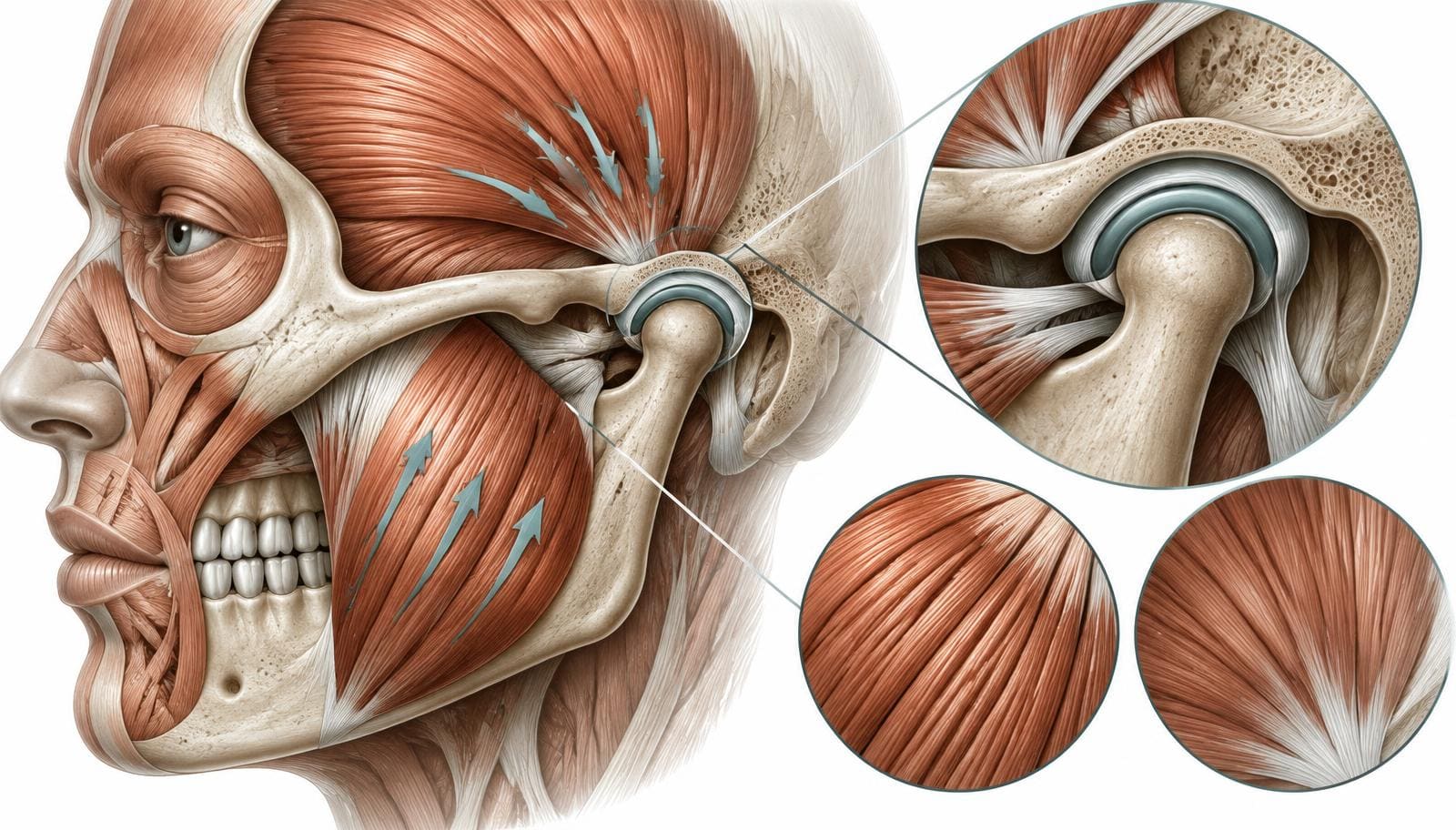
The masseter is a principal elevator of the mandible; the temporalis elevates and retracts it and may become prominent in patients who clench. Palpation at rest and during graded clench helps map bulk and familiar pain. Ultrasound can add an objective thickness measurement when available, especially when serial change will influence retreatment.
Trials have used masseter-only and combined masseter–temporalis approaches. Combined treatment is not automatically better: it is justified only when examination identifies clinically relevant involvement in both regions. Emerging observations of altered temporalis activity after masseter treatment support monitoring for compensatory recruitment, but do not establish that splitting a dose reduces pressure within the temporomandibular joint.
Deep muscles and joint disorders require particular caution. A lateral pterygoid injection is not a routine extension of masseter treatment and should not be inferred from external tenderness. Joint locking, disc displacement and inflammatory arthropathy may require imaging or specialist dental, maxillofacial or pain assessment rather than escalating muscular toxin.
Treatment goals should be recorded separately: reduction of familiar pain, improvement in function, reduction of damaging force, and aesthetic narrowing are not interchangeable outcomes. A patient can have a visible reduction in bulk without meaningful pain improvement, or improved pain with an undesirable aesthetic change.
7. Safety, aesthetics and longitudinal review
Expected pharmacological effects include reduced muscle force and atrophy. Adverse outcomes can include chewing fatigue, altered smile from diffusion, asymmetry, dysphagia in susceptible anatomical contexts, temporal hollowing and an outcome that does not address the original pain mechanism. Consent should also cover the uncertainty around repeated high-dose exposure and mandibular bone changes; human data are limited and do not permit a precise individual risk estimate.
Reducing a hypertrophic masseter changes the soft-tissue envelope. In younger patients with good elasticity, gradual reduction may be accommodated without visible laxity. In patients with pre-jowling, marionette change, existing lower-face laxity or volume loss, reduction of muscular support may reveal or worsen contour concerns. The incidence and predictors are not established by controlled studies, so pretreatment photography and explicit discussion are important.
HSI clinicians have described support behind the masseter or within the lateral temporal-cheek fat compartment when aesthetic descent becomes clinically relevant. This is an expert aesthetic-management proposition, not a proven treatment for pain and not a controlled-evidence standard. It introduces separate filler indications and risks and must not be presented as an automatic correction after toxin.
Review should record symptoms, function, adverse effects, muscle bulk and the original goal. Reinjection should follow renewed examination rather than a calendar alone. A smaller muscle or reduced functional load may justify less toxin or a longer interval; persistent pain despite reduced force should trigger diagnostic reconsideration rather than automatic dose escalation.
8. HSI expert-practice framework: explicitly not a validated dosing scale
Evidence boundary. The following S/M/L/XL shorthand and dose progression describe an HSI author-practice framework for onabotulinumtoxinA. They have not been validated as a diagnostic scale, sex-based algorithm or superior dosing protocol. They should not replace examination, prescribing judgement, product information, local regulation or informed consent. Units from different botulinum toxin products cannot be converted on a simple one-to-one basis.
The 'T-shirt' shorthand classifies observable and palpable masseter bulk as small, medium, large or extra-large. It is intentionally crude. A more defensible record pairs the category with side-to-side comparison, familiar-pain reproduction, functional findings and, where available, ultrasound thickness. Sex may correlate with average muscle bulk, but sex alone should never determine treatment.
Within this author-practice framework, a conservative onabotulinumtoxinA starting reference is 15 units per side for a smaller female masseter, increasing in five-unit steps when clinical bulk and response justify it. A larger male masseter may begin around 20 units per side, with examples of 30, 40 or 50 units reserved for progressively greater assessed bulk and functional load. These values are practice propositions, not evidence-derived thresholds, and are not instructions for untrained injectors.
At subsequent treatments the clinician recalculates the current masseter size and reassesses symptoms rather than repeating the original quantity. HSI practice may step down exposure across successful cycles as bulk decreases—for example six, five, four then three relative dose steps—while lengthening the interval where control persists. This sequence is not supported by a direct trial and must not operate as an automatic schedule.
If both masseter and temporalis reproduce the patient's symptoms, selective distribution between them may be considered instead of concentrating the entire planned exposure in the masseter. This is examination-led expert practice. It should not be described as proven to decrease TMJ pressure, and neither muscle should be treated merely because it appears in a diagram.
9. A practical decision pathway
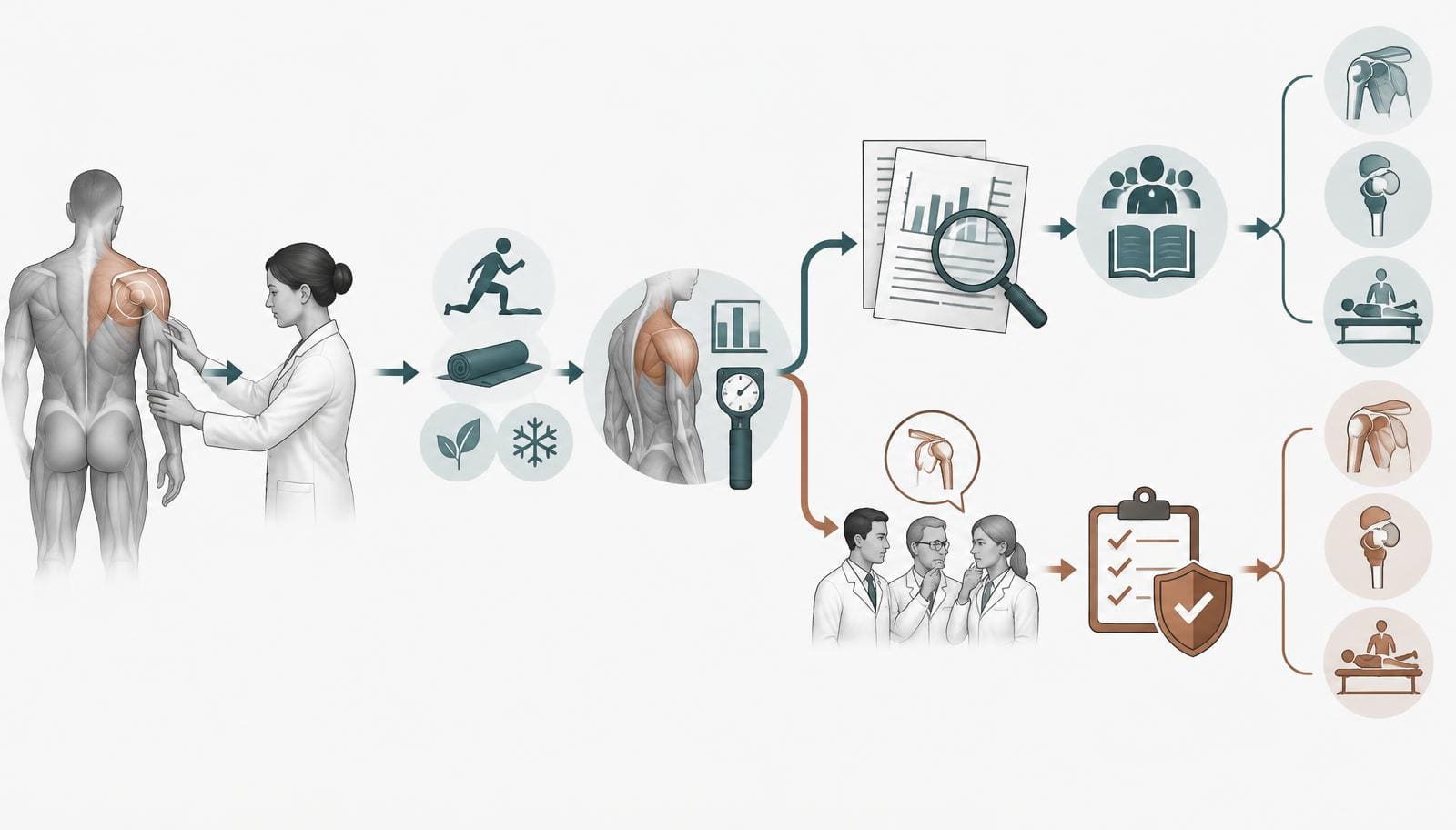
First, classify the pain and exclude dental, joint, neurological and headache red flags. Second, document the patient's familiar symptoms and baseline function rather than relying on tenderness or muscle size alone. Third, begin diagnosis-appropriate conservative care and address discrete trigger points when they are the dominant reproducible finding.
Only after an adequate review should an off-label BoNT-A trial be considered for selected refractory muscle-dominant pain. Select muscles from the examination; state the formulation; record the clinical rationale and goal; use the lowest proportionate exposure; and arrange review. Chronic migraine that meets diagnostic criteria should follow its own evidence-based pathway rather than an improvised extension of a TMD plan.
At review, compare familiar pain, jaw function, headache days where relevant, chewing tolerance, muscle thickness or bulk and aesthetic change. A favourable response does not prove the original mechanism, and a poor response should not automatically lead to a larger dose. Recheck diagnosis, adherence, central pain contributors and whether another specialty should be involved.
This pathway deliberately separates evidence from practice. Published evidence supports conservative-first care and cautious case selection. It does not validate the T-shirt system, fixed sex-based dosing, trigger-point-first sequencing, automatic dose tapering, a pressure-reducing effect from dose sharing, or filler management of laxity.
10. Practical insights and conclusion
The clinically useful unit is not the masseter in isolation but the patient-specific head–jaw–neck pattern. Bruxism, TMD, temporalis pain, headache and cervical trigger points may overlap, yet each requires diagnostic discipline. Treating every region at once can obscure which intervention helped and unnecessarily increase weakness, atrophy and aesthetic change.
Current evidence does not support routine BoNT-A for all orofacial or neck pain. It supports, at most, a carefully consented second-line trial in selected refractory myogenous cases, embedded within conservative and rehabilitative care. PREEMPT evidence for chronic migraine must remain distinct from evidence for TMD or isolated trapezius pain.
HSI's expert-practice framework offers a transparent way to discuss gradual masseter dosing, reassessment and dose distribution, but its limits are as important as its content. Objective measurement, the lowest proportionate exposure, serial review and willingness not to reinject are safer than a fixed template.
The central practical lesson is assessment before injection, focal treatment before indiscriminate weakening, and reassessment before repetition. Where evidence ends and expert practice begins, the reader and patient should be able to see the boundary.
Related HSI clinical reading
References
- Dinsdale A, et al. What is the evidence for botulinum toxin in temporomandibular disorders? An umbrella review of systematic reviews. Drugs. 2024.
- Saini RS, et al. The effectiveness of botulinum toxin for temporomandibular disorders: systematic review and meta-analysis. PLoS One. 2024;19:e0300157.
- Machado D, et al. Botulinum toxin type A for painful temporomandibular disorders: systematic review and meta-analysis. J Pain. 2020;21:281–293.
- Busse JW, et al. Management of chronic pain associated with temporomandibular disorders: a clinical practice guideline. BMJ. 2023;383:e076227.
- De la Torre Canales G, et al. Efficacy and safety of botulinum toxin type A on persistent myofascial pain: a randomised clinical trial. Toxins. 2020;12:395.
- Ernberg M, et al. Efficacy of botulinum toxin type A for persistent myofascial TMD pain: a multicentre, randomised controlled trial. Pain. 2011;152:1988–1996.
- Buzatu R, et al. Botulinum toxin for sleep bruxism-associated temporomandibular disorders: a systematic review. Dent J. 2024;12:156.
- Al-Wayli H. Treatment of chronic pain associated with nocturnal bruxism with botulinum toxin: a prospective and randomised clinical study. J Clin Exp Dent. 2017;9:e112–e117.
- Guarda-Nardini L, et al. Efficacy of botulinum toxin in treating myofascial pain in bruxers: a controlled placebo pilot study. Cranio. 2008;26:126–135.
- De la Torre Canales G, et al. Effects of botulinum toxin type A on mandibular bone and muscle: systematic considerations from clinical and preclinical evidence. Toxins. 2019.
- International Classification of Orofacial Pain, 1st edition. Cephalalgia. 2020;40:129–221.
- Schiffman E, et al. Diagnostic Criteria for Temporomandibular Disorders (DC/TMD). J Oral Facial Pain Headache. 2014;28:6–27.
- NICE. Headaches in over 12s: diagnosis and management (CG150). Updated guidance.
- Aurora SK, et al. OnabotulinumtoxinA for treatment of chronic migraine: pooled PREEMPT results. Headache. 2011;51:1358–1373.
- Mor N, et al. Botulinum toxin in the treatment of temporomandibular disorders: a review of the literature. Toxins. 2015;7:2791–2800.
Search the indexed TMD evidence on PubMed · NICE headache guidance