
1. Scope, diagnosis and the clinical question
OnabotulinumtoxinA has a defined evidence base in chronic migraine, not in migraine as an undifferentiated symptom. ICHD-3 defines chronic migraine as headache on at least 15 days per month for more than three months, with migraine features on at least eight days. Diagnosis still requires a careful history: clinicians must distinguish migraine from secondary headache, cervicogenic pain, medication-overuse headache, neuralgia and other primary headache disorders before interpreting an injection response.
The central question is not whether fewer injections might be more convenient. It is whether a reduced-site or lower-dose strategy preserves the benefit demonstrated by the PREEMPT programme. No randomised non-inferiority trial has answered that question in chronic migraine. Therefore, 155–195 product-specific units across 31–39 sites remains the evidence-supported paradigm; alternatives are hypotheses rather than equivalent protocols.
This review reports trial regimens to explain evidence, not to prescribe treatment. Product units are not interchangeable. Patient assessment, treatment eligibility, technique, consent, monitoring and governance remain the responsibility of appropriately trained clinicians working within current licensing and local guidance.
2. How strong is the pivotal PREEMPT evidence?
PREEMPT 1 and PREEMPT 2 were large, multicentre, placebo-controlled phase 3 studies followed by open-label treatment. PREEMPT 1 did not meet its original primary endpoint of headache episodes, although several secondary outcomes improved. PREEMPT 2 used headache days as its primary endpoint and reported a mean reduction of 9.0 days with onabotulinumtoxinA versus 6.7 with placebo at week 24. Pooled analyses supported statistically significant improvements in headache days, migraine days and disability measures.
The placebo response was substantial, as is common in injection trials, and the absolute between-group effect was more modest than within-group changes suggest. The Cochrane review estimated approximately two fewer migraine days per month versus placebo in chronic migraine and judged certainty across outcomes to be limited by heterogeneity and risk of bias. This does not negate efficacy; it frames its average magnitude and the uncertainty around individual response.
Most pivotal and several long-term datasets were sponsor funded. That relationship should be declared rather than used to dismiss the evidence. Replication in clinical cohorts, consistency across disability outcomes and guideline appraisal strengthen confidence, while sponsorship, selective endpoints and open-label extensions limit causal interpretation.
3. What exactly is the PREEMPT injection paradigm?
The fixed-site, fixed-dose component delivers 155 units through 31 intramuscular sites distributed across seven bilateral or midline muscle groups: corrugator, procerus, frontalis, temporalis, occipitalis, cervical paraspinal and trapezius. A protocolised follow-the-pain component permits up to 40 additional units across as many as eight sites in temporalis, occipitalis or trapezius, producing a maximum of 195 units across 39 sites. Cycles are separated by 12 weeks.
The map is not simply a collection of tender points. It deliberately samples trigeminal and upper-cervical territories and includes posterior head and neck muscles even when the presenting pain appears predominantly frontal. Conversely, follow-the-pain dosing is structured customisation, not unrestricted dose placement. Anatomical knowledge remains essential because excessive depth or incorrect position may increase neck pain, weakness, brow effects or ptosis.
Published units belong to the onabotulinumtoxinA formulation used in the trials. They cannot be translated into another botulinum toxin product through a universal conversion ratio. Similarly, a cosmetic upper-face pattern is not a miniature PREEMPT protocol: it addresses fewer tissues, a different outcome and a population that may not have chronic migraine.
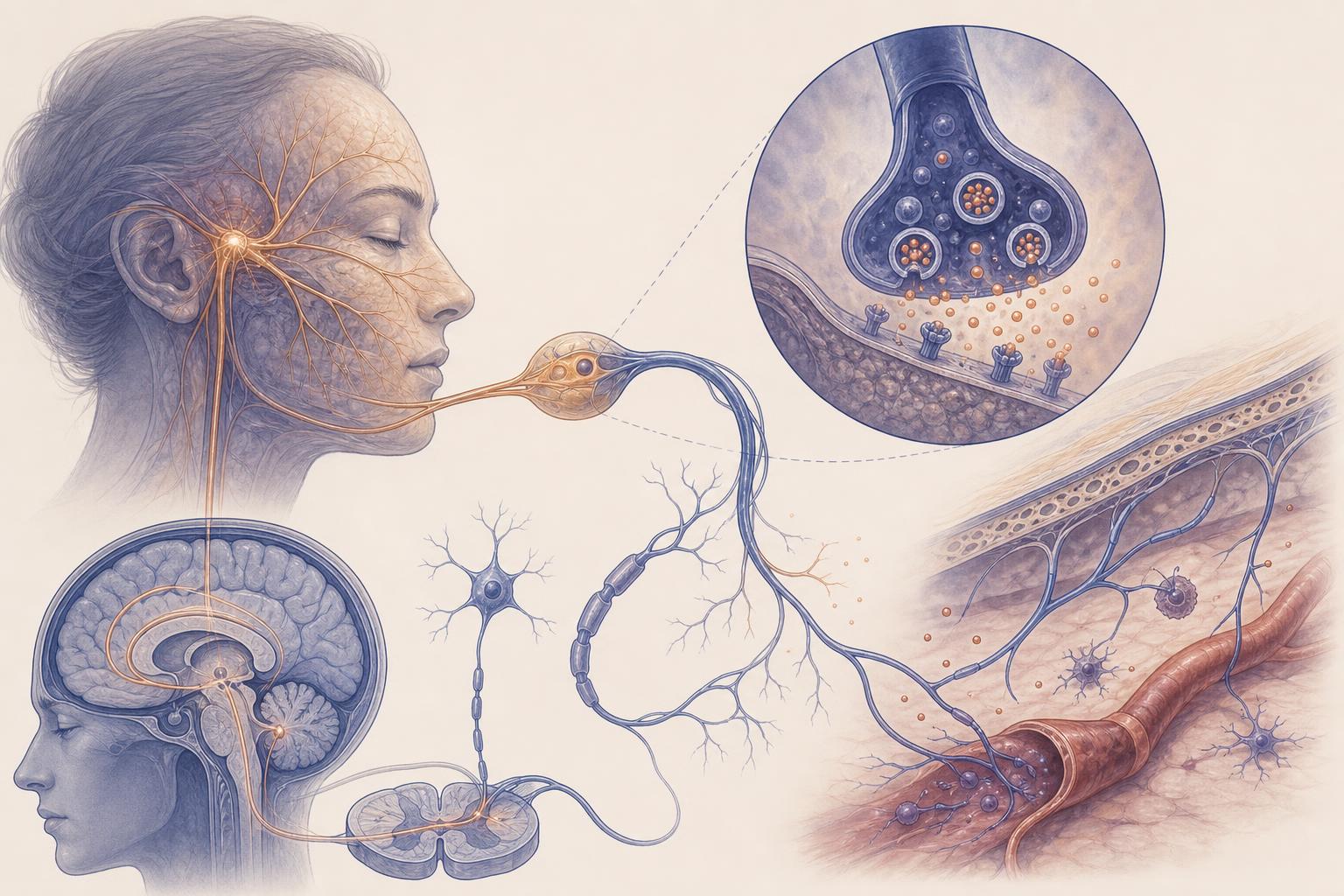
4. Why might a peripheral injection prevent migraine?
OnabotulinumtoxinA cleaves SNAP-25, reducing vesicular transmitter release. In motor terminals this inhibits acetylcholine release and weakens muscle. Migraine prevention is unlikely to be explained by muscle relaxation alone. Experimental work supports uptake at peripheral sensory endings and reduced release of calcitonin gene-related peptide, glutamate and substance P, with reduced trafficking or expression of nociceptive channels including TRPV1 and TRPA1.
A plausible model is that dampening peripheral trigeminal and cervical nociceptive input reduces the drive sustaining central sensitisation. This fits the delayed clinical effect and the distribution of PREEMPT sites, but the complete human mechanism is not established. Evidence for direct central transport as a clinically important mechanism remains inferential. Mechanistic plausibility must not be used to validate an untested site map.
5. Who is represented by the evidence—and who is not?
The pivotal population had chronic migraine, often with substantial disability and frequent acute-medication use. Medication overuse was common. A PREEMPT subgroup analysis found benefit in participants with baseline medication overuse, but injection treatment should not displace assessment of overuse, withdrawal where appropriate and optimisation of acute treatment. NICE requires medication overuse to be appropriately managed.
Episodic migraine is different. PRECLUDE, a modern phase 3 trial, found neither 155 nor 195 units superior to placebo on the primary endpoint in episodic migraine. A second phase 3 programme was terminated for futility. Smaller open-label studies reporting improvement cannot overcome that negative randomised evidence because expectancy, regression to the mean and selective retention may inflate apparent benefit.
Evidence is also thinner in pregnancy, lactation, adolescents, older adults with multimorbidity and patients with important neuromuscular disease. Pregnancy pharmacovigilance and observational cohorts are reassuring but cannot establish safety; they are vulnerable to reporting and selection bias. Such populations require individual specialist risk assessment rather than extrapolation from PREEMPT.
6. How should response be measured?
A headache diary should establish baseline frequency and track headache days, migraine days, acute-medication days and meaningful function. A single average can conceal clinically relevant change: a patient may have fewer severe days or regain work capacity without reaching a 50% frequency threshold. Disability instruments such as HIT-6 or MIDAS can complement, but not replace, diary data and patient-defined goals.
NICE defines an inadequate response as less than a 30% reduction in headache days after two treatment cycles. The European Headache Federation similarly recognises that some patients respond only after a second or third cycle, making premature judgement after one cycle unreliable. Continued treatment without a prospectively documented benefit, however, converts a therapeutic trial into unmeasured maintenance.
NICE also recommends stopping when chronic migraine has converted to episodic migraine for three consecutive months. This positive stopping rule is not evidence that disease is cured; it reflects commissioning and the possibility of reassessment. Relapse after withdrawal can occur, so plans should define monitoring and routes back to specialist review.
7. Does 195 units work better than 155 units?
PREEMPT was not designed as a randomised comparison of 155 against 195 units. The additional 40 units were selected according to pain distribution, so patients receiving more treatment differ systematically from those receiving the fixed dose alone. Apparent dose-response findings within that design are therefore confounded.
Observational cohorts and paired dose-escalation studies suggest that some incomplete responders improve after escalation, but these data are vulnerable to selection, time and regression effects. REPOSE and other real-world studies support effectiveness across the licensed range without proving that 195 units is generally superior. The rational interpretation is conditional: 155 units is the evidence-based fixed minimum; additional dosing is protocol-defined and individualised, not automatically better.
| Question | Best interpretation |
|---|---|
| Is 155 units evidence based? | Yes. It is the fixed-dose component tested in PREEMPT. |
| Is 195 units always better? | No direct randomised comparison establishes general superiority. |
| Are fewer sites equivalent? | Unknown. No chronic-migraine non-inferiority trial has established this. |
8. Why are reduced-site and anterior-only protocols unproven?
A smaller anterior pattern could plausibly reduce treatment burden, cost and unwanted posterior weakness. Early trials tested limited frontal, temporal and glabellar patterns, but largely in episodic migraine and with inconsistent results. Those experiments cannot establish non-inferiority to PREEMPT in chronic migraine.
The European Headache Federation found no randomised studies comparing PREEMPT with an alternative injection protocol. A convincing reduced-site trial would need chronic-migraine eligibility, blinded assessment, a prespecified non-inferiority margin, adequate power, at least two cycles, disability and safety outcomes, and transparent handling of rescue treatment and medication overuse. Until then, 'fewer sites worked for my patient' remains clinically interesting but causally weak evidence.
9. What does real-world evidence add?
COMPEL followed 716 adults through nine treatment cycles over 108 weeks and reported sustained reductions in headache days and disability. Its duration is valuable, but the open-label design lacks a concurrent placebo group and attrition can enrich the later cohort for responders. PREDICT and multiple national cohorts similarly suggest persistence of benefit, improved quality of life and reduced healthcare use in routine care.
Real-world meta-analysis broadly supports effectiveness and tolerability beyond trial settings, including patients with comorbidity who might be excluded from RCTs. It cannot resolve the minimum effective dose or site count because treatment selection is not random. Long follow-up also introduces changes in concomitant preventives, acute medication, behaviour and natural disease course.
10. How does onabotulinumtoxinA fit beside CGRP-targeted prevention?
CGRP monoclonal antibodies and gepants have changed preventive care. Comparative choice depends on eligibility, previous treatment, preference, pregnancy considerations, comorbidity, route, access and local guidance. PREEMPT did not compare onabotulinumtoxinA directly with modern CGRP-targeted therapies, so cross-trial differences in response should not be treated as head-to-head evidence.
Retrospective cohorts suggest additional benefit when a CGRP monoclonal antibody is added to onabotulinumtoxinA in persistently disabled patients. However, no adequately powered randomised trial has established the magnitude, cost effectiveness or best sequence of combination therapy. 'Synergy' is biologically plausible but remains an observational claim.
11. Safety, anatomy and consent
Common treatment-related events include neck pain, muscular weakness, injection-site pain, eyelid ptosis and brow effects. Most are mild or moderate, but functional neck weakness can matter substantially to a patient already limited by pain. Long-term COMPEL and multicentre observational data have not identified a new cumulative safety signal, although open-label surveillance is less sensitive than controlled comparison for common subjective outcomes.
Risk is influenced by anatomy, dose distribution, depth and patient factors. Injections placed too low or deep in the cervical region may increase weakness; frontalis treatment without respect for brow position may worsen ptosis or heaviness. Consent should cover the average modest treatment effect, delayed onset, need for repeated cycles, common adverse effects, realistic stopping rules and uncertainty around off-protocol strategies.
Symptoms suggesting systemic toxin spread, dysphagia, dysarthria, respiratory compromise or generalised weakness require urgent clinical assessment. Contraindications, interacting medicines and neuromuscular conditions must be considered according to the current product information and specialist governance.
12. Evidence table: what each evidence family can answer
PREEMPT 1 and 2 establish efficacy of the 155–195-unit, 31–39-site paradigm in chronic migraine relative to placebo. They do not determine whether fewer sites are non-inferior or whether 195 units is superior to 155 units.
Systematic reviews estimate a modest average advantage over placebo and expose heterogeneity and bias. They improve effect-size context but inherit limitations of the underlying trials. COMPEL, PREDICT, REPOSE and other practice cohorts address durability and generalisability but cannot remove confounding.
PRECLUDE and the terminated episodic programme argue against extending the chronic-migraine indication to episodic disease. Observational combination and biomarker studies generate hypotheses; they do not establish treatment synergy or permit reliable responder selection.
13. Research priorities
The highest-value unanswered question is a pragmatic non-inferiority comparison of standard PREEMPT against a reduced-site, lower-dose strategy in correctly diagnosed chronic migraine. Randomisation should be stratified by medication overuse, baseline frequency, predominant pain distribution and previous preventive exposure. Treatment fidelity and injector competence must be audited.
Dose optimisation requires a true randomised 155-versus-195-unit comparison rather than post hoc analysis of follow-the-pain use. Factorial designs could separate dose from site distribution. Trials should report headache and migraine days, acute-medication use, disability, patient-defined function, adverse effects, cost and treatment persistence over multiple cycles.
Validated predictors of response remain absent. Proposed CGRP, inflammatory and neuroimaging biomarkers are exploratory and unreplicated. Combination therapy with CGRP-targeted preventives, safe de-escalation after sustained response and outcomes in underrepresented populations all require prospective studies.
14. Conclusion
OnabotulinumtoxinA is an evidence-based preventive option for appropriately selected adults with chronic migraine. The case for treatment rests on a specific protocol and population: 155 units across 31 fixed sites, optional protocolised additions to 195 units and 39 sites, repeated at 12-week intervals and assessed across at least two cycles with documented outcomes.
Its average advantage over placebo is real but modest, individual response is heterogeneous and episodic-migraine phase 3 evidence is negative. Reduced-site treatment, routine dose minimisation, CGRP combination and biomarkers are important research questions—not established substitutes for PREEMPT. Scientific precision means preserving both conclusions at once: the standard has meaningful evidence, and the evidence does not answer every optimisation question.
Related HSI clinical reading
References
- Headache Classification Committee of the International Headache Society. The International Classification of Headache Disorders, 3rd edition. Cephalalgia. 2018;38:1–211. View source
- Aurora SK, Dodick DW, Turkel CC, et al. OnabotulinumtoxinA for treatment of chronic migraine: PREEMPT 1. Cephalalgia. 2010;30:793–803. View source
- Diener HC, Dodick DW, Aurora SK, et al. OnabotulinumtoxinA for treatment of chronic migraine: PREEMPT 2. Cephalalgia. 2010;30:804–814. View source
- Dodick DW, Turkel CC, DeGryse RE, et al. Pooled results from the PREEMPT programme. Headache. 2010;50:921–936. View source
- Aurora SK, Winner P, Freeman MC, et al. OnabotulinumtoxinA for chronic migraine: 56-week PREEMPT clinical programme. Headache. 2011;51:1358–1373. View source
- Herd CP, Tomlinson CL, Rick C, et al. Botulinum toxins for the prevention of migraine in adults. Cochrane Database Syst Rev. 2018;6:CD011616. View source
- Herd CP, Tomlinson CL, Rick C, et al. Botulinum toxins for the prevention of migraine in adults: systematic review and meta-analysis. BMJ Open. 2019;9:e027953. View source
- National Institute for Health and Care Excellence. Botulinum toxin type A for the prevention of headaches in adults with chronic migraine (TA260). View source
- Bendtsen L, Sacco S, Ashina M, et al. Guideline on the use of onabotulinumtoxinA in chronic migraine: European Headache Federation consensus. J Headache Pain. 2018;19:91. View source
- Silberstein SD, Blumenfeld AM, Cady RK, et al. OnabotulinumtoxinA for chronic migraine with medication overuse: PREEMPT subgroup analysis. J Neurol Sci. 2013;331:48–56. View source
- Blumenfeld AM, Stark RJ, Freeman MC, et al. Long-term study of efficacy and safety of onabotulinumtoxinA for chronic migraine: COMPEL. J Headache Pain. 2018;19:13. View source
- Blumenfeld AM, Stark RJ, Freeman MC, et al. Long-term safety and tolerability in the COMPEL study. Drug Saf. 2019;42:1019–1031. View source
- Lanteri-Minet M, et al. Real-world evidence for onabotulinumtoxinA in chronic migraine: systematic review and meta-analysis. Cephalalgia. 2022;42. View source
- Pozo-Rosich P, et al. PRECLUDE: phase 3 evaluation of onabotulinumtoxinA in episodic migraine. Cephalalgia. 2025. View source
- ClinicalTrials.gov. Study of onabotulinumtoxinA for prevention of episodic migraine (NCT05028569). View source
- Burstein R, Blumenfeld AM, Silberstein SD, et al. Mechanism of action of onabotulinumtoxinA in chronic migraine. Headache. 2020;60:1259–1272. View source
- Scuteri D, et al. Safety of botulinum toxin type A for chronic migraine: systematic review and meta-analysis. Toxins. 2023;15. View source
- Navarro-Pérez MP, et al. Long-term safety of onabotulinumtoxinA in chronic migraine: a five-year multicentre study. Front Neurol. 2024;15:1417831. View source
- Ailani J, Burch RC, Robbins MS. American Headache Society consensus statement: integrating new migraine treatments. Headache. 2021;61:1021–1039. View source
- Salim A, et al. Concurrent anti-CGRP monoclonal antibody and onabotulinumtoxinA treatment for chronic migraine: retrospective evidence. CNS Drugs. 2024. View source
- Brin MF, Kirby RS, Slavotinek A, et al. Pregnancy outcomes following exposure to onabotulinumtoxinA: 29-year safety update. Neurology. 2023. View source
- Domínguez C, Vieites-Prado A, Pérez-Mato M, et al. CGRP and PTX3 as predictors of response to onabotulinumtoxinA in chronic migraine. Headache. 2018;58:714–725. View source