
Combining Botulinum Toxin and Corticosteroid Injections for Trigger Point Management
Evidence-based clinical review examining whether botulinum toxin and corticosteroid should be combined for trigger point injections. Covers RCT evidence, guideline positions, mechanisms, dosing, safety and a pragmatic decision algorithm.
Postgraduate Level
Equivalence to 1 CPD/CME point — we do not award CPD/CME directly
Read the article, complete a short assessment, and submit your reflection to receive your AiCE Points certificate.
Take Assessment & Get CertificateLearning Objectives
- •Critically appraising evidence for combined BoNT-A and corticosteroid trigger point injections
- •Interpreting the 2024 RAPM multi-society guideline on trigger point injections
- •Comparing mechanisms of action: chemodenervation vs anti-inflammatory pathways
- •Applying a decision algorithm for refractory myofascial pain syndromes
- •Recognising off-label, consent and medico-legal considerations
No high-quality randomised trial supports same-syringe or same-session combination of botulinum toxin (BoNT-A) and corticosteroid into a single trigger point. Across the comparative literature, no injectate has shown consistent superiority; corticosteroids have not reliably outperformed local anaesthetic or saline; and BoNT-A shows mixed efficacy. The 2024 multi-society RAPM guideline recommends considering local anaesthetic alone for trigger point injections. Where BoNT-A is selected for refractory cases, separate syringes, saline-only reconstitution, ultrasound for deeper muscles, and explicit off-label consent are essential.
Executive Summary
The practical answer is no, not as a routine evidence-based protocol. There is no high-quality randomised trial directly supporting same-syringe or same-session combined botulinum toxin plus corticosteroid injection into the same trigger point as a standard approach. The evidence base is much stronger for comparing single agents and simpler injectates: local anaesthetic, saline, dry needling, steroid-containing trigger point injections, and botulinum toxin alone.
The overall pattern is that no injectate has shown consistent superiority, corticosteroids have not reliably outperformed simpler injectates, and botulinum toxin shows mixed efficacy with some positive and several negative trials. The 2024 multi-society RAPM guideline (ASRA, AAPM, ASIPP, IPSIS, NASS) states that local anaesthetic alone should be considered for trigger point injections, with ultrasound used for deeper muscles or adjacent high-risk structures.
⚠️ Clinical bottom line
Do not routinely combine Botox and steroid in one syringe for trigger point management. Where both agents are contemplated for a highly selected refractory patient, use separate syringes, explicit off-label consent, and image-guided or anatomically precise technique.
Background and Biological Rationale
Myofascial pain syndrome is a regional pain disorder characterised by trigger points — hyperirritable spots within taut bands of skeletal muscle that produce local tenderness, referred pain, and reduced function. The prevailing mechanistic model is the integrated hypothesis: dysfunctional motor endplates drive excessive acetylcholine release, sustained sarcomere contraction, local ischaemia, and accumulation of sensitising mediators which then sustain peripheral and central sensitisation.
Mechanistic uncertainty matters because it explains inconsistent injectate trial results. If the dominant biology is mechanical and neuromuscular, then needling the locus, releasing the taut band, and temporarily interrupting nociceptive signalling may matter more than the precise drug used.
Botulinum toxin has a more plausible mechanistic argument than corticosteroid in some chronic phenotypes. Beyond acetylcholine blockade, BoNT-A reduces release of glutamate, substance P, and CGRP, with downstream effects on peripheral sensitisation and neurogenic inflammation. Product information specifies reconstitution only with sterile preservative-free 0.9% sodium chloride, and units are not interchangeable between toxin preparations.
Corticosteroids are broad anti-inflammatory agents. Local anti-inflammatory effects via glucocorticoid receptor pathways suppress phospholipase A2 and leukocyte-endothelial interactions — highly plausible in inflamed bursae or entheses, but less obviously decisive in a trigger point whose core physiology may be endplate dysfunction and sensitisation rather than steroid-responsive inflammation.
Evidence Synthesis
Steroid-containing trigger point injections are not clearly superior to simpler injectates, botulinum toxin alone has mixed evidence, and direct evidence for the combination is essentially absent. Cochrane's review of botulinum toxin for myofascial pain syndromes found inconclusive evidence and could not meta-analyse owing to clinical heterogeneity. A 2022 systematic review of trigger point injection therapies for chronic myofascial neck and back pain reached a similarly cautious conclusion across 14 studies.
Comparative trial table
| Study | Comparison | Main finding |
|---|---|---|
| Garvey 1989 | Lidocaine ± steroid vs dry needling vs spray | No important difference; steroid did not improve outcomes |
| Venancio 2008/09 | Lidocaine + corticoid vs lidocaine vs dry needling | All groups improved; steroid only better for post-injection sensitivity |
| Roldan 2020 | Saline vs lidocaine + triamcinolone | Non-inferiority; steroid mix not superior to saline |
| Porta 2000 | BoNT-A + bupivacaine vs methylprednisolone + bupivacaine | BoNT-A superior at 60 days in deep-muscle spasm |
| Kamanli 2005 | Lidocaine vs dry needling vs BoNT-A | Lidocaine at least as good as BoNT-A |
| Ferrante 2005 | Saline vs BoNT-A 10/25/50 U | No difference in cervicothoracic MPS |
| Wheeler 2001 | BoNT-A vs saline (chronic neck pain) | No BoNT-specific effect; more adverse events |
| Qerama 2006 | BoNT-A 50 U vs saline (infraspinatus) | EMG changes; no analgesic superiority |
| Göbel 2006 | Dysport 400 IU vs placebo (upper back) | Significant pain improvement at 4–6 weeks |
| Kwanchuay 2015 | 20 IU BoNT-A vs saline (upper trapezius) | No VAS difference; pressure pain threshold improved |
Steroids do not appear to rescue trigger point injections when simpler needling or local anaesthetic already works. Botulinum toxin may help selected refractory phenotypes, but routine use is not established. Porta's trial — the closest comparator — pitted BoNT-A against methylprednisolone, not the combination.
Guidelines and Consensus
No major society guideline endorses simultaneous botulinum toxin plus corticosteroid trigger point injection for routine practice.
2024 RAPM Multi-Society Guideline
Trigger point injections may be done by palpation or ultrasound; ultrasound considered for deeper or higher-risk locations. Local anaesthetic alone should be considered.
2025 RAPM Soft-Tissue Steroid Guideline
Repeated corticosteroid use can increase blood glucose, suppress the HPA axis, and reduce bone mineral density. If steroid is used, it should be the lowest effective exposure.
NICE & AAN
NICE NG193 supports non-pharmacological care for chronic primary pain; TA260 endorses onabotulinumtoxinA for chronic migraine only. The 2016 AAN BoNT update covers blepharospasm, cervical dystonia, spasticity, and headache — not myofascial trigger points.
Practical Clinical Protocol
Confirm the pain generator is genuinely myofascial and not radicular, articular, dystonic, neuropathic, or visceral. Conservative care should usually precede injection: rehabilitation, stretching, ergonomic modification, manual therapy, occlusal or TMD measures where relevant, and treatment of contributing disorders.
The patient profile most likely to justify escalation is a focal, reproducible active trigger point with referred pain, demonstrable functional limitation, and failure of conservative measures. A narrower subgroup may justify botulinum toxin: recurrent symptoms, brief response to simpler injections, motor overactivity dominance, and tolerance for region-specific weakness. Deeper muscles such as piriformis, deep gluteals, or selected cervical muscles deserve a lower threshold for ultrasound guidance.
Same syringe vs separate
Use separate syringes if both agents are used. Botox labelling specifies reconstitution only with preservative-free saline. There are no compatibility or stability data supporting syringe admixture with corticosteroid.
Published dosing examples
| Region | Protocol |
|---|---|
| Upper trapezius | 20 IU onabotulinumtoxinA in 0.2 mL (Kwanchuay) |
| Cervicothoracic | 10/25/50 U per point, max 5 points (Ferrante) |
| Infraspinatus | 50 U / 0.25 mL (Qerama) |
| Upper back, multiple points | 400 IU Dysport across 10 trigger points (Göbel) |
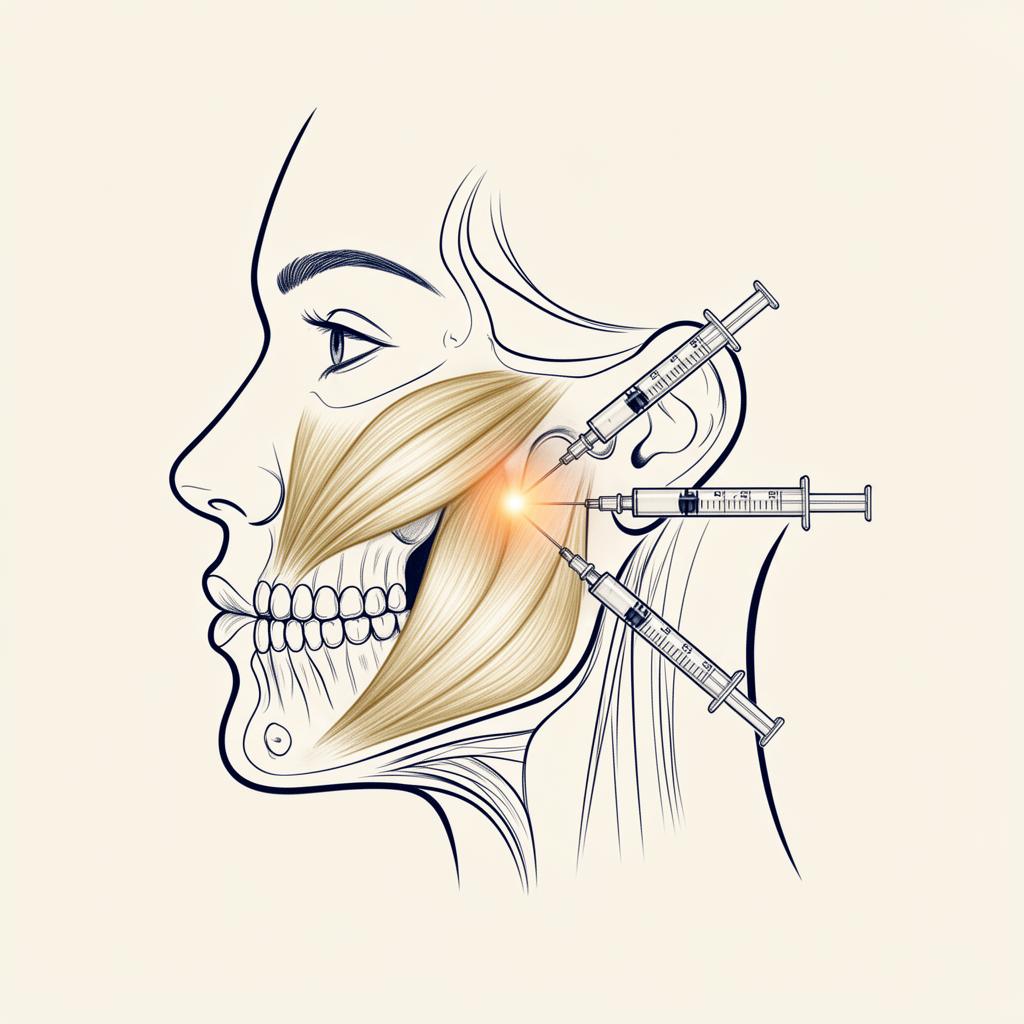
| Masseter | 0.1 mL BoNT-A per trigger point, ultrasound-guided |
Safety, Adverse Effects and Monitoring
Botulinum toxin and corticosteroid each carry recognisable adverse-event profiles, and combining them may concentrate the liabilities rather than the benefits. BoNT-A labelling warns about injection-site reactions, hypersensitivity, infection at the proposed site as a contraindication, and possible spread of toxin effect with weakness, dysphagia, and breathing difficulty.
Clinically the most common region-specific issue is functional weakness: neck fatigue after trapezius or cervical injection, chewing weakness after masseter injection, gait or pelvic instability after deep gluteal or piriformis injection, or aesthetically important hollowing in muscles that contribute to contour.
Corticosteroid risks include post-injection flare, skin hypopigmentation, subcutaneous fat atrophy, infection, tendon injury, and systemic effects (adrenal suppression, hyperglycaemia, osteoporosis). Soft-tissue atrophy and depigmentation occur in less than 1% — but rare does not mean trivial in a visible area such as the masseter.
Consent and Medico-Legal Considerations
Botulinum toxin for trigger point management is generally off-label. The GMC requires that off-label use be explained with reasons given. Consent should cover the structure thought to be the pain generator, alternatives (no injection, local anaesthetic, dry needling, rehabilitation), off-label status, region-specific functional risks, and how success and failure will be judged.
The record should include muscle, side, dose, diluent, toxin brand, lot number, steroid type and dose if used, guidance method, and the patient's acknowledgement of off-label uncertainty.
Research Gaps
There is no direct high-quality trial of same-session or same-syringe combined botulinum toxin plus corticosteroid trigger point injection compared with each agent alone or with local anaesthetic. Future trials need standardised diagnostic criteria, muscle-by-muscle phenotyping, real-world arms (anaesthetic alone, anaesthetic + steroid, BoNT-A alone, pre-specified separate-syringe combination), stratification by muscle depth, and outcomes including pain, function, time to recurrence, weakness, and contour change at ≥6 months.
Key References
- Soares AP, et al. Botulinum toxin for myofascial pain syndromes in adults. Cochrane Database Syst Rev. 2014
- Benzon HT, et al. Use of corticosteroids for adult chronic pain interventions: trigger point injections. RAPM multi-society guideline. 2024.
- Garvey TA, et al. Trigger-point injection therapy for low-back pain. Spine. 1989
- Porta M. BoNT-A vs methylprednisolone for myofascial pain and chronic muscle spasm. Pain. 2000
- Ferrante FM, et al. Evidence against trigger point injection technique with BoNT-A. Anesthesiology. 2005
- Roldan CJ, et al. Saline vs conventional active drug mix for myofascial pain. Am J Emerg Med. 2020
- Kwanchuay P, et al. Single BoNT-A injection for upper trapezius MPS. J Med Assoc Thai. 2015.
- NICE NG193. Chronic pain assessment and management