
OnabotulinumtoxinA for Migraine Prevention: Why Neurology Uses 31–39 Sites and 155–195 Units
An evidence-based review of the PREEMPT protocol, NICE TA260, the dose debate, and what randomised trials tell us about lower-dose or anterior-only botulinum toxin strategies for chronic and episodic migraine.

Postgraduate Level
Equivalence to 1 CPD/CME point — we do not award CPD/CME directly
Read the article, complete a short assessment, and submit your reflection to receive your AiCE Points certificate.
Take Assessment & Get CertificateLearning Objectives
- •Distinguishing chronic migraine (ICHD-3) from episodic migraine for treatment selection
- •Understanding the PREEMPT protocol: 155–195 U across 31–39 sites every 12 weeks
- •Interpreting NICE TA260 and NHS commissioning around the licensed regimen
- •Critically appraising lower-dose and anterior-only alternative strategies and the PRECLUDE trial
- •Designing a research framework to test trigger-point guided protocols against PREEMPT
OnabotulinumtoxinA (Botox) is licensed for chronic migraine — not migraine in general — defined as headache on ≥15 days/month with ≥8 migraine days. The PREEMPT phase 3 programme established a fixed regimen of 155 units across 31 head and neck sites, with an optional follow-the-pain add-on up to 195 units across 39 sites, repeated every 12 weeks. NICE TA260 and NHS protocols are built around this exact paradigm. The European Headache Federation confirms no randomised trials have compared PREEMPT to a reduced or anterior-only alternative, and modern episodic migraine trials (including PRECLUDE) remain negative. The "high dose, many points" practice therefore reflects the only evidence-supported paradigm — not over-treatment — though dose-optimisation trials remain a real research gap.
Clinical Context: Why the "Dose Debate" Is Really a "Population, Protocol and Licensing" Debate
OnabotulinumtoxinA (commercially BOTOX®; hereafter "onabotA") is licensed and guideline-supported for chronic migraine, not "migraine in general". Chronic migraine is defined by the International Headache Society's ICHD-3 as headache on ≥15 days/month for >3 months, with ≥8 days/month having migraine features. In the US product labelling, BOTOX is indicated for "prophylaxis of headaches in adult patients with chronic migraine (≥15 days per month with headache lasting 4 hours a day or longer)".
The same label explicitly highlights a key limitation: "Safety and effectiveness have not been established for the prophylaxis of episodic migraine (14 headache days or fewer per month)", citing seven placebo-controlled studies. This matters because much of the "why not just treat the frown?" debate implicitly compares two different clinical entities — episodic migraine and chronic migraine, which often includes mixed migraine-like and tension-type headache days, medication overuse, and central sensitisation.
In the UK, the NHS "high-dose, multi-site" approach is heavily shaped by how NICE appraised the evidence and how the drug is licensed and commissioned. NICE TA260 describes the recommended dose for chronic migraine as 155–195 units, administered as 0.1 mL (5 units) injections to 31–39 sites around the head and back of the neck, repeated every 12 weeks.
Origins: Cosmetic Observations and Early Low-Dose Trials
The link between botulinum toxin and headache improvement was initially propelled by observations in patients treated for cosmetic and other facial indications, followed by early open-label headache experiences. A 2020 historical review in Toxins (Becker) describes that interest accelerated after case reports/series and that Binder reported benefit for migraine in an open-label study in 2000, leading Allergan to launch a large clinical programme.
Crucially, the earliest randomised controlled migraine trial evidence did not test a PREEMPT-style "full head + neck" protocol. In a small double-blind, vehicle-controlled trial in mostly episodic migraine, 25 U and 75 U were injected into frontalis, temporalis, and glabellar (corrugator/procerus) muscles. The injection pattern was 11 total sites (4 frontalis, 2 temporalis, 5 glabellar), with dose-per-site scaled by group.
Interestingly, the 2020 historical review notes this trial produced a "paradoxical" signal where 25 U showed statistically significant differences vs placebo on some outcomes, while 75 U did not — and it argues that these early signals likely reflected placebo or random error given later negative episodic migraine trials. This early era supports the clinical intuition that "smaller, limited-site" strategies were part of Botox's migraine story. But it also foreshadows the central controversy: early episodic-migraine trials were inconsistent, and the regimen that ultimately won regulatory acceptance was developed later in a different population (chronic migraine) with a different protocol (PREEMPT).
The PREEMPT Protocol: The Standard of Care
The "50-some points / 150-some units" approach is best understood as a family of protocols that evolved toward PREEMPT. In PREEMPT 2 (one of the two pivotal phase 3 chronic migraine trials), injections were delivered as 31 fixed-site, fixed-dose intramuscular injections (minimum 155 U) across seven head/neck muscle areas:
This fixed portion is repeated every 12 weeks. PREEMPT also incorporates a built-in customisation mechanism: based on the location of predominant pain and severity of palpable muscle tenderness, investigators may add a follow-the-pain component — up to 40 additional units (max 195 U total) into up to three muscle groups (occipitalis, temporalis, trapezius).
So the neurologist protocol is already a hybrid: a standardised minimum dosing map plus an option to chase pain or tenderness.
Why NHS UK Clinicians Tend to "Start Full" Rather Than Titrate Up
In UK commissioning terms, NICE TA260 focused on the two pivotal PREEMPT trials and their pooled results. NICE reports that the manufacturer identified seven relevant RCTs but only three were placebo-controlled, and the two large phase 3 trials (PREEMPT 1 and 2) were the centre of the submission. Because these pivotal trials used 31–39 injections per cycle, the NICE-recommended NHS implementation inherits that paradigm.
This is reinforced by UK/NHS local protocols. For example, an NHS Greater Glasgow & Clyde neurology protocol specifies 155–195 units delivered as 0.1 mL (5 U) injections to 31–39 sites, with a muscle-by-muscle site map and 12-week re-treatment. UK neurologists therefore inject "that much" because it is what licensing, NICE economic appraisal and local NHS protocols are built around — and deviation can create reimbursement and medico-legal friction even when a clinician believes a lower-dose plan might work.
The Trial Landscape: Mostly "Full Protocol vs Placebo"
Chronic migraine: PREEMPT is the centre of gravity
In PREEMPT 2, onabotA showed statistical superiority to placebo on the primary endpoint, with headache days reduced by 9.0 vs 6.7 days per 28 days (placebo) at ~24 weeks. PREEMPT therefore established both clinical adoption and the "31–39 sites, 155–195 U, q12 weeks" paradigm. Notably, PREEMPT 1's original primary endpoint (headache episodes) was negative, while secondary endpoints including headache days were positive.
Episodic migraine: low- and high-dose trials, largely negative
The claim that "all RCTs compare placebo to very high dose" is accurate for licensing-grade chronic migraine evidence but not for episodic migraine. A clear example of few-site, low-dose RCT evidence is the early Silberstein trial: 25 U or 75 U into frontalis, temporalis and glabellar across 11 sites.
A clear example of dose-ranging higher-dose research comes from a later European programme summarised by NICE's ERG report: in a multi-arm episodic migraine study, reductions were similar across placebo and toxin arms, "no Botox group was consistently better than placebo".
Most notably, the modern phase 3 PRECLUDE trial compared onabotA 155 U, 195 U and placebo. Although all groups improved, neither dose achieved statistical superiority versus placebo on the primary endpoint (change in monthly migraine days), and 50% responder rates were also non-significant.
Pre-PREEMPT chronic daily headache trials
The "50-some points" behaviour also reflects the older chronic daily headache era. The Mathew et al. RCT used a single toxin arm with 105–260 units, injected into a minimum of six muscle areas with 23 to 58 injection sites, with dosing decided by the physician via a "follow-the-pain" approach. This is the same dose-and-site universe that explains today's high-volume habit.
Fewer Sites, Trigger Points and Minimum Effective Dose: The Real Evidence Gap
The European Headache Federation consensus is unusually direct on this central question: while customisation has been argued to be preferable, they found "no studies comparing the PREEMPT protocol with an alternative protocol." Their clinical guide states PREEMPT should be followed because it is "the only protocol that has proved efficacy", and notes only indirect evidence that higher dosing (195 vs 155) might help some non-responders.
This effectively answers the original question: randomised chronic migraine research is overwhelmingly "PREEMPT-style dosing vs placebo" — not "10 vs 20 vs 30 points" comparisons.
Dose minimisation: suggestive but observational
- A retrospective paired comparison (n=175) reported that increasing onabotA from 150 U to 200 U was associated with fewer headache days and severe headache days; the authors called for randomised confirmation.
- The large real-world REPOSE study supports effectiveness and safety of both 155 U and 195 U, but highlights ongoing uncertainty about whether higher doses translate to better efficacy and which patients benefit most.
Trigger points and posterior injections: mechanism vs evidence
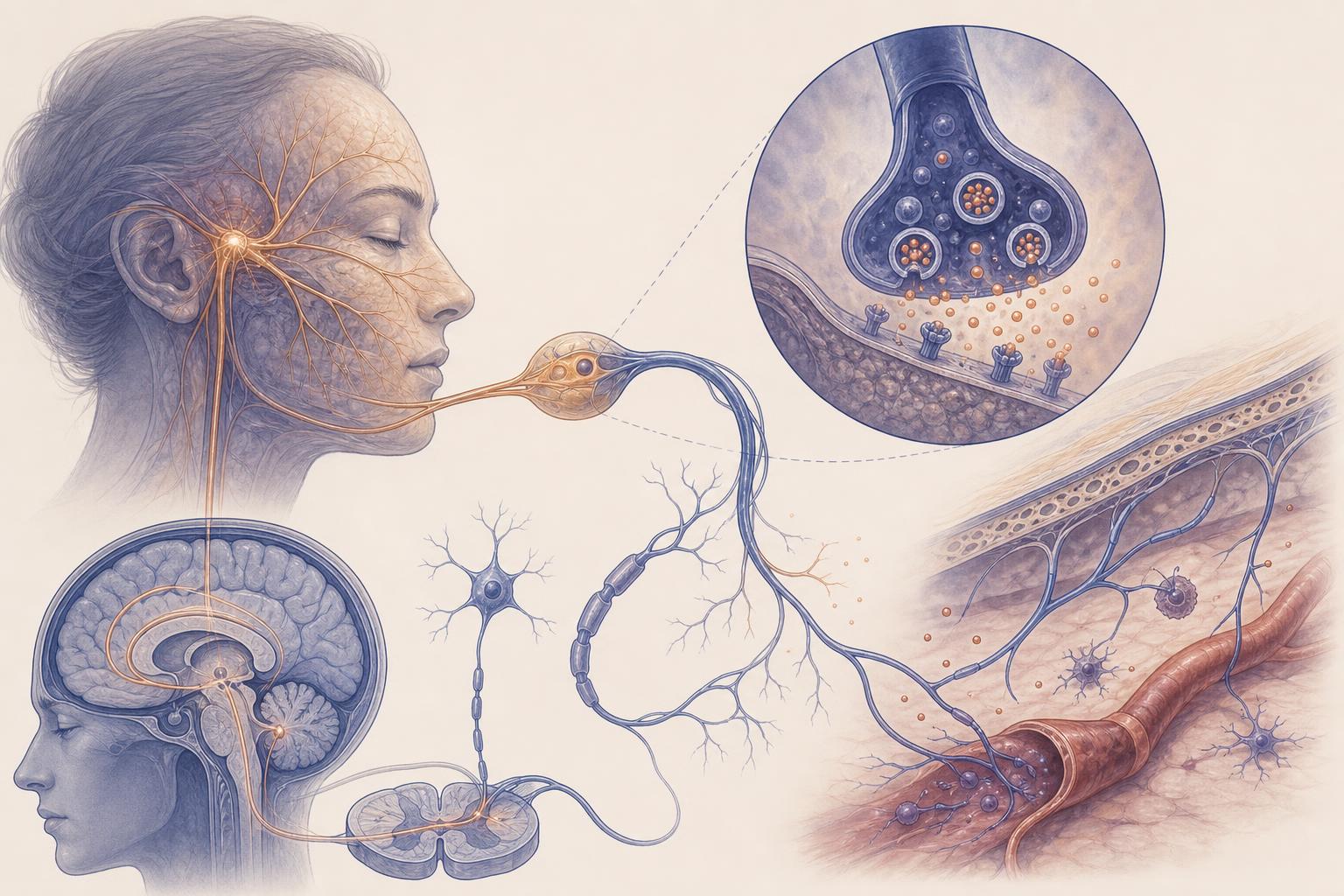
PREEMPT mandates posterior injections (occipitalis, cervical paraspinal, trapezius) as part of fixed baseline dosing. Mechanistically, BoNT-A is now understood to act primarily on trigeminal and cervical nerve endings, reducing CGRP and inflammatory mediator release and raising activation thresholds of trigeminal/cervical fibres. This provides a coherent rationale for posterior scalp/neck injection even when a patient does not report obvious neck trigger points: the target is plausibly nociceptive afferent traffic, not just myofascial tenderness.
Trial Families: What They Do and Do Not Answer
| Trial family | Population | Dosing & sites | Conclusion for "minimum dose" |
|---|---|---|---|
| Silberstein 2000 | Episodic migraine | 25 U or 75 U; frontalis + temporalis + glabella; 11 sites | Low-dose, limited-site tested early; later evidence did not reproduce benefit at scale. |
| Mathew et al. | Chronic daily headache | Follow-the-pain; 105–260 U; 23–58 sites | Explains historic "50+ points" practice; not a modern CM optimisation study. |
| PREEMPT 1 & 2 | Chronic migraine | 31 sites / 155 U fixed + up to 8 sites / 40 U follow-the-pain (max 195 U) | Defines licensing & NHS practice; does not test anterior-only or reduced-site starts. |
| PRECLUDE | Episodic migraine | 155 U vs 195 U vs placebo | Negative for both doses; does not justify extrapolating "frown-only works" to chronic migraine. |
A Defensible Position for Practice
The discrepancy between aesthetic-injector intuition ("start with the frown, add only what's needed") and neurology practice is not primarily over-injection. Neurologists are operationalising the only chronic-migraine protocol with proven efficacy and payer support. Four pillars anchor this:
- Licensing & NICE guidance: 155–195 U across 31–39 sites every 12 weeks.
- Pivotal RCT design: PREEMPT is fixed-site/fixed-dose with structured optional add-ons; posterior head and neck are part of the regimen, not "only if tender".
- Evidence gap: EHF found no studies comparing PREEMPT to alternative protocols.
- Episodic migraine is different: not labelled, and modern phase 3 testing (PRECLUDE) is negative.
A clinic algorithm that minimises sites (corrugator/procerus + frontalis + temporalis first, then add neck/trapezius/masseter only if tender) is a sensible hypothesis — minimising dose burden, ptosis/neck weakness risk, cost and patient aversion — but is not evidence-equivalent to PREEMPT in chronic migraine, because the non-inferiority comparisons have not been done.
A Trial That Could Resolve This
A pragmatic, multi-arm, randomised trial in chronic migraine could compare at least three strategies:
- Standard PREEMPT: 155 U / 31 sites ± protocolised add-on to 195 U.
- Anterior-only starter strategy: e.g., corrugator/procerus/frontalis/temporalis only (~75 U, fewer sites), with step-up rules for non-responders.
- Trigger-point guided strategy: restricted baseline map plus predefined tenderness/pain-distribution criteria for posterior injections — operationalising informal "palpate and treat" practice.
Outcomes should include headache days, migraine days, responder rates, disability/QoL and adverse events. Because placebo responses are large in injection studies, rigorous blinding and expectation management are essential. Embedded 155 vs 195 substudies could link to emerging real-world dose-escalation signals, while acknowledging current dose-escalation evidence is largely observational.
Clinical Evidence Base — Internal Reading
- Botulinum Toxin Type A in Orofacial Pain Management — overlapping trigeminal/cervical territory.
- Bruxism and Masseter Hypertrophy: BoNT-A Review — masseter dosing & technique.
- BoNT-A + Corticosteroid for Trigger Points — myofascial pain decision algorithm.
- Botulinum Toxin Dosing: Comprehensive Review — unit equivalence & dose principles.
External References
Earn 1 AiCE Point – 100% Free
FREE10-question assessment + short clinical reflection — earn your CPD certificate.