Review Article · Aesthetic Intelligence · Vol 1 · Issue 5
Artificial Intelligence in Aesthetic MedicinePowerful Adjunct, Not Substitute
AI now sits in the consultation room as image analyser, risk calculator, simulator and chat agent. The discipline that gets it right will not be the one with the most AI — it will be the one with the most disciplined humans using it.
HSI Team1
- 1 Harley Street Institute, London, United Kingdom
Corresponding author: journal@harleystreetinstitute.com
Journal: Aesthet Intell
DOI: to be assigned
Volume / Issue: 1 / 5
Pages: 1–14
Received: 2025-08-12
Accepted: 2025-09-30
Published: 2026-06-05
Licence: CC BY 4.0
From the Editor's Desk
The machine has opinions now. It looks at a face the way a junior used to — confidently, quickly, and with the faint suggestion that it has read more textbooks than you have. The difference is that the machine is right often enough to be useful, and wrong often enough to be dangerous, and it never tells you which is which.
There is a version of this profession that hands the clipboard to the algorithm and goes for coffee. There is another version — the only honest one — that keeps the clipboard, reads what the algorithm wrote, and signs its own name underneath. This article is for the second version. It assumes you are still the doctor in the room, and that you intend to remain so when the software is in its third major revision and your patients are quoting it back to you.
Abstract
- Background.
- Artificial intelligence (AI) is rapidly entering aesthetic medicine through image analysis, skin assessment, treatment planning, outcome simulation, clinical documentation, patient communication and business operations. The specialty is particularly receptive because aesthetic practice depends on visual assessment, reproducible photography, longitudinal comparison and personalised decision-making — yet the pace of adoption now exceeds the maturity of clinical validation.
- Methods.
- Narrative review of peer-reviewed literature and major governance documents published between 2017 and 2026, with emphasis on AI applications relevant to aesthetic medicine, cosmetic dermatology, facial analysis and clinical decision support. Priority was given to peer-reviewed reviews, clinical AI reporting guidelines (TRIPOD+AI, CONSORT-AI), dermatology AI bias studies and authoritative governance frameworks from the FDA and WHO.
- Results.
- Current applications cluster into six domains: objective skin and facial analysis, photographic standardisation, personalised treatment planning, procedural support, complication prediction and patient-facing education or triage. Evidence is strongest for technical feasibility and image-based classification, but comparatively limited for prospective clinical benefit, patient safety, complication reduction, cost-effectiveness and long-term patient-reported outcomes. Aesthetic AI is further constrained by dataset bias, underrepresentation of darker skin tones, variable image-acquisition protocols, weak external validation, limited explainability and inconsistent regulatory classification.
- Conclusion.
- AI should be regarded as an adjunct to clinical reasoning rather than a substitute for professional judgement. Responsible integration requires transparent disclosure, validated performance across diverse populations, active human oversight, documentation of human–AI interaction, prospective evaluation and continuous post-deployment monitoring. Aesthetic medicine should adopt the highest clinical AI standards — TRIPOD+AI, CONSORT-AI and lifecycle SaMD governance — and prove safety, fairness, explainability and measurable value, not novelty.
Keywords: artificial intelligence, aesthetic medicine, cosmetic dermatology, machine learning, deep learning, skin analysis, facial analysis, patient safety, clinical decision support, algorithmic bias
| Evidence domain | What the article reports | How to interpret it |
|---|---|---|
| Background | Artificial intelligence (AI) is rapidly entering aesthetic medicine through image analysis, skin assessment, treatment planning, outcome simulation, clinical documentation, patient communication and business operations. The specialty is particularly receptive because aesthetic practice depends on visual assessment, reproducible photography, longitudinal comparison and personalised decision-making — yet the pace of adoption now exceeds the maturity of clinical validation. | Defines the problem and the reason for review or investigation. |
| Methods | Narrative review of peer-reviewed literature and major governance documents published between 2017 and 2026, with emphasis on AI applications relevant to aesthetic medicine, cosmetic dermatology, facial analysis and clinical decision support. Priority was given to peer-reviewed reviews, clinical AI reporting guidelines (TRIPOD+AI, CONSORT-AI), dermatology AI bias studies and authoritative governance frameworks from the FDA and WHO. | Shows how the evidence or observations were assembled. |
| Results | Current applications cluster into six domains: objective skin and facial analysis, photographic standardisation, personalised treatment planning, procedural support, complication prediction and patient-facing education or triage. Evidence is strongest for technical feasibility and image-based classification, but comparatively limited for prospective clinical benefit, patient safety, complication reduction, cost-effectiveness and long-term patient-reported outcomes. Aesthetic AI is further constrained by dataset bias, underrepresentation of darker skin tones, variable image-acquisition protocols, weak external validation, limited explainability and inconsistent regulatory classification. | Summarises the principal findings reported by the authors. |
| Conclusion | AI should be regarded as an adjunct to clinical reasoning rather than a substitute for professional judgement. Responsible integration requires transparent disclosure, validated performance across diverse populations, active human oversight, documentation of human–AI interaction, prospective evaluation and continuous post-deployment monitoring. Aesthetic medicine should adopt the highest clinical AI standards — TRIPOD+AI, CONSORT-AI and lifecycle SaMD governance — and prove safety, fairness, explainability and measurable value, not novelty. | States the authors’ clinical interpretation and its limits. |
Postgraduate Level
Complete this article to earn your certificate
Read the article, complete a short assessment, and submit your reflection to receive your AiCE Points certificate. Equivalence to 1 CPD/CME point — we do not award CPD/CME directly.
Learning Objectives
- 1Current AI applications across aesthetic diagnostics and planning
- 2Limitations of current evidence and regulatory considerations
- 3Future direction of AI-assisted aesthetic practice
AI in Practice — Quick Reference
Six Application Domains
- Skin & dermatological analysis
- Most mature — quantifies pigmentation, erythema, pores, texture, wrinkles.
- Facial analysis & proportion
- Useful descriptive aid; not a normative authority on beauty.
- Treatment simulation
- Illustrative, never a guaranteed outcome — record this in consent.
- Injectable & complication prediction
- Emerging; limited by underreported adverse-event datasets.
- Energy-based & procedural support
- Highest safety bar; often SaMD regulated.
- Patient-facing chat & triage
- Highest liability if it answers red-flag questions unscoped.
Three Output Categories (Clinic Policy)
- Informational
- Skin-feature maps. Support discussion.
- Advisory
- Treatment suggestions. Require clinician interpretation.
- Directive
- Device-setting recommendations. Require validation + SaMD compliance.
Reporting Standards to Demand
- Prediction models
- TRIPOD+AI (Collins et al., BMJ 2024).
- Clinical trials of AI
- CONSORT-AI (Liu et al., Nat Med 2020).
- Early clinical evaluation
- DECIDE-AI.
- Post-deployment
- Lifecycle SaMD governance — drift, audit, retraining.
Share this article
Download the card below or share the article directly. Tag @harleystreetinstitute.
Review · Aesthetic Intelligence
AI in aesthetic medicine: adjunct, not authority.
Six clinical domains, three output categories, one accountable clinician. A governance framework for responsible adoption.
- Six application domainsSkin analysis · facial analysis · simulation · injectable prediction · procedural support · patient-facing chat.
- Bias warningOnly 14/70 dermatology AI studies report ethnicity; only 7 report skin tone (Daneshjou, JAMA Derm 2021).
- Skin type VIRepresented by 5 subjects across an entire JAAD scoping review of 136 ML studies (Guo et al., 2022).
- Reporting standardsTRIPOD+AI for prediction · CONSORT-AI for trials · SaMD lifecycle for deployment.
- Clinic ruleClassify every output as Informational, Advisory or Directive. Validate accordingly.
Aesthetic Intelligence
The Harley Street Institute
harleystreetinstitute.com
1. Introduction
Artificial intelligence has moved from speculative technology to practical clinical infrastructure across healthcare. AI systems now recognise patterns in images, support diagnosis, stratify risk, automate administrative work, summarise records and guide decisions. The U.S. Food and Drug Administration defines AI as a machine-based system that, for a given set of human-defined objectives, makes predictions, recommendations or decisions influencing real or virtual environments; machine learning refers to techniques that train algorithms to improve task performance using data. These capabilities are especially relevant to aesthetic medicine because the specialty is visually intensive, procedure-focused and highly dependent on individualised judgement.
Aesthetic medicine occupies a distinctive position within healthcare. It combines anatomical knowledge, procedural safety, dermatological assessment, psychology, ethics and artistic judgement. Unlike many areas of disease-centred medicine, aesthetic practice often begins with subjective concerns: perceived ageing, asymmetry, skin quality, facial proportion, scarring, pigmentation, laxity or dissatisfaction with previous treatment. These concerns are clinically meaningful because appearance affects self-perception, confidence and social functioning — yet their assessment is frequently less standardised than the assessment of inflammatory dermatoses or malignant disease. Wrinkles, pores, pigmentation and laxity lack universally accepted severity scales comparable with the Psoriasis Area and Severity Index or Eczema Area and Severity Index.
AI is attractive here because it promises objectivity where clinical evaluation has depended on experience, visual memory and patient perception. Computer vision can quantify pigmentation, erythema, wrinkle depth, texture, pores and volume change; machine learning can identify patterns across photographs and patient variables; large language models can support patient education, documentation and administrative communication. Yet the same features that make aesthetic medicine receptive to AI also make it vulnerable. Beauty standards differ across cultures, ethnic groups, genders and age cohorts. Training data may encode narrow ideals of attractiveness or underrepresent darker skin tones. Commercial tools may be marketed before adequate external validation. Patients may mistake simulated outcomes for guarantees. Clinicians may over-rely on algorithmic recommendations that appear precise but are not clinically superior.
The central question is therefore not whether AI will enter aesthetic medicine — it already has. The more important question is how clinicians, educators, researchers, device manufacturers and regulators should evaluate and govern AI so that it improves safety, consistency and patient experience without narrowing aesthetic judgement or amplifying inequity. This review examines the current applications of AI in aesthetic medicine, assesses the strength and limitations of the evidence base, and proposes a governance-oriented framework for responsible clinical adoption.
2. Methods
This article is a narrative review rather than a systematic review. A narrative approach was selected because AI in aesthetic medicine spans heterogeneous literatures, including dermatology, cosmetic dermatology, plastic surgery, imaging science, medical device regulation, clinical prediction modelling, research reporting standards, health ethics and digital governance. The objective was to synthesise clinically relevant evidence and provide an implementation-oriented appraisal for aesthetic medicine practitioners.
Literature was identified through targeted searches of PubMed, PubMed Central, BMJ, Nature Medicine, Springer Nature, Wiley, JAMA Dermatology, the Journal of the American Academy of Dermatology and authoritative regulatory or governance websites. Search terms included combinations of 'artificial intelligence,' 'machine learning,' 'deep learning,' 'aesthetic medicine,' 'cosmetic dermatology,' 'aesthetic dermatology,' 'skin analysis,' 'facial analysis,' 'bias,' 'skin tone,' 'TRIPOD+AI,' 'CONSORT-AI,' 'software as a medical device' and 'AI governance.' Priority was given to sources published from 2018 onward, while selected landmark studies and foundational guidance were included for context.
Because this review does not claim to be systematic, it does not present pooled effect estimates or formal risk-of-bias scoring. Instead, it uses the available literature to identify recurring themes, clinical opportunities, limitations and governance requirements.
3. Conceptual Foundations: What AI Means in Aesthetic Medicine
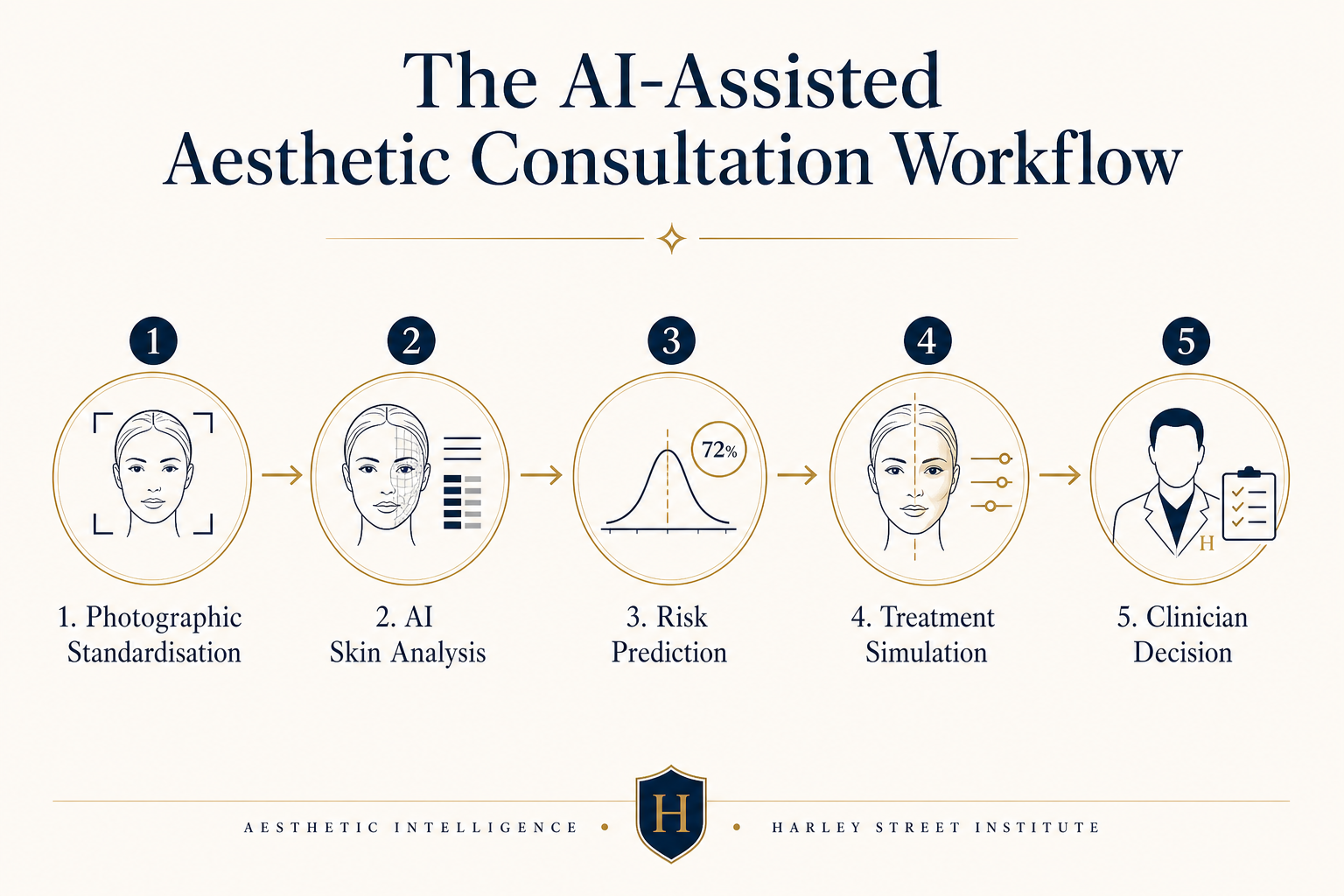
AI is often used imprecisely, and this imprecision can obscure clinical accountability. In practical terms, most aesthetic AI tools rely on one or more of four technical approaches: computer vision, machine learning, deep learning and natural language processing. Computer vision analyses photographs, videos or three-dimensional scans. Machine learning identifies statistical patterns in data and produces classifications, predictions or recommendations. Deep learning, especially convolutional neural networks, is particularly suited to image-rich tasks such as lesion classification, wrinkle analysis or segmentation of facial regions. Natural language processing and large language models process text and can support documentation, patient education, consent preparation and triage communication.
Definition. In clinical aesthetic practice, AI should be understood as a set of computational methods that can analyse visual, textual or structured clinical data to generate measurements, predictions, recommendations or communications that may support — but must not replace — clinician judgement.
Aesthetic AI differs from many diagnostic AI systems because it must integrate objective anatomical or dermatological data with subjective patient goals. An algorithm may quantify facial asymmetry, but it cannot independently decide whether correction is desirable. It may simulate filler augmentation, but it cannot determine whether the patient has realistic expectations. It may identify skin redness, but it cannot fully interpret rosacea triggers, medication history, barrier dysfunction, cultural preferences or psychosocial context. This makes human–AI collaboration the central operating model.
4. Current Clinical Applications
4.1 Objective skin analysis and dermatological assessment. The most mature aesthetic use of AI is image-based skin analysis. Commercial and research systems can quantify pigmentation, erythema, pores, texture, wrinkles, oiliness, vascularity and acne-related features, typically combining standardised photography, multispectral imaging, three-dimensional imaging or smartphone-based image acquisition with algorithms trained to detect surface features. Aesthetic dermatology has historically relied on patient questionnaires, clinician grading scales and device-based point measurements; each has limitations. AI-assisted imaging offers repeatable, whole-face assessment and longitudinal comparison — but objective measurement should not be confused with clinical meaning. A system may detect a small change in pigmentation or wrinkle depth, but the relevant endpoint is patient satisfaction, fewer complications or avoidance of overtreatment. The evidence base still contains more studies of technical performance than studies demonstrating improved patient-centred outcomes.
4.2 Facial analysis, symmetry and proportional planning. AI-enabled facial analysis can measure distances, ratios, symmetry, volume distribution, contours and age-associated changes; three-dimensional platforms can compare baseline and post-treatment morphology after filler, biostimulators, body contouring or skin tightening. The clinical benefit lies in structured communication and avoidance of overcorrection. The limitation is that facial proportion is not reducible to a universal mathematical template. Golden-ratio language and algorithmic symmetry scores may appear scientific, but aesthetic harmony is culturally, individually and contextually mediated. Over-standardisation risks producing homogenised results when tools are trained on narrow datasets or commercial beauty filters. AI measurement is a descriptive aid, not a normative authority.
4.3 Treatment planning and outcome simulation. Outcome simulation is among the most visible applications of AI in aesthetic practice. Virtual before-and-after tools can model potential changes following dermal fillers, rhinoplasty, jawline contouring, resurfacing, hair restoration, body contouring or skin rejuvenation. The ethical issue is expectation management. A simulated image is persuasive precisely because it looks personal and specific. Unless clearly labelled as illustrative, it may be interpreted as a promise. Consent documentation should record that AI-generated images are approximations influenced by image quality, model assumptions, anatomy, healing, product behaviour, procedural technique and biological variability.
4.4 Injectable planning and complication avoidance. AI may support injectable planning by mapping anatomy, estimating volume requirements, identifying asymmetry and tracking previous treatment. Research and commercial interest also extends to predicting vascular occlusion, nodules, bruising, asymmetry, overcorrection or dissatisfaction. At present this remains an emerging area rather than an established clinical standard. High-quality complication prediction requires reliable adverse-event datasets, consistent definitions, accurate denominators and external validation across settings. Many aesthetic complications are underreported, documented inconsistently or managed outside formal registries. Without better data infrastructure, predictive models may appear sophisticated while resting on incomplete or biased inputs.
4.5 Energy-based devices, laser treatments and procedural assistance. AI may assist energy-based procedures by analysing skin type, pigmentation, lesion characteristics, hair density, vascularity or treatment response. In laser and light-based treatment, the potential value lies in better parameter selection, safer treatment of diverse skin types and improved monitoring across sessions. Robotic assistance has also been explored in hair transplantation. The safety threshold for procedural AI is higher than for educational AI because the output may directly influence treatment intensity, device settings or anatomical targeting. Tools that recommend energy settings should be treated as clinical decision-support systems and, depending on jurisdiction, may fall under medical device regulation. Clinicians should not assume that a vendor's 'AI-powered' label implies regulatory clearance, prospective validation or superiority to established protocols.
4.6 Patient-facing communication, education and triage. Large language models and chatbots can answer frequently asked questions, explain aftercare, collect histories, remind patients of post-procedure precautions and streamline administrative communication. These functions may reduce staff burden and improve consistency. The risk is that patient-facing systems may generate inaccurate, incomplete or overly reassuring advice — particularly for red-flag symptoms after procedures, including visual disturbance, escalating pain, skin blanching, livedo, necrosis, infection, allergic reaction or neurological symptoms. Chatbots should be constrained by approved clinical content, direct patients to urgent human review when red flags are reported, and be audited regularly. Patients should be told when they are interacting with an AI system rather than a clinician.
5. Evidence Base and Limitations
The current evidence base supports a cautious conclusion: AI in aesthetic medicine is promising, but most tools remain better supported by feasibility data than by robust clinical outcome evidence. Reviews consistently identify potential benefits in precision, personalisation, efficiency and patient experience, while also noting limited prospective validation, inconsistent standards, bias risk and uncertain real-world impact.
The contrast with skin cancer AI is instructive. Dermatology has landmark evidence showing that deep learning can achieve dermatologist-level performance in image classification under selected conditions (Esteva et al., 2017). Yet even in skin cancer — a domain with clearer labels and higher-stakes outcomes — concerns remain about dataset transparency, patient diversity, external validation and clinical deployment. These concerns are amplified in aesthetic medicine, where labels such as 'good skin quality,' 'facial harmony,' 'improvement' and 'natural result' are more subjective.
A further limitation is publication bias. Commercial AI tools may be used widely without peer-reviewed evidence, while positive performance claims may appear in promotional material rather than independent studies. Conversely, clinically useful systems may not be published if developed internally or protected by proprietary interests. For a peer-reviewed field to mature, aesthetic medicine needs transparent reporting of datasets, validation cohorts, failure cases and post-market performance.
6. Bias, Diversity and Fairness
Bias is one of the most important challenges for AI in aesthetic medicine. A JAMA Dermatology scoping review of 70 studies using dermatology images for AI found that only 14 studies reported patient ethnicity or race in at least one dataset, and only 7 reported skin tone information (Daneshjou et al., 2021). Only 24.2% of the images used across included studies were publicly available, limiting independent appraisal and reproducibility.
Underrepresentation is especially concerning for darker skin tones. A JAAD scoping review of 136 machine-learning studies for skin cancer detection found that skin type was disclosed in only 6 studies, and among those, skin type VI was represented by only five subjects (Guo et al., 2022). Race or ethnicity was disclosed in only 12 studies. Algorithmic performance cannot be assumed to generalise across patients when the underlying data are narrow or poorly documented.
The implications for aesthetic medicine are substantial. Pigmentary disorders, post-inflammatory hyperpigmentation, keloid risk, laser safety, erythema detection, vascular assessment and perception of ageing vary across skin types. A tool that performs well on lighter skin may under-detect erythema in darker skin, misclassify pigmentation, provide unsafe energy-based recommendations or normalise aesthetic ideals derived from unrepresentative populations. Dataset transparency initiatives, including dataset 'nutrition labels,' have been proposed to make composition, intended use, limitations and risks more visible to researchers and clinicians (Li et al., 2025).
Clinical principle. An aesthetic AI system should not be used as a general-purpose tool unless its performance has been evaluated across the populations in whom it will be deployed, including clinically relevant variation in skin tone, age, sex, ethnicity, lighting conditions, camera systems and treatment indications. Fairness is not achieved simply by removing race or skin tone variables from a model — images contain visual proxies, and performance may still differ across groups. Responsible developers should evaluate subgroup performance explicitly, report limitations honestly and avoid deployment claims that exceed the validation population. Clinicians should ask vendors for subgroup performance data before integrating AI into consultations or treatment planning.
7. Ethical, Legal and Regulatory Considerations
7.1 Transparency and disclosure. Patients should be told when AI contributes materially to assessment, simulation, treatment recommendation, triage or communication. Disclosure does not need to be alarmist, but it should be clear. Where AI-generated images are shown, patients should be informed that they are illustrative simulations rather than guaranteed outcomes. Transparency also applies to clinicians: vendors should disclose intended use, training-data characteristics, validation methods, known limitations, contraindicated uses, update schedules and whether the tool is regulated as a medical device. If such information is unavailable, the tool should be treated as unvalidated.
7.2 Consent and expectation management. AI can strengthen consent by improving visual explanation, but it can also weaken consent if patients are seduced by unrealistic simulations or simplified recommendations. Consent in AI-assisted aesthetic medicine should include the role of the tool, the limits of prediction, the possibility of error, the continued need for clinical judgement and the patient's right to decline AI-supported assessment where feasible.
7.3 Data protection and image governance. Aesthetic practice generates sensitive data, including facial photographs, body images, treatment histories and psychosocial concerns. Facial images can be identifying even when names are removed. Clinics must ensure that image storage, vendor access, cloud processing, model-training permissions and cross-border data transfers comply with applicable data protection law. Patients should not be enrolled into secondary AI training datasets without appropriate disclosure and consent.
7.4 Regulation and software as a medical device. Some AI tools may qualify as software as a medical device (SaMD), particularly when they influence diagnosis, treatment selection, procedural settings or risk stratification. The FDA has emphasised that AI/ML-enabled medical software requires lifecycle management because performance may change over time and adaptive systems challenge traditional regulatory paradigms. Regulatory status varies by jurisdiction and intended use: a patient education chatbot is regulated differently from a system recommending laser settings or triaging suspicious lesions. Clinics should document regulatory status, intended use and local compliance before clinical deployment.
7.5 Human accountability. AI does not remove professional responsibility. If a clinician relies on an AI output to recommend treatment, dismiss risk or alter procedural technique, the clinician remains responsible for determining whether that reliance is reasonable. Human oversight must be active rather than ceremonial. Clinicians should understand what the tool does, what data it requires, when it fails and when to disregard its output.
8. Reporting and Evaluation Standards for Aesthetic AI Research
Aesthetic medicine should not develop isolated standards when robust clinical AI reporting frameworks already exist. Prediction models should be reported according to TRIPOD+AI, which provides updated guidance for transparent reporting of clinical prediction models using regression or machine-learning methods (Collins et al., 2024). Clinical trials of AI interventions should follow CONSORT-AI, which adds AI-specific reporting items, including descriptions of the intervention, input and output handling, human–AI interaction, operational setting and error analysis (Liu et al., 2020).
These frameworks are directly relevant to aesthetic medicine. A study evaluating an AI model for predicting filler complications should report dataset sources, patient characteristics, outcome definitions, missing data, model specification, validation approach, calibration, subgroup performance and clinical usefulness. A trial evaluating an AI skin-analysis platform should describe how images were acquired, how outputs were presented to clinicians and patients, how clinicians used or overrode the outputs, and what errors occurred.
The aesthetic field should also adopt minimum dataset reporting standards. At a minimum, studies should report age, sex, relevant ethnicity or race categories where ethically and legally appropriate, skin tone or phototype, imaging device, lighting protocol, anatomical site, treatment indication, label source, number of annotators, inter-rater agreement, exclusion criteria and intended use. Without these details, readers cannot judge whether the model is safe or generalisable.
9. Implementation Framework for Clinics
AI implementation should be treated as a clinical governance project rather than a technology purchase. A clinic adopting AI should define the problem it is trying to solve, evaluate whether AI is necessary, assess evidence and regulatory status, train staff, inform patients, monitor performance and review incidents. The process should be documented within the clinic's quality-management system.
A useful clinic-level policy is to classify AI outputs into three categories: informational, advisory and directive. Informational outputs, such as skin-feature maps, support discussion. Advisory outputs, such as treatment suggestions, require clinician interpretation. Directive outputs, such as device-setting recommendations, require the highest level of validation, regulatory scrutiny and documentation. Most aesthetic AI should remain informational or advisory unless robust evidence supports a more direct role.
10. Education and Workforce Implications
AI literacy should become part of aesthetic medicine education. Clinicians do not need to become data scientists, but they should understand enough to evaluate claims, detect overfitting, question biased datasets, interpret validation metrics and explain AI to patients. Educational programmes should cover the difference between internal and external validation, the meaning of sensitivity and specificity, calibration, dataset shift, subgroup analysis, explainability, automation bias, data protection and regulatory status.
AI may also reshape training. Standardised image analysis can help trainees compare their assessments with objective measurements and expert annotations. Simulated cases may support consultation training and complication recognition. However, education should reinforce that AI is an adjunct to anatomy, ethics, communication and procedural skill. Aesthetic judgement cannot be outsourced to software.
11. Future Directions
The next phase of AI in aesthetic medicine should be defined by validation rather than novelty. First, the field needs prospective studies that evaluate patient-centred outcomes — satisfaction, decisional confidence, anxiety, trust, complication rates, retreatment rates, naturalness of result, quality of documentation and clinician efficiency. Technical accuracy alone is not enough.
Second, datasets must become more diverse and transparent. Skin tone, age, ethnicity, sex, anatomical site, imaging device and treatment context should be reported. Dataset nutrition labels or similar transparency frameworks may help clinicians and researchers understand whether data are appropriate for a given use.
Third, multimodal models should be developed cautiously. The future may combine images, three-dimensional scans, treatment records, patient-reported outcomes, genomics, medication history, lifestyle factors and longitudinal follow-up. Such integration could improve personalisation, but it also increases privacy risk, complexity and the possibility of hidden bias.
Fourth, generative AI will require strict safeguards. Systems that generate images, treatment plans or patient-facing explanations should be constrained by clinical standards, labelled clearly and audited for hallucination, unrealistic representations and inappropriate aesthetic norms.
Finally, professional bodies and academic institutions should develop aesthetic-specific AI guidance addressing consent, photography, skin-tone equity, simulation ethics, complication triage, device recommendations, vendor accountability and post-deployment monitoring.
12. Conclusion
AI is becoming part of aesthetic medicine because the specialty is visual, data-rich and increasingly digital. Used responsibly, AI can improve measurement, documentation, patient education, longitudinal monitoring and shared decision-making. It may also support safer and more personalised treatment planning as datasets and validation methods improve. However, the current evidence base does not justify replacing clinical judgement with algorithmic authority.
The most defensible position is neither rejection nor uncritical adoption. AI should be welcomed as a powerful adjunct while being held to the standards expected of any clinical technology: transparency, validation, fairness, safety, accountability and measurable benefit. For aesthetic medicine, the defining challenge is to ensure that AI enhances the clinician's capacity for careful, humane and individualised care rather than reducing beauty, identity and wellbeing to a score.
AI Disclosure
Large language model assistance was used in literature triage, structural organisation and manuscript drafting. The named human author or editorial team retains full responsibility for factual accuracy, clinical interpretation, integrity and editorial content.
Competing Interests
The author(s) declare no competing financial or non-financial interests relevant to this work.
Funding
This work received no specific grant from any funding agency in the public, commercial, or not-for-profit sectors.
Ethics & Consent
Where applicable, ethical approval and informed patient consent were obtained in accordance with the Declaration of Helsinki. Reviews and commentaries did not require ethical approval.
HSI Editorial · Reflection & Forward Recommendations
Where we stand on this
Reflection
Reviewing the AI tools now sold into aesthetic clinics, our editorial impression is consistent: the technology is improving faster than the discipline's ability to evaluate it. Most practitioners we speak to cannot describe the training set of the skin-analysis platform installed at their reception desk, and most patients do not know that the chat agent answering their pre-treatment questions is not a clinician. That asymmetry — confident deployment without literacy on either side of the conversation — is the true clinical risk of AI in aesthetics, not the algorithms themselves.
Two findings from the wider dermatology literature should reframe how the aesthetic field buys software. Skin tone is reported in only a small minority of dermatology AI studies, and skin type VI is functionally invisible in most validation cohorts. Any tool deployed to a UK or international aesthetic clinic that has not demonstrated subgroup performance across Fitzpatrick I–VI is, by definition, a generalisation beyond its evidence base. The corrective is unglamorous: procurement discipline, training, documentation, and a culture in which a clinician who overrides the algorithm is treated as having done their job — not as having created a problem.
Forward Recommendations
- Adopt a written AI procurement checklist — intended use, training-data demographics, subgroup performance across Fitzpatrick I–VI, failure mode, SaMD status, accountability — and apply it before any tool enters a clinical workflow.
- Classify every AI output as Informational, Advisory or Directive. Restrict Directive tools to those with prospective validation and appropriate regulatory clearance for their intended use.
- Treat patient-facing AI agents as delegated clinical surfaces. Scope them to triage, scheduling and education; escalate every clinical question to a human; disclose AI involvement to the patient in plain language.
- Demand TRIPOD+AI and CONSORT-AI compliance from vendors of prediction or trial-evidenced tools. Treat the absence of these reporting standards as a marker of immaturity, not innovation.
- Embed AI literacy in postgraduate aesthetic training — validation, calibration, dataset shift, automation bias, explainability and SaMD status. Competence is the ability to interrogate any AI tool, not familiarity with a specific product.
- Document AI-assisted decisions in the medical record, including any clinician override. Future regulatory frameworks will expect this trail to exist; building the habit now is cheaper than retrofitting it later.
Editorial position of the Harley Street Institute. Authored by the HSI Clinical Review Board; not a substitute for the peer-reviewed evidence summarised above.
References
- U.S. Food and Drug Administration. Artificial Intelligence in Software as a Medical Device. Updated 25 March 2025.
- Thunga S, Khan M, Cho SI, Na JI, Yoo J. AI in Aesthetic/Cosmetic Dermatology: Current and Future. J Cosmet Dermatol. 2024;24(1):e16640.
- Chen X, Zhou Z, Ding H, Zheng H, Ge Y, et al. Transforming Aesthetic Dermatology: The Role of Artificial Intelligence in Skin Health. Dermatol Ther. 2025;15:1999–2013.
- Al-Dhubaibi MS, Mohammed GF, Atef LM, Bahaj SS, Al-Dhubaibi AM, Bukhari AM. Artificial Intelligence in Aesthetic Medicine: Applications, Challenges, and Future Directions. J Cosmet Dermatol. 2025;24(6):e70241.
- Liu X, Cruz Rivera S, Moher D, Calvert MJ, Denniston AK; SPIRIT-AI and CONSORT-AI Working Group. Reporting guidelines for clinical trial reports for interventions involving artificial intelligence: the CONSORT-AI extension. Nat Med. 2020;26:1364–1374.
- Kania B, Montecinos K, Goldberg DJ. Artificial intelligence in cosmetic dermatology. J Cosmet Dermatol. 2024;23(10):3305–3311.
- Esteva A, Kuprel B, Novoa RA, Ko J, Swetter SM, Blau HM, Thrun S. Dermatologist-level classification of skin cancer with deep neural networks. Nature. 2017;542:115–118.
- Daneshjou R, Smith MP, Sun MD, Rotemberg V, Zou J. Lack of Transparency and Potential Bias in Artificial Intelligence Data Sets and Algorithms: A Scoping Review. JAMA Dermatol. 2021;157(11):1362–1369.
- Guo LN, Lee MS, Kassamali B, Mita C, et al. Bias in, bias out: Underreporting and underrepresentation of diverse skin types in machine learning research for skin cancer detection — a scoping review. J Am Acad Dermatol. 2022;87(1):157–159.
- Li Y, Taylor M, Chmielinski KS, Halpern AC, Daneshjou R, Lester JC, Rotemberg V. Improving dataset transparency in dermatologic Artificial Intelligence using a dataset nutrition label. NPJ Digit Med. 2025;8:641.
- Collins GS, Moons KGM, Dhiman P, Riley RD, Beam AL, Van Calster B, et al. TRIPOD+AI statement: updated guidance for reporting clinical prediction models that use regression or machine learning methods. BMJ. 2024;385:e078378.
- World Health Organization. Ethics and governance of artificial intelligence for health: WHO guidance. Geneva: WHO; 2021. ISBN 9789240029200.
Declarations
- Peer review:
- This article underwent single-blind external peer review by at least two independent reviewers, followed by editorial acceptance.
- Conflicts of interest:
- The author(s) declare no competing financial or commercial interests relating to the content of this article. Editorial decisions are made independently of the Harley Street Institute's commercial training activities.
- Funding:
- No external funding was received for the preparation of this article.
- Licence:
- © 2026 Harley Street Institute. Open access article distributed under the Creative Commons Attribution 4.0 International Licence (CC BY 4.0), permitting unrestricted use with appropriate citation.
Post-publication review
Discuss this article with the journal AI
Ask a clinical question about this article, or flag a possible error. Our AI agent will reply in real time, log your input, and — if you have identified a credible mistake — escalate it to the HSI editorial team for review and a published correction notice.
AI responses are generated by an assistant model. They do not constitute medical advice. Editorial corrections are only applied after a named HSI editor reviews and signs off.
Hi. I'm the Aesthetic Intelligence reader AI for this article.
Try: "Explain section 3 in plain English." · "What's the evidence for the 1-in-6,410 figure?" · "How does this compare to UK NICE guidance?"