
Summary — The 5Rs and the Safe Practitioner
Pulling it all together
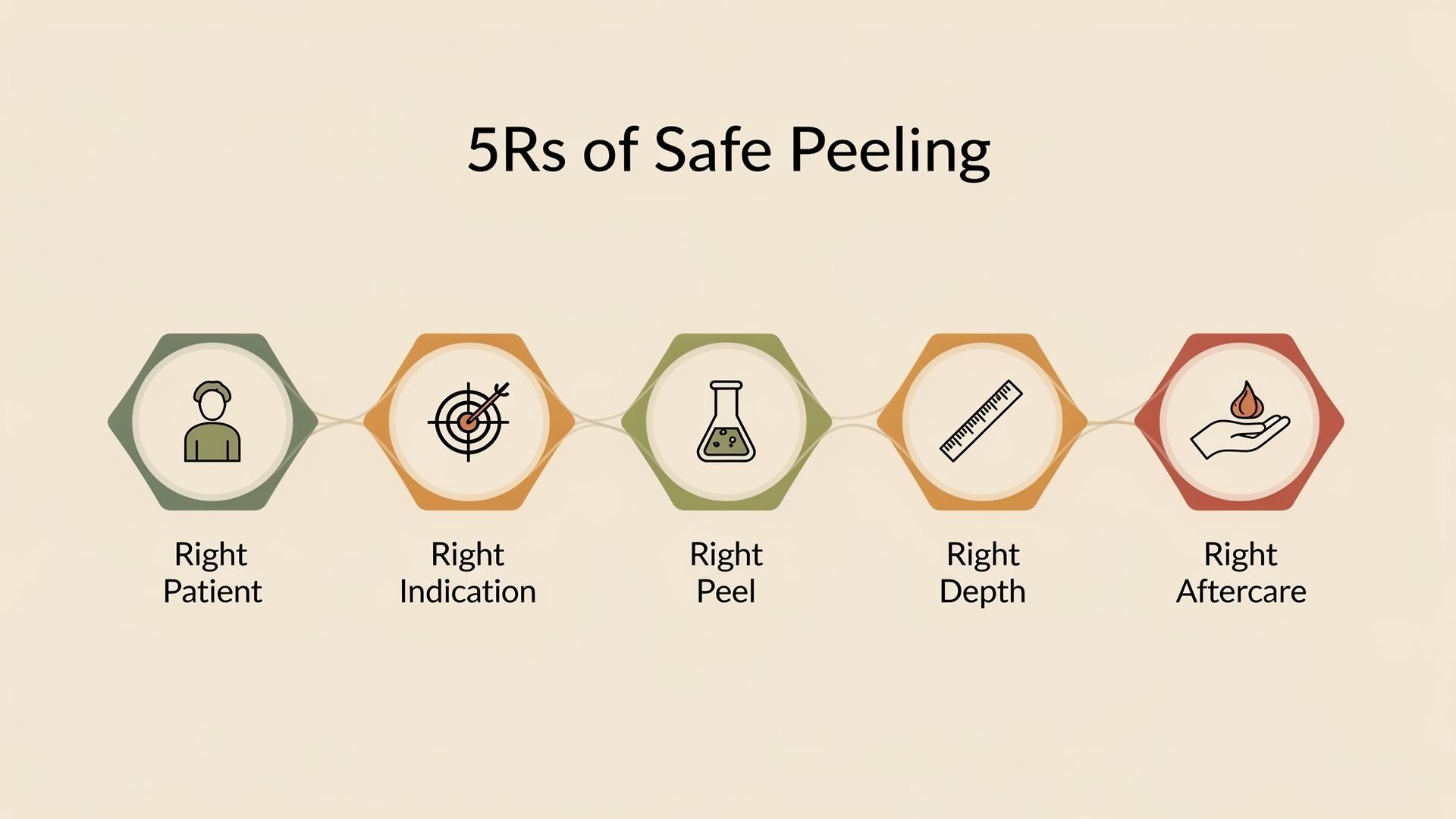
The 5Rs of safe peeling
- Right patient — screened, prepared, expectations aligned, contraindications cleared
- Right indication — diagnosed concern, peel-responsive, no better alternative being missed
- Right peel — agent matched to biology, not patient request
- Right depth — conservative-first, never escalating mid-procedure, biased downward in high-risk skin
- Right aftercare — specific, written, supported by review
Most complications fail at one of those points long before the acid touches skin. Audit your own complications when they occur and you will almost always find one of the five quietly missing.
Take-home messages
- Peels are controlled injuries, not beauty facials
- Depth determines both result and risk
- PIH prevention starts before the first session, not after the first complication
- Skin of colour is a planning constraint, not a permission to escalate
- Melasma is exquisitely sensitive to inflammation and heat
- The periocular area magnifies everything — reward and harm
- Active infection or active HSV is a hard stop, every time
- Written aftercare is part of the procedure
- Complications that are recognised early are complications that are managed well
- The safest practitioners are those who know when not to treat
The mindset
Aesthetic medicine, done well, is a careful, evidence-led, conservative discipline that happens to deliver visible results. It is not a service industry that happens to use scalpels and acids. The clinicians whose patients trust them for a decade are not the ones with the longest treatment menu. They are the ones who said no when no was the right answer, who chose conservatively when conservatively was the right choice, and who reviewed the patient at day five rather than waiting for the call at day ten.
You can deliver excellent peels for a long career without a single avoidable complication. The peels themselves are not the difficult part. The discipline around them is.
Clinical Takeaway
Peels are simple in execution and complex in judgement. Master the judgement and the execution looks after itself.
Frequently Asked Questions
What is the single most important factor in safe peeling?
Patient selection. Almost every avoidable complication begins with treating a patient who should not have been peeled that day, with that agent, at that depth.
How does the 5Rs framework help in practice?
It gives you a five-point checklist to run before every peel and a structure for auditing any complication afterwards. Most failures map cleanly onto one of the five Rs.
Key Points
- The 5Rs frame catches almost every avoidable peel complication before it begins
- Depth determines both result and risk in roughly equal measure
- Skin of colour requires planning, not permission to push harder
- The safest practitioners are the ones who say no well
- Aesthetic medicine is a discipline of restraint as much as technique
Clinical Tip
Audit your own peel complications quarterly against the 5Rs. The point is not blame; the point is to discover, almost always, that one of the five was quietly skipped. Patch the workflow, not the practitioner.
Continue Your Clinical Dermatology Training
This page is part of the CAD – Certificate in Aesthetic Dermatology by Harley Street Institute. Unlock the full structured programme to build clinical confidence in dermatological assessment.