
1. The clinical problem: a dynamic response across the whole face
The phenotype considered is recurrent, socially provoked redness extending across the forehead, bilateral cheeks and lower face, with minimal inter-episode erythema. This operational definition distinguishes diffuse emotional blushing from fixed telangiectasia, persistent rosacea redness and predominantly burning-associated flushing. It is not a validated diagnostic category. Patient-perceived blushing, fear and measured vascular responses can diverge; therefore, distress alone cannot quantify hyperaemia. [1]
The clinical motivation is extensive blushing persisting after reported cognitive behavioural therapy (CBT) and beta-blocker trials. Adequacy, tolerability and actual effects of those treatments require documentation. Reduced anxiety with continuing redness is not the same outcome as unchanged anxiety and unchanged redness. Assessment should also establish whether emotional episodes coexist with rosacea, medication-related flushing or symptoms suggesting another cause; an emotionally triggered history does not automatically exclude mixed pathology. [2-3]
For this phenotype, a treatment must cover multiple vascular regions without sacrificing socially important expression. A modest improvement in cheek colour is insufficient if accompanied by an altered smile. This article presents a therapeutic hypothesis, not a treated case or an original patient dataset.
A useful baseline assessment would map the onset, peak, duration and distribution of episodes, alongside triggers, perceived heat, sweating and associated discomfort. Patient-recorded episodes and supervised provocation could complement examination between attacks. This proposed phenotyping is especially important when redness is described as "full-face": reproducible forehead-to-jawline involvement should be distinguished from isolated cheeks, patchy neck flushing or a subjective sensation of whole-face heat.
2. Evidence review approach
Targeted searches of PubMed-indexed records, PubMed Central and journal websites through 5 November 2026 combined emotional blushing, flushing, botulinum toxin, microneedling and alternative-treatment terms, with reference checking. Published clinical studies and relevant mechanistic experiments were prioritised. Evidence was separated by phenotype, delivery route and outcome. This critical narrative review is informed by SANRA; retrieval was not exhaustive, full-text access was incomplete, and independent duplicate screening and formal risk-of-bias assessment were not performed. No pooled estimate was calculated. [4]
3. Alternative treatments: what they actually address
The evidence does not support a universal sequence in which every patient moves from CBT to medication, laser, toxin and surgery. A more defensible clinical framework separates three residual problems: disabling fear, a reproducible vascular response, and persistent background skin disease. Their relative contributions determine whether additional psychological treatment, treatment of a coexisting dermatosis or investigation of a peripheral intervention is most coherent.
3.1 Psychological treatment and serotonergic medication
Blushing-focused psychological treatment addresses self-focused attention, catastrophic interpretation, avoidance and the fear-blush-fear cycle. In a randomised study of 82 patients with social anxiety disorder and fear of blushing, cognitive therapy and task-concentration training outperformed waiting-list control. Six-month completer diagnostic remission was 69-73%. These figures describe remission of the psychological disorder, not abolition of objectively measured facial vasodilation. [5]
Consequently, prior generic CBT should not automatically be equated with adequately delivered blushing-focused therapy. Conversely, persistent physiological blushing should not be dismissed as psychological treatment failure when distress or avoidance has improved. The clinical objective may reasonably shift from changing appraisal to reducing the visible vascular response, while preserving psychological gains.
Serotonergic medication is relevant when social anxiety remains clinically significant. Pooled placebo-controlled sertraline data, involving 346 treated and 273 placebo recipients, showed improvement in rated blushing alongside other social-anxiety symptoms. However, this was a symptom-scale analysis, not a trial of instrumentally verified diffuse blushing in otherwise non-anxious patients. It supports treating an associated disorder, not prescribing antidepressants indiscriminately for isolated facial redness. [6]
3.2 Adrenergic approaches
Evidence for propranolol is weaker than familiarity with its use might suggest. A retrospective series reported subjective improvement in eight of nine patients with idiopathic or rosacea-associated flushing, without a control group or a homogeneous emotional-blushing population. Such findings cannot predict response in every patient, and intolerance and non-response should be distinguished. [2]
For systemic interventions, cardiovascular and psychiatric context, tolerability and reasons for discontinuation matter alongside average study response. A trial abandoned because of adverse effects should not be interpreted as evidence that sympathetic modulation is mechanistically ineffective. This distinction is particularly relevant before proposing an invasive alternative.
Clonidine is sometimes discussed as an alternative sympathetic intervention, but an experimental rosacea study found that it did not suppress provoked flushing despite reducing baseline malar temperature. Neither drug has established reliable control of diffuse emotional blushing. Failure of beta-blockade also does not identify a residual pathway that must respond to BoNT-A. [1,7]
3.3 Topical vasoconstrictors
Brimonidine and oxymetazoline have randomised trial evidence for persistent facial erythema associated with rosacea. Their direct vascular action makes them conceptually relevant to visible redness, but those trials did not establish suppression of emotion-provoked whole-face blushing in patients with normal resting colour. [8-9]
The distinction affects both benefit and acceptability: temporary reduction in resting erythema does not establish protection during a stressful conversation. Brimonidine-associated rebound erythema and burning have also been reported. In someone distressed by unpredictable redness, treatment-related fluctuations could undermine benefit. These agents therefore require phenotype-specific evaluation rather than automatic extrapolation from rosacea trials. [10]
3.4 Vascular laser and light treatment
Absence of persistent erythema does not prove that vascular treatment cannot help. A retrospective series of ten adults with idiopathic flushing and dysaesthesia reported reduced flushing frequency and discomfort after 585-nm pulsed-dye laser, with a mean of seven treatments. However, this uncontrolled population was not defined by isolated emotional blushing, and improvement was not established through standardised emotional challenges. [3]
Laser may modify the vascular component without removing its central trigger. That is a reasonable therapeutic rationale, but not evidence that diffuse emotional blushing will respond predictably. Before recommending repeated treatment, clinicians should establish the dominant symptom, baseline vascular findings and the patient’s acceptable treatment burden. Rosacea or visible telangiectasia may provide an additional target; their absence leaves greater uncertainty about the benefit-harm balance. Thus, laser is neither an established answer nor an option that can be rejected solely because the face appears normal between episodes. [3]
3.5 Sympathetic surgery
Thoracic sympathetic surgery has more directly relevant evidence for severe isolated facial blushing, but substantial trade-offs. In a 100-patient randomised comparison of surgical interruption levels, 85% reported excellent or satisfactory results, while compensatory sweating occurred in 93% and 13% regretted surgery. Importantly, randomisation compared surgical approaches, not surgery against a non-operative control. [11]
At a median 16-year follow-up of this trial, 82% of respondents reported excellent or satisfactory outcomes, compensatory sweating persisted in 77%, and 41% reported recurrence, generally milder. Only 66% of eligible patients responded, leaving potential attrition bias. These findings show that durable benefit and substantial unwanted effects can coexist. Surgery is therefore a specialist option for carefully selected, severely affected patients, not a simple escalation for anyone who has tried CBT and propranolol. [12]
3.6 Emerging neurovascular therapy
An open-label, single-group study of the calcitonin gene-related peptide receptor antibody erenumab in 30 rosacea patients reported fewer moderate-to-extreme flushing days. The absence of placebo control and the rosacea phenotype prevent extrapolation to isolated emotional blushing. Nevertheless, this work supports investigating neurovascular targets beyond adrenergic signalling; it does not establish CGRP-directed treatment for the present patient group. [13]
3.7 Choosing the next step after CBT and beta-blockade
For the proposed patient group, the unresolved target is the dynamic whole-face vascular response. The potential attraction of microneedling-assisted toxin is broad cutaneous coverage without intentionally treating facial muscles. Its place should therefore be assessed against both continued non-procedural care and other vascular interventions, rather than inferred from dissatisfaction with previous treatment. An unmet need establishes research relevance, not permission to assume efficacy.
4. Why botulinum toxin could work - and why it might not
BoNT-A cleaves SNAP-25 and inhibits vesicular transmitter release. Human experimental studies demonstrate inhibition of sweating and active cutaneous vasodilation during heat stress, and attenuation of capsaicin-induced neurogenic vasodilatation. These establish peripheral biological activity, but thermoregulatory and nociceptive responses are not interchangeable with emotional blushing. [14-16]
Emotional blushing is not established as a purely cholinergic reflex. In an experimental study of 42 participants, local beta-adrenergic blockade partially modified blushing, whereas alpha blockade did not suppress it. The incomplete response suggests physiological complexity rather than a single universally blockable pathway. [1]
Rosacea adds another mechanism: experimental BoNT-A inhibition of mast-cell activation and rosacea-like inflammation. Such anti-inflammatory effects may improve rosacea without benefiting emotionally induced hyperaemia in otherwise normal skin. Clinical improvement in one condition cannot identify the mechanism operating in another. [17]
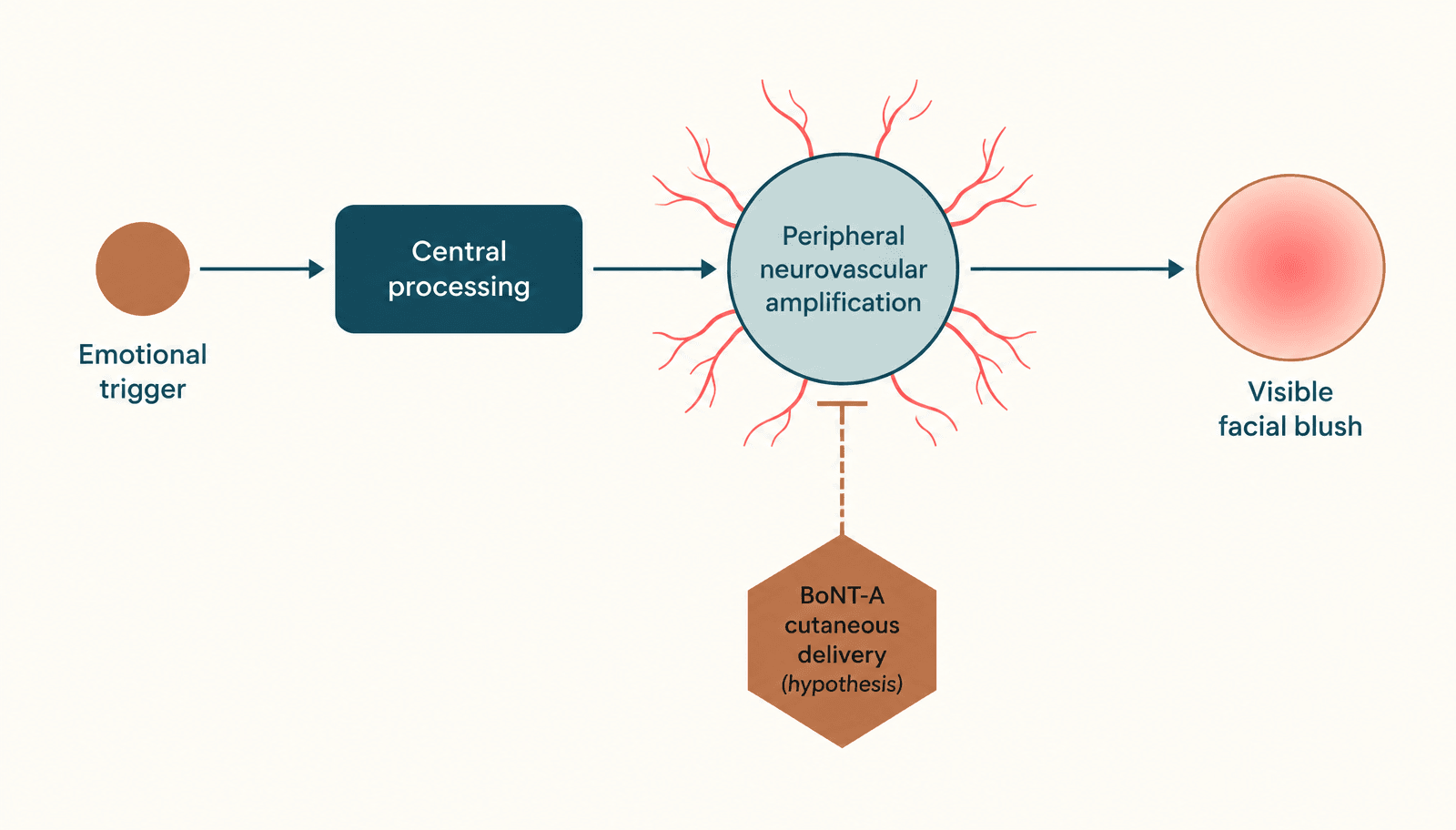
Conversely, a 30-participant experiment found that topical ibuprofen reduced embarrassment-induced cheek blood-flow responses. This is important proof that a centrally triggered blush can be modified locally. It neither validates routine facial ibuprofen nor proves toxin responsiveness, but supports the proposed concept of attenuating peripheral amplification rather than eliminating the emotional trigger. [18]
A useful mechanistic prediction follows: reduced sweating without reduced provoked redness would demonstrate biological delivery but undermine the assumption that the relevant blush pathway is toxin-sensitive. Successful penetration alone is therefore insufficient.
Nor would a calmer appearance during conversation necessarily demonstrate vascular efficacy: an altered brow or smile could change the visual impression without reducing perfusion. Conversely, a measurable fall in erythema may not improve distress. The biological, expressive and psychological components therefore require independent outcomes. This separation is essential to distinguish therapeutic success from apparent improvement caused by facial masking.
5. Intradermal BoNT-A: an indirect efficacy signal with functional costs
Small controlled rosacea studies support intradermal BoNT-A effects on erythema. Kim and colleagues studied 24 patients in a placebo-controlled split-face trial; Dagtas and colleagues subsequently studied 30 using a randomised, double-blind design. Both reported improvement in relevant clinical or instrumental measures. A 2026 randomised trial of 46 patients found better outcomes with doxycycline plus intradermal BoNT-A than doxycycline plus saline. None establishes efficacy for diffuse emotional blushing with normal inter-episode skin colour. [19-21]
Safety findings are especially relevant to whole-face treatment. In Park and colleagues’ 20-patient rosacea pilot, three discontinued because of facial muscle paralysis or unnatural expression; improvement was reported within three months. This small study does not establish a generalisable complication rate, but excluding these patients from efficacy analysis can make the benefit-harm balance appear more favourable. [22]
A further 2026 uncontrolled pilot in 11 rosacea patients reported improvement after two weeks, with transient cheek heaviness or dryness in three. Its short follow-up and lack of a comparator cannot resolve the full-face safety question. Increasing the number of positive rosacea reports does not remove the mismatch between persistent inflammatory erythema and isolated emotional blushing. [23]
The evidence is not uniformly positive: a 15-person split-face study of botulinum toxin B did not demonstrate superiority over saline for objective erythema. Serotype differences prevent treating this as a definitive negative study of BoNT-A, but it cautions against assuming a universal anti-flushing effect. [24]
6. Microneedling-assisted delivery: what has actually been demonstrated?
Direct non-thermal microneedling evidence for rosacea includes a single uncontrolled case. Improvement following treatment cannot separate toxin activity from needling effects, natural variation or concurrent care. No controlled study specifically establishing efficacy for primary diffuse emotional blushing was identified in this review. [25]
The strongest adjacent comparison involved 42 patients with facial hyperhidrosis. Intradermal treatment and microneedling-assisted topical toxin achieved the best Hyperhidrosis Disease Severity Scale category in 85.7% and 83.3%, respectively. These are sweating outcomes, not blushing-response rates. Injection generally acted sooner; many microneedling-treated sides required a second session. Crucially, both routes used the same nominal toxin dose, and lower-face injection regions were avoided to reduce smile asymmetry. The study therefore establishes neither dose-sparing nor comprehensive forehead-to-jawline motor safety. Non-significance between treatments is not proof of equivalence. [26]
A separate 20-patient split-face study of enlarged pores found more durable benefit and greater satisfaction with intradermal treatment than topical toxin after microneedling. Pore changes cannot establish a vascular response, but the difference reinforces the importance of delivery reliability. [27]
Intradermal injection deposits a known nominal amount at selected sites; subsequent local distribution remains variable. Topical application after needling adds uncertainty about how much active protein enters the skin and where it travels. Uniform surface application therefore cannot be assumed to provide uniform target exposure. The comparison is not simply "needles versus no needles", but two delivery systems with different uncertainties and potential procedural burdens.
Related rosacea reports used fractional microneedling radiofrequency with a pumping tip or thermomechanical barrier disruption. Their thermal, pressure and toxin effects cannot be disentangled, and these platforms should not be grouped with ordinary non-thermal microneedling. They provide adjacent delivery evidence, not validation of the proposed intervention. [28-29]
7. Why diffuse involvement changes the therapeutic margin
The relevant risk is not simply the number of needle punctures. Forehead-to-jawline treatment exposes several regions in which unwanted motor effects could affect brow position, eye closure, smiling or oral function. Existing studies do not establish repeated whole-face safety for this indication. Equally, they do not justify asserting that repeated treatment inevitably produces progressive systemic toxicity. [22,26]
Microneedling does not inherently solve this problem. Applied dose is not absorbed bioactive dose; an unknown proportion may remain on the surface, lose activity or reach unintended tissue. A shallow device setting does not demonstrate pharmacological confinement, and greater dilution does not itself reduce total units. The comparative studies did not quantify cutaneous-to-motor exposure. [26-27]
Immunogenicity is a separate repeat-treatment issue. A pooled analysis of onabotulinumtoxinA registration studies found new neutralising antibodies in 27 of 5,876 evaluable patients (0.5%). Those data span other indications and cannot establish immunogenicity or functional safety for this proposed route. They nevertheless caution against conflating antibody-mediated loss of response, local expression weakness and systemic toxicity as a single cumulative hazard. [30]
Consequently, the desired improvement is a wider therapeutic margin: sufficient local neurovascular modulation before clinically meaningful motor impairment. Fewer injections or less procedural discomfort would be welcome but cannot substitute for this requirement. Sustainability also depends on total product consumption, retreatment frequency, cost and the patient’s willingness to accept repeated procedures, not merely an absence of immediate complications.
8. Proposed hypothesis and a clinically meaningful test
We propose that non-thermal microneedling-assisted topical BoNT-A could attenuate cutaneous neurovascular amplification of diffuse emotional blushing, provided reproducible bioactive exposure reaches relevant skin targets while limiting exposure to facial motor structures. This is a skin-selective delivery hypothesis, not a claim of proven dose reduction, improved safety or control of the central emotional stimulus.
Two conditions must hold independently: emotional blushing must contain a sufficiently BoNT-sensitive peripheral component, and the delivery method must reach that component with an acceptable functional margin. If effective vascular suppression requires accompanying expression weakness, the proposed advantage fails. If delivery suppresses sweating but not blushing, a different target may be required.
The aim need not be complete abolition of normal emotional colour change. A patient-defined reduction in peak intensity, duration or episodes that interrupt social participation may be sufficient. A development programme should therefore define a meaningful benefit before treatment, rather than declaring success from any statistically detectable colour change or an aesthetically smoother face.
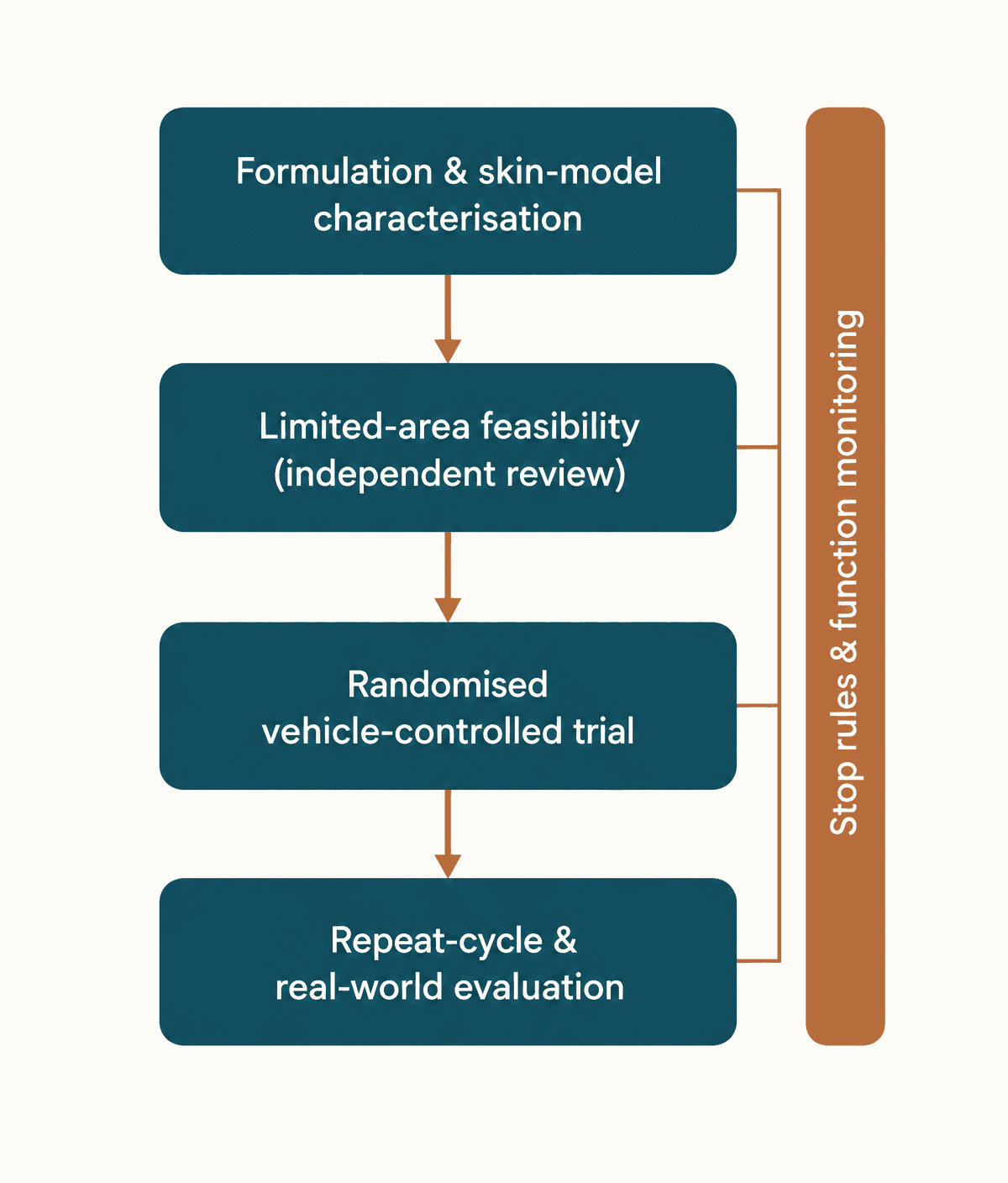
Development should first characterise formulation compatibility, retained toxin activity, distribution and spatial consistency in suitable skin models; tracer penetration alone cannot establish biological activity. Independently reviewed, limited-area feasibility work should precede whole-face exposure. Current evidence does not justify specifying a clinical needle depth, dilution, unit allocation or maintenance schedule.
A subsequent randomised parallel-group trial should compare microneedling plus toxin against identical microneedling plus vehicle. An intradermal comparator would be informative only after an ethically acceptable regimen is established. Comparing two unproven active approaches without vehicle control would not establish efficacy. Split-face studies could explore local effects, but are less suited to whole-person distress and the functional consequences of asymmetry.
The primary efficacy outcome should capture baseline-adjusted facial erythema during a standardised emotional challenge and recovery, weighted across forehead, cheeks and lower face. Calibrated imaging or colourimetry, supplemented by perfusion assessment where feasible, should be accompanied by repeated baseline challenges to address habituation. Resting erythema is not an adequate primary endpoint for this phenotype.
Measurement reliability should be established across the enrolled skin tones, under standardised lighting and temperature. Recovery time may be as important as peak intensity. Analysis should report effect sizes and confidence intervals, and examine whether improvement persists during ordinary social encounters rather than only the laboratory task. These are proposed design requirements, not validated response thresholds.
Blinded video assessment of brow elevation, eye closure, smiling, lip pursing and speech should assess function independently. Distress, avoidance, sweating, symptom diaries and quality of life require separate measurement. Prespecified stopping rules, complete withdrawal reporting and follow-up through recurrence are essential. Repeat-cycle evaluation should address both benefit and cumulative treatment burden; a small initial study cannot establish uncommon-event safety.
9. Conclusion
Diffuse emotional blushing remains a treatment gap, not simply an undertreated form of rosacea. Existing alternatives target different mechanisms and have materially different outcomes and burdens. Microneedling-assisted topical BoNT-A merits investigation because local modulation is plausible, not because lower dosing or muscle sparing has been demonstrated. The clinically worthwhile result is a smaller, shorter provoked blush across the face with preserved expression and an acceptable repeat-treatment burden.
Declarations
Competing interests: Dr Ahmed Haq is affiliated with Harley Street Institute and practises at Cosmedocs; these are relevant professional and commercial interests. Manufacturer relationships, product support and intellectual-property interests require author confirmation.
Funding: Funding and any product provision require author confirmation before submission.
Ethics and consent: No original patient dataset or identifiable case is reported. Prospective intervention requires independent ethics and medicines-governance review, registration and written informed consent.
AI assistance: AI assisted literature discovery and drafting. The author is responsible for reference verification, clinical interpretation and final approval.
References
- Drummond PD. The effect of adrenergic blockade on blushing and facial flushing. Psychophysiology. 1997;34(2):163-168. doi:10.1111/j.1469-8986.1997.tb02127.x.
- Craige H, Cohen JB. Symptomatic treatment of idiopathic and rosacea-associated cutaneous flushing with propranolol. J Am Acad Dermatol. 2005;53(5):881-884. doi:10.1016/j.jaad.2005.07.021.
- Fogelman JP, Stevenson ML, Ashinoff R, Soter NA. Idiopathic flushing with dysesthesia: treatment with the 585nm pulsed dye laser. J Clin Aesthet Dermatol. 2015;8(8):36-41. PMID:26345489.
- Baethge C, Goldbeck-Wood S, Mertens S. SANRA-a scale for the quality assessment of narrative review articles. Res Integr Peer Rev. 2019;4:5. doi:10.1186/s41073-019-0064-8.
- Härtling S, Klotsche J, Heinrich A, Hoyer J. Cognitive therapy and task concentration training applied as intensified group therapies for social anxiety disorder with fear of blushing-a randomized controlled trial. Clin Psychol Psychother. 2016;23(6):509-522. doi:10.1002/cpp.1975.
- Connor KM, Davidson JRT, Chung H, Yang R, Clary CM. Multidimensional effects of sertraline in social anxiety disorder. Depress Anxiety. 2006;23(1):6-10. doi:10.1002/da.20086.
- Wilkin JK. Effect of subdepressor clonidine on flushing reactions in rosacea. Change in malar thermal circulation index during provoked flushing reactions. Arch Dermatol. 1983;119(3):211-214. PMID:6218789.
- Fowler J Jr, Jackson M, Moore A, et al. Efficacy and safety of once-daily topical brimonidine tartrate gel 0.5% for the treatment of moderate to severe facial erythema of rosacea: results of two randomized, double-blind, and vehicle-controlled pivotal studies. J Drugs Dermatol. 2013;12(6):650-656. PMID:23839181.
- Kircik LH, DuBois J, Draelos ZD, et al. Pivotal trial of the efficacy and safety of oxymetazoline cream 1.0% for the treatment of persistent facial erythema associated with rosacea: findings from the first REVEAL trial. J Drugs Dermatol. 2018;17(1):97-105. PMID:29320594.
- Routt ET, Levitt JO. Rebound erythema and burning sensation from a new topical brimonidine tartrate gel 0.33%. J Am Acad Dermatol. 2014;70(2):e37-e38. doi:10.1016/j.jaad.2013.10.054.
- Licht PB, Pilegaard HK, Ladegaard L. Sympathicotomy for isolated facial blushing: a randomized clinical trial. Ann Thorac Surg. 2012;94(2):401-405. doi:10.1016/j.athoracsur.2012.03.076.
- Dittberner FA, Jørgensen OD, Pilegaard HK, Ladegaard L, Licht PB. Sympathicotomy for isolated facial blushing: long-term follow-up of a randomized trial. Eur J Cardiothorac Surg. 2024;65(3):ezad414. doi:10.1093/ejcts/ezad414.
- Wienholtz NKF, Christensen CE, Do TP, et al. Erenumab for treatment of persistent erythema and flushing in rosacea: a nonrandomized controlled trial. JAMA Dermatol. 2024;160(6):612-620. doi:10.1001/jamadermatol.2024.0408.
- Blasi J, Chapman ER, Link E, et al. Botulinum neurotoxin A selectively cleaves the synaptic protein SNAP-25. Nature. 1993;365:160-163. doi:10.1038/365160a0.
- Kellogg DL Jr, Pergola PE, Piest KL, et al. Cutaneous active vasodilation in humans is mediated by cholinergic nerve cotransmission. Circ Res. 1995;77(6):1222-1228. doi:10.1161/01.RES.77.6.1222.
- Tugnoli V, Capone JG, Eleopra R, et al. Botulinum toxin type A reduces capsaicin-evoked pain and neurogenic vasodilatation in human skin. Pain. 2007;130(1-2):76-83. doi:10.1016/j.pain.2006.10.030.
- Choi JE, Werbel T, Wang Z, Wu CC, Yaksh TL, Di Nardo A. Botulinum toxin blocks mast cells and prevents rosacea like inflammation. J Dermatol Sci. 2019;93(1):58-64. doi:10.1016/j.jdermsci.2018.12.004.
- Drummond PD, Minosora K, Little G, Keay W. Topical ibuprofen inhibits blushing during embarrassment and facial flushing during aerobic exercise in people with a fear of blushing. Eur Neuropsychopharmacol. 2013;23(12):1747-1753. doi:10.1016/j.euroneuro.2013.07.013.
- Kim MJ, Kim JH, Cheon HI, et al. Assessment of skin physiology change and safety after intradermal injections with botulinum toxin: a randomized, double-blind, placebo-controlled, split-face pilot study in rosacea patients with facial erythema. Dermatol Surg. 2019;45(9):1155-1162. doi:10.1097/DSS.0000000000001819.
- Dagtas BB, Erdem O, Gunec TI, Avci EB, Manav V, Koku Aksu AE. Effects of botulinum toxin type A treatment on clinical and biophysical parameters in patients with erythematotelangiectatic rosacea: a prospective, randomized, controlled, double-blind study. Dermatol Surg. 2025;51(5):515-521. doi:10.1097/DSS.0000000000004528.
- Nguyen TT, Le DH, Vu HT, Vu LH, Vu MN, Pham PTM. Combination therapy with oral doxycycline and intradermal botulinum toxin type A for moderate-to-severe rosacea: a randomized controlled trial. Indian J Dermatol. 2026;71(2):135-141. doi:10.4103/ijd.ijd_654_24.
- Park KY, Kwon HJ, Kim JM, et al. A pilot study to evaluate the efficacy and safety of treatment with botulinum toxin in patients with recalcitrant and persistent erythematotelangiectatic rosacea. Ann Dermatol. 2018;30(6):688-693. doi:10.5021/ad.2018.30.6.688.
- Bańka-Wrona A, Wrona W, Barańska-Rybak W. LetibotulinumtoxinA for rosacea: a pilot study. Toxins (Basel). 2026;18(4):162. doi:10.3390/toxins18040162.
- Oh YJ, Lee NY, Suh DH, Koh JS, Lee SJ, Shin MK. A split-face study using botulinum toxin type B to decrease facial erythema index. J Cosmet Laser Ther. 2011;13(5):243-248. doi:10.3109/14764172.2011.613479.
- Dall'agnol Soares A, Antunes FTT, Gerhardt Martins M. Use of botulinum toxin type A associated with nonthermal microneedling for treating erythematoustelangiectatic rosacea: a case report. J Clin Images Med Case Rep. 2022;3(7):1955.
- Ebrahim H, Nassar A, Mousa MM, Khater E. Microneedling delivery of botulinum toxin versus intradermal injection in the treatment of facial hyperhidrosis. J Clin Aesthet Dermatol. 2022;15(9):40-44. PMID:36213604.
- Salem RM, Salah SAE, Ibrahim SE. Microbotox injection versus its topical application following microneedling in the treatment of wide facial pores: a split face comparative study. J Cosmet Dermatol. 2023;22(4):1249-1255. doi:10.1111/jocd.15590.
- Park JS, Lee SY, Kim JC, Park CW, Kim HO, Chung BY. A novel regimen of transdermal botulinum toxin delivery using fractional microneedling radiofrequency for treatment of erythema in rosacea. Dermatol Ther. 2023;2023:8838206. doi:10.1155/2023/8838206.
- Friedman O, Koren A, Niv R, Mehrabi JN, Artzi O. The toxic edge-a novel treatment for refractory erythema and flushing of rosacea. Lasers Surg Med. 2019;51(4):325-331. doi:10.1002/lsm.23023.
- Jankovic J, Carruthers J, Naumann M, et al. Neutralizing antibody formation with onabotulinumtoxinA (BOTOX) treatment from global registration studies across multiple indications: a meta-analysis. Toxins (Basel). 2023;15(5):342. doi:10.3390/toxins15050342.
SANRA quality scale for narrative reviews · Erenumab in rosacea flushing (JAMA Dermatology) · Sympathicotomy for isolated facial blushing: randomised trial