
Tear Trough - Light Beneath the Eye
What Is the Tear Trough?
The tear trough is one of those areas that every face has — even as a child. It's the gentle groove that starts from the inner corner of your eye and runs downward toward the cheek. In your early years, it's subtle — hidden by the fullness of your cheek fat compartments. But as you move past your mid-20s, those fat pads begin to deflate. The cheek loses its projection, the skin thins, and the trough becomes visible. What once looked like a single smooth surface now separates into the "eye" and the "cheek."
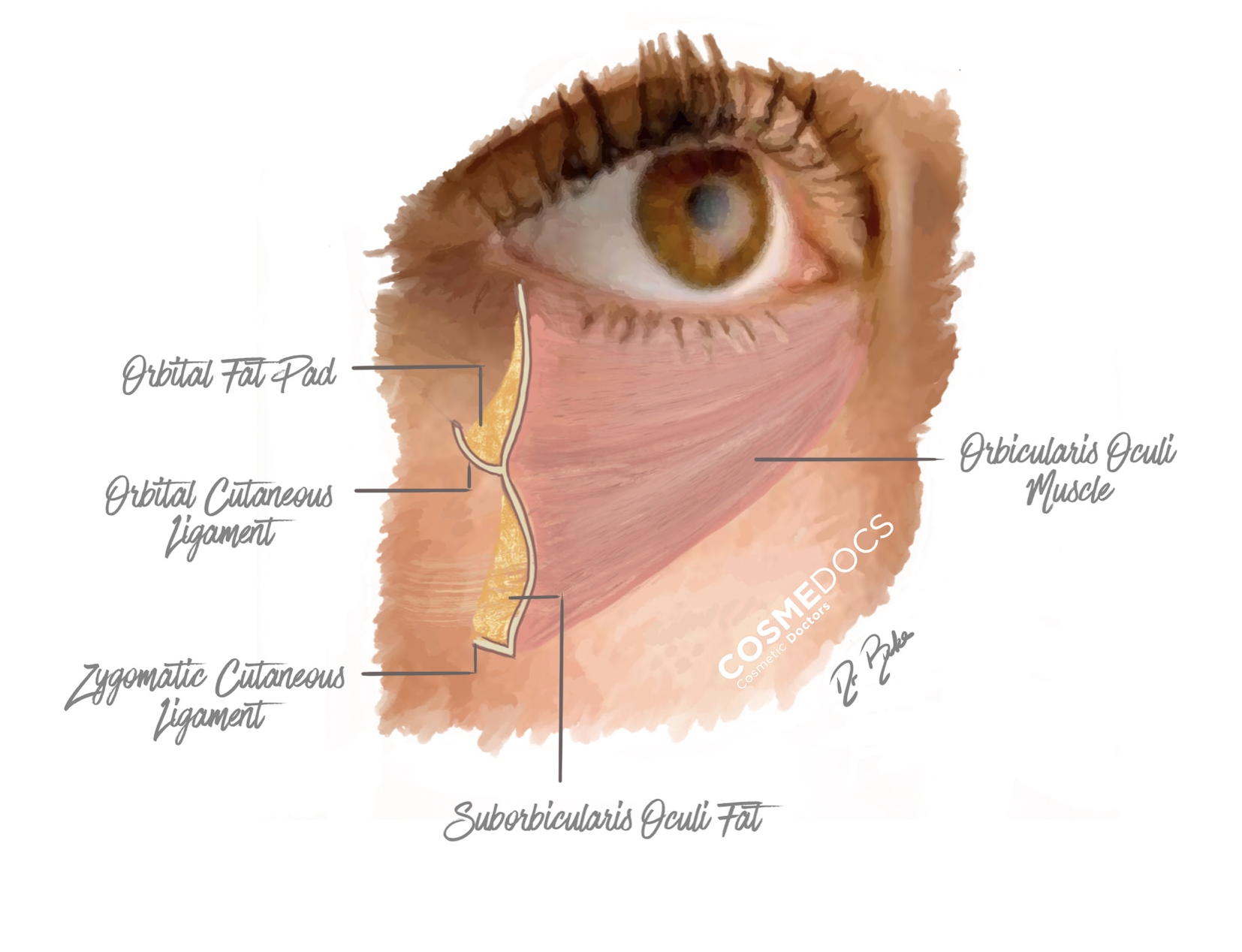
It's not a flaw or a sign of ageing gone wrong — it's normal anatomy becoming more defined.And in aesthetic medicine, our role isn't to remove it. It's to camouflage it, to restore that seamless transition by adding a soft filler that bridges the light between the lower eyelid and the cheek.
Reflection:
"If I have seen further, it is by standing on the shoulders of giants."— Isaac Newton
I repeat this often, because the techniques and philosophies we use today come from those before us — their lessons etched into our understanding. What I share here is not mine alone; it's the collective wisdom of those giants who shaped our craft.
A Short History of Tear Trough Treatment
Back when tear trough treatments first began, practitioners had two main approaches. The first was injecting tiny blebs of filler right into the dermis — small micro-droplets that hydrated and thickened the skin. This worked beautifully in young patients who only had early signs of hollowing. The second method went to the opposite extreme — injecting directly onto the periosteum, the bone itself. This was more technical but gave excellent structure for deeper troughs.
Both techniques had their place — one for hydration, one for structure. But they also represented two ends of a very wide spectrum: one superficial, one deep. Then came the cannula, and the game changed completely. Suddenly, you could enter safely from the cheek, glide along the natural trough, and deliver filler smoothly in one continuous, controlled motion.
| Historical Technique | Plane of Injection | Purpose | Limitations |
|---|---|---|---|
| Intradermal Micro-Blebs | Dermis | Skin hydration, fine line improvement | Only suitable for early troughs |
| Periosteal Bolus Injections | On bone | Volume restoration, structure | Technically demanding; higher risk |
| Cannula Technique (Modern) | Subcutaneous | Smooth blending and safety | Requires depth awareness |
The Modern Cannula Approach
Today, most of us start from the mid-cheek region. The insertion point is just over the cheek, usually around the mid-cheek fold. From here, the cannula is directed gently towards the inner corner of the eye, following the natural depression of the tear trough.
Before inserting, always measure the length of your cannula — you want to ensure it comfortably reaches the inner part of the trough whilst stopping about half a centimetre before the medial canthus.
Now, here's where many go wrong — they angle downward. The trick is to stay flat and parallel to the skin.You're gliding just under the dermis, not digging deep. When your cannula moves parallel to the surface, it's almost impossible to go too deep.
As you move through the tissue, you'll occasionally feel little "clicks" or resistance — those are the fibrous septa or small retaining ligaments tethering the skin. Don't force it. Withdraw slightly, redirect, and continue your path gently.
Among these, you'll eventually meet one that feels different — a firm, springy band that suddenly lets go with a soft "pop." That's the orbicularis retaining ligament (ORL) — the true border between the eyelid and the cheek. When you feel it, that's your cue. Cross it gently, never abruptly, because you're entering the delicate sub-orbicularis plane where the tear-trough filler belongs.
When you're doing tear-trough work, you'll glide through this ligament softly. But when you're treating the cheek, you'll stop beneath it — the cheek filler is thicker, designed for structure, not finesse. This distinction keeps your tear-trough light and natural while giving your cheek definition without weight. If there's any leftover tear-trough filler, use it to blend that upper mid-cheek fold so the trough melts smoothly into the cheek.
Once you reach your target area, inject slowly and retrogradely — meaning you deposit filler as you withdraw. Usually, 0.05–0.1 mL per pass is more than enough. The goal isn't to fill; it's to blend.
Clinical Tip
The flatter your cannula, the safer you are. Glide with patience. Respect resistance — it's your anatomy talking to you. And when you feel that little click under the eye — smile. You just met the orbicularis retaining ligament, and you're officially in the right neighbourhood.
Tear Trough Cannula Technique
| Injection Plane Reference | Depth & Feel | Purpose | Filler Type |
|---|---|---|---|
| Dermal (Needle Micro-Blebs) | Slight drag, surface blanching | Hydration & fine lines | Very soft, low G′ |
| Subcutaneous (Cannula) | Smooth glide, minimal resistance | Volume blending | Medium-soft, low-moderate G′ |
| Periosteal (Needle Bolus) | Firm "bone touch" | Deep structural support | High G′, cohesive |
The Tear Trough Ligament Reset
For those more advanced, understanding the tear trough ligament is essential. This structure originates from the maxilla and continues as the orbicularis oculi retaining ligament, separating the orbital and eyelid parts of the orbicularis muscle.
In some ethnicities — particularly East Asian or Oriental faces — this ligament is more fibrous and pronounced, producing a distinct separation between the lid and cheek. In such cases, a ligament reset or partial release can be helpful. It allows the filler to spread evenly without being blocked by a tight tether.
But this is not a move for beginners. It requires anatomical precision and a gentle, controlled hand. Think of it not as "breaking a ligament" but as easing a tight seam so the skin drapes more naturally.
Anatomy Note:
The ligament is not your enemy. It defines beauty and structure. You don't always need to release it — sometimes, you just need to work around it with understanding.
The Forgotten Layer — Restoring Skin Quality
Once the volume is replaced, the deeper hollow softens. But many patients still complain of tired skin, fine lines, or crepiness under the eyes. That's not volume — that's dermal thinning.
Here's where we return to the surface.The skin above the trough is thin, but it still has a dermis. Tiny micro-boluses of soft filler into this layer can dramatically improve skin quality — hydration, elasticity, and smoothness.
Imagine it like renovating a wall: the subcutaneous filler gives the structure, whilst the dermal injections add the finish — the plaster and paint that make everything seamless.
These small micro-spots of hyaluronic acid enhance hydration, stimulate light collagen remodelling, and create a radiant, rested look.
Comparison — Dermal vs. Subcutaneous Approach
- Dermal injections improve texture, hydration, and radiance.
- Subcutaneous filler restores contour and softens the shadow.
- Combining both gives a complete, natural restoration — structure beneath, vitality above.
Clinical Tip:
If you're hesitant, start with the cannula. Once you're comfortable and steady, add gentle dermal injections for refinement. Don't aim for symmetry — aim for even texture.
Tear Trough Technique Videos
See what you can achieve using just two simple techniques — once you understand the injection anatomy of the dermis and subcutaneous layers that truly defines skill.
Tear Trough Dermal Hydration
Crow's Feet (Peri Orbital Rejuvenation)
Choosing the Right Filler
Every filler has a personality. Some spread and integrate easily; others hold their shape. For the tear trough, the ideal filler is soft, elastic, and hydrating — one that won't cause lumpiness or Tyndall effect even in the thinnest skin.
My personal favourite is Teosyal Redensity II. It's versatile — soft enough for the dermis, structured enough for subcutaneous use, and perfect for blending into the crow's feet region at the same time. It hydrates the skin beautifully and lasts long enough to justify the treatment.
Others like Restylane Eyelight or Juvederm Volbella work well too — slightly different personalities, but equally reliable when used correctly.
Filler Comparison
- Teosyal Redensity II — soft, forgiving, perfect for subcutaneous and dermal hydration.
- Restylane Eyelight — firmer, holds contour, ideal for younger hollowing.
- Juvederm Volbella — smooth, long-lasting, great for blending skin transitions.
The Tyndall Effect — When Light Turns Visible
The Tyndall effect is one of the most visually recognisable complications in aesthetic medicine. It appears as a subtle blue-grey hue when filler sits too superficially under thin skin. Although it can appear anywhere on the face, it is discussed almost exclusively in the tear trough because the skin here is exceptionally thin, translucent, and unforgiving.
To understand it, you must understand light.
When a hyaluronic acid gel sits too close to the skin surface, it behaves like a micro–prism matrix. The gel refracts, bends, and scatters incoming light. Shorter wavelengths — the blue tones — scatter the most. That's why we see a blue hue: the physics of light interacting with gel density, crosslinking patterns, and water content.
The tear trough is the perfect environment for this phenomenon:
- a hollow that collects light,
- a dermis barely a few cells thick, and
- soft tissue planes that show everything beneath them.
Even 0.05 mL in the wrong plane can become visible.
Why the Tear Trough Shows Tyndall Most
- The dermis is extremely thin
- The skin is translucent
- The hollow shape reflects light directly outward
- There is minimal fat to diffuse the gel
- Even tiny deposits become concentrated visually
Other regions can show Tyndall — for example, the nasolabial fold, especially when someone uses a needle and deposits filler too superficially or too concentrated in one segment — but because the skin there is thicker and more fibrous, the effect is much less dramatic.
My Clinical Experience With Dermal Blebbing
Over the years, using the micro-blebbing dermal technique, I have observed something consistently:
I have not once encountered Tyndall when blebbing with:
- Teosyal Redensity II
- RHA-2
- Teoxane Global Action / Teosyal Global
- Juvederm range (Volbella, Volift, Vollure, etc.)
- Stylage S or M
These fillers are monophasic, cohesive, soft, and capable of integrating smoothly into delicate dermal tissues. They do not separate into visible particles, and they do not scatter light in the same way older biphasic gels do.
"The Tyndall effect isn't a filler problem — it's a physics problem. And physics does not negotiate."
Filler Structure Comparison Table
| Filler Type | Internal Structure | Behaviour Under Light | Tyndall Risk | Example Brands |
|---|---|---|---|---|
| Biphasic | HA particles + carrier gel | High light scattering (prism effect) | Higher risk if superficial | Restylane Classic; some older particle gels |
| Monophasic | Smooth, cohesive single-phase gel | Minimal scatter, uniform refraction | Lower risk | Teosyal Redensity II, RHA-2, Juvederm, Stylage |
My Recommended Under-Eye Fillers
| Brand | Type | Notes |
|---|---|---|
| Teosyal Redensity II | Monophasic | Gold-standard for tear trough; ideal for both subcutaneous and dermal hydration. |
| RHA-2 | Monophasic | Excellent elasticity and integration for fine dermal work. |
| Juvederm Volbella | Monophasic Vycross | Smooth, subtle, long-lasting; blends beautifully. |
| Stylage S / M | Monophasic IPS | Good balance of softness and structure for under-eye. |
| Teosyal Global Action | Monophasic | Hydrates dermis well; excellent for fine blebs. |
Real Causes of Tyndall (Beyond the Filler)
- Superficial placement (dermal or just under dermis)
- Thin, translucent skin
- Over-concentration in one tight pocket
- Particle-heavy biphasic gels
- Incorrect product for tear trough anatomy
If you fix the plane and the product, Tyndall rarely appears.
Correction
Fortunately, hyaluronic acid is reversible.
Small, precise doses of hyaluronidase eliminate the superficial filler, often instantly removing the blue tone.
However — dissolve cautiously. Under the eye, every tenth of a millilitre matters.
Common Pitfalls
Even the simplest tear trough treatment can go wrong when rushed or misunderstood. Steep angles, overfilling, or the wrong filler choice are the most common mistakes. Entering too deep means you're under the muscle — and no matter how good your filler is, it won't look right. Overfilling gives puffiness. Using thick filler risks lumpiness or the dreaded Tyndall effect.
And remember, the tear trough isn't just about the trough. It's about how the eye meets the cheek — it's a relationship, not a point. Treat it as such.
Tear Trough Technique Video
Lymphatic Pooling, Malar Oedema & Chronic Tear Trough Puffiness After Filler
The tear trough is a beautiful treatment to perform — elegant, subtle, and transformative — but it is also one of the most unforgiving areas on the face. And whilst complications like Tyndall are mostly a matter of depth and filler choice, issues like lymphatic pooling, malar oedema, and chronic puffiness belong to a different category entirely.
These complications are not simply about technique — they're about anatomy, patient selection, and skin quality. This is why, for beginners especially, case selection is not optional — it is your first and most important safety layer.
Why the Under-Eye Is Prone to Lymphatic Issues
- Slow lymphatic drainage
- Thin, delicate skin
- Loose areolar tissue (which holds fluid easily)
- A natural tendency for diurnal swelling (morning puffiness)
If you add filler to the wrong patient — or in the wrong plane — you can exacerbate an already sluggish drainage system. The result is persistent swelling, sometimes days or weeks after injection.
Malar Oedema — The Anatomical Trap
Malar oedema is swelling over the malar crescent — the semi-circular region over the cheek, just below the tear trough.
This area is a classic "water trap." The malar septum can act like a dam, preventing fluid from draining freely.
Injecting filler near or across this zone can worsen the problem, especially in patients who already have:
- Early malar bags
- Subtle festoons
- Waking-up puffiness
- Fluid retention tendencies
- Soft, doughy cheek skin
- Poor cheek support
For these patients, even perfect filler placement can create chronic swelling. This is why many injectors argue that malar oedema is not a filler complication — it is a patient selection complication.
Aesthetic Talk Case-Selection Philosophy for Beginners
🟦 Choose your cases wisely.
🟦 Start with easy anatomy, not challenging anatomy.
Your ideal beginner's patient is:
- Under 35–40
- Mild hollowing (Grade 1–2 volume loss)
- Good skin elasticity
- No morning puffiness
- No malar bags
- No festoons
- No crepey paper-thin skin
- Healthy cheek support
- No history of infraorbital swelling
If the skin snaps back nicely with a pinch — the simple SNAP test — that's an early sign that the dermis and epidermis still have structural integrity.
Who You Should Avoid (For Now)
- Visible festoons
- Soft, fluidy malar bags (even early ones)
- Puffy eyes on waking
- Very thin, crepey lower lid skin
- Significant hollowness but no cheek support
- Allergic or atopic tendencies (prone to swelling)
- Chronic rhinitis or sinus issues (fluid retention)
- Those who say: "I've always had puffy eyes since my 20s"
- True lymphatic insufficiency patterns
If your patient already looks puffy before you touch them,
they will look worse after filler.
What To Do If Swelling Appears
- Wait and observe
Sometimes swelling settles over 2–6 weeks. - Avoid massaging
It can worsen fluid displacement. - Assess plane & product
If filler was too superficial, dissolve conservatively. - Use hyaluronidase strategically
Small amounts, targeted to the offending pocket. - Re-evaluate patient's anatomy
Don't rush to "redo" the area — some patients simply aren't candidates.
Summary for Beginners
- The under-eye is lymphatically fragile.
- Not all patients are candidates.
- Avoid those with puffiness, festoons, or malar oedema.
- Start with mild hollows in young patients with good skin.
- The SNAP test can guide your early judgement.
- Chronic puffiness after filler is usually patient selection, not technique.
- And yes — early festoons can be treated with filler, but not yet.