
Medical Rhinoplasty - Balance Without Surgery
The First Rule: Listen, Inspect, and Palpate
Every good procedure — and every good medicine — begins not with your syringe, but with your ears.
Before you inspect or touch the nose, listen. Ask the patient what bothers them, what they see, what they wish was different. Their answer will reveal far more about your treatment plan than any measurement ever could.
You want to understand their aesthetic goal, not impose your idea of the "perfect" or "ideal" nose. That single step — truly listening — saves you from overtreating, from chasing textbook symmetry, and from ending up where most trouble begins: trying to fix something the patient never asked you to fix.
Once you've listened, then inspect. Look for dips, bumps, contour irregularities, asymmetry, and balance with the rest of the face.
💡 Tip from Dr. Haq:
"Patients tell you the destination. Your job is to choose the safest road to get there."
And finally, examine and palpate. As you're assessing or even cleansing the skin, feel what lies beneath. You'll learn how much space there is between the skin and bone, how mobile or tethered the tissue feels, and where the flexible upper third of the nose starts to give way to the fixed, fibrotic lower third attached to cartilage.
That tactile mapping will tell you everything — how deep to go, how far you can glide, and when to stop. Respect that insight, and your cannula will seem to guide itself.
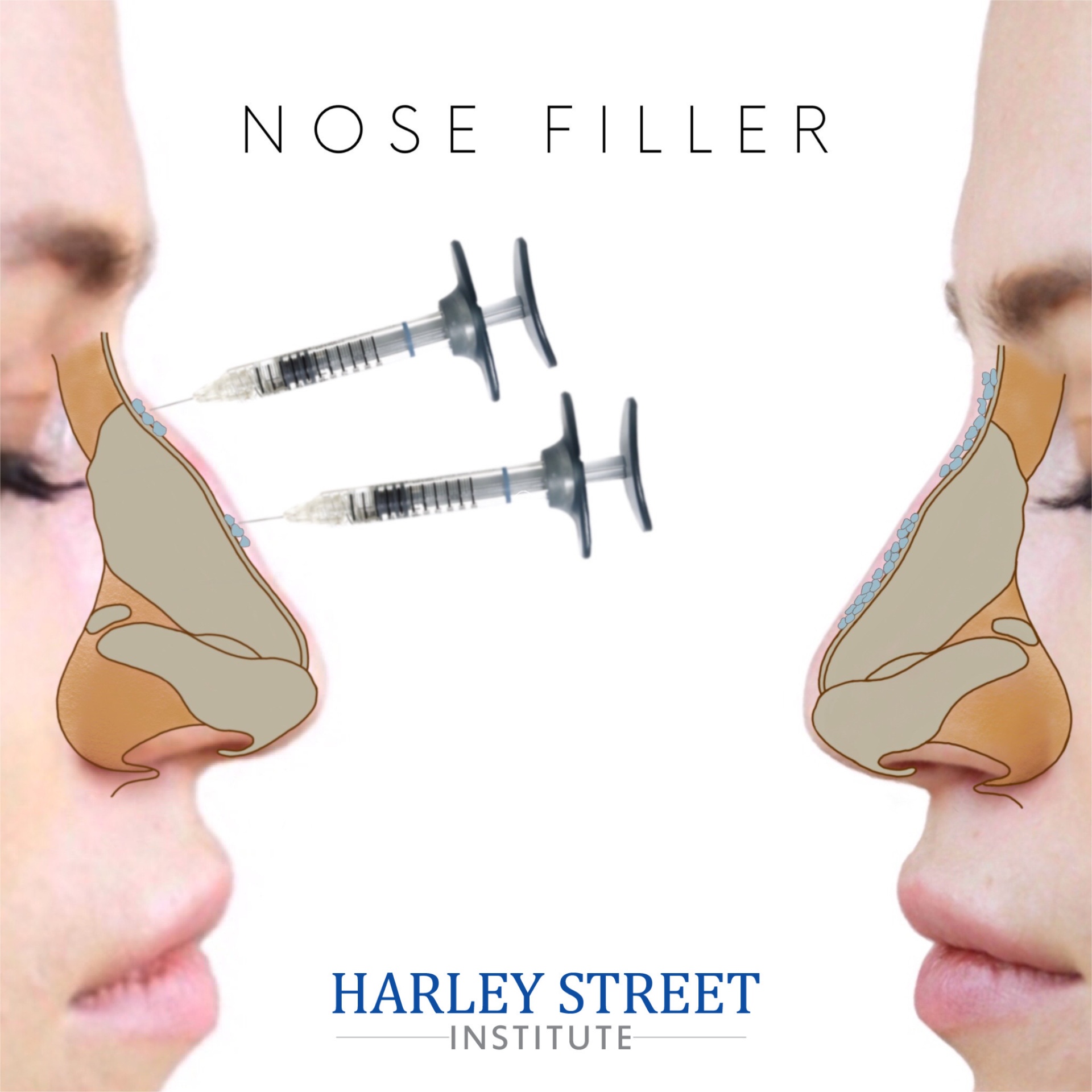
Simple soft tissue augmentation (skin and subcutaneous)
Art Books and Real Noses
On my desk sits a beautifully illustrated rhinoplasty textbook — hundreds of pages referencing Michelangelo's Creation of Adam, the Sistine Chapel, Renaissance symmetry, Chinese beauty, Egyptian sculpture, and whatnot. It's poetic, intellectual, and utterly useless once you've got a syringe in your hand.
If I could take one image from that book, it'd be a simple cross-section of the nasal layers — skin, subcutaneous tissue, fibrous connections, cartilage, bone. And the profound truth that image reveals?
🧠 Anatomy Note:
"The skin and subcutaneous tissue of the nose are arranged exactly as elsewhere — the only difference is how tightly they're attached."
The Feel of the Nose
The upper third (bony dorsum) has skin that's thicker, looser, and forgiving. The middle third (cartilaginous vault) becomes tighter. The lower third (tip and alae) — skin is thin, immobile, and fused to the underlying cartilage through dermocartilaginous ligaments.
This is where trouble brews. In these areas, filler has nowhere to go — pressure rises quickly, and compression necrosis can occur even with small volumes.
⚠️ Risk Zone:
Lower third of the nose — especially the tip and alar sidewalls — are the highest-risk areas for vascular compromise due to limited subcutaneous space and poor collateral circulation.
Vascular Awareness (Simplified)
Forget the Latin exam version — here's what matters in your hands:
🧠 Anatomy Note:
- Dorsal nasal artery: runs near the midline, joins supratrochlear and angular branches.
- Angular artery: more lateral, along the nasofacial groove.
- Tip and alae: supplied by unpredictable columellar and lateral nasal branches.
👉 The further you go from the midline, the more chaotic and variable it gets.
👉 The tighter the skin, the less room you have for error.
So, stay central, inject slow, and massage more than you inject.
💡 Tip:
If you ever see blanching, stop immediately. Massage, apply warmth, and check capillary refill. Blanching does not always equal occlusion — but it always equals caution.
Why This Is One of the Easiest Treatments
Fifteen years ago, this wouldn't have made my top ten. But with the cannula revolution, everything changed.
For most noses, this is now one of the most forgiving and rewarding procedures. You're not reconstructing — you're camouflaging contour irregularities.
- A dorsal bump? Soften above and below.
- A concave sidewall? Smooth it.
- A droopy tip? Lift slightly and stop.
Once you respect the anatomy, this becomes second nature.
🪶 Quote:
"You're not sculpting a new nose. You're simply removing distractions from the existing one."
Aesthetic Perception vs. Reality
Patients already know what they dislike — they've stared at it for years. Listen carefully; they'll point you straight to the problem.
Forget Da Vinci's triangles or perfect 115° nasofrontal angles. You're not decoding geometry. You're managing confidence.
And remember: Over 50% of surgical rhinoplasty patients report dissatisfaction. Not from poor surgery — from unrealistic expectations and the tyranny of millimeters.
🎯 Your role is not to achieve perfection, but satisfaction.
💡 Tip: When the patient says "That's perfect," stop. Anything after that point is risk, not improvement.
Product Personality
When I first started teaching nonsurgical rhinoplasty in the UK, we only had soft fillers — Juvederm Ultra 2, Teosyal Global, etc. They worked beautifully.
Then came the thicker, "strong" fillers — higher G'. I tried them. They caused more blanching, stiffness, and unpredictable swelling, especially in ethnic noses with tight bridges.
So I returned to softer gels. They move, integrate, and heal better.
🧠 Anatomy Note:
- High G' = structure but more compression
- Low G' = flexibility but less lift
- The best lies between — flow with control.
⚠️ Risk Tip:
Avoid high G' fillers in low-bridge ethnic noses — the tissue is already tight. Compression risk is exponentially higher.
Cannula Technique
I use a 25G or 23G wide-bore cannula, midline entry — usually over the highest curvature of the dorsal bump. This lets me move both upward and downward safely.
Never inject directly on a bump — treat above and below it. Beginners should not exceed 0.5ml total, divided between superior and inferior points.
If resistance increases, stop. Withdraw, redirect, and re-enter. For lateral dips, angle carefully — you're near vessels. Inject small amounts and spread by massage.
💡 Tip:
A good rule of thumb — if you can feel resistance, the skin can feel pressure. That's your early warning sign for vascular stress.
Hand Control & Stability
The non-injecting hand is your guide — it stretches, senses, and protects. Your injecting hand rests upon it — steady, economical, deliberate. This position minimises tremor and gives you precise depth control.
Avoid bending the cannula convexly (it directs downward). A straight or slightly concave shape keeps your track consistent.
🧠 Technique Note:
When your cannula is in the correct subcutaneous plane, it feels smooth, almost "glassy." Scratchiness or tugging means you're tethered — withdraw and realign.
Finishing & Sculpting
After injecting, massage firmly with gauze — not gently. Shape the product, don't push it. A neatly squared gauze distributes pressure evenly — try it; you'll notice the difference.
💡 Tip:
Take a step back and check symmetry in three lighting angles before you call it done.
Aging Nose & Subtle Rejuvenation
Yes, noses age too — bone resorbs, cartilage weakens, skin thins. Even 0.2–0.3ml of soft filler can restore youthful volume and balance the face.
These are the invisible wins — patients who didn't ask for a nose treatment but end up looking fresher. That's where mastery lies.
🪶 Quote:
"Sometimes your most powerful result is the one the patient can't quite name — only feel."
Botulinum Toxin Synergy
Botulinum toxin can quietly amplify your results:
- Lift the tip (by relaxing the depressor septi nasi).
- Reduce nasal flaring.
- Soften bunny lines.
- Stabilise filler placement by decreasing dynamic pull.
Use it intelligently, not habitually.
⚠️ Risk Reminder:
Avoid combining toxin and filler in the same sitting in high-risk vascular clients — stage treatments if in doubt.
Summary
- Examine and palpate before every procedure.
- Feel where the skin moves and where it sticks.
- Stay midline.
- Less filler, slower pace, more massage.
- Stop when the patient smiles.
Remember: control over the filler starts with control over yourself.
🪶 Final Thought:
"Injection is easy. Interpretation is art. Discipline is mastery."
🧠 Where the Cannula Actually Travels — Layer by Layer
When you insert a cannula for nonsurgical rhinoplasty, it does not glide in one fixed plane like textbook diagrams suggest. It tends to find the path of least resistance — and in the nose, that plane usually lies within the subcutaneous areolar layer, above the musculature, and below the dermis.
However, depending on your entry point, angle, and pressure, the cannula can sometimes dip slightly deeper — just beneath the muscular layer, especially over the upper bony dorsum where muscles are thin and loosely attached.
Let's go through the regions, because it changes as you move down the nose.
1️⃣ Upper Third (Bony Dorsum) — the "Glide Zone"
Natural plane: Subcutaneous areolar tissue between the skin/subcutaneous layer and the procerus & transverse nasalis muscles.
The skin here is thick and mobile, with a small cushion of loose connective tissue. Your cannula usually slides effortlessly in this plane — it feels smooth, "glassy," and forgiving.
Occasionally, the tip may pass under the thin procerus fibres, but it's still essentially a subcutaneous track, not intramuscular.
💡 Tip from Dr. Haq:
"If it glides like silk, you're in the right place. If it scrapes or tugs, you're fighting fascia or fibrous septa — back out and redirect."
2️⃣ Mid-Third (Cartilaginous Vault)
As you pass over the upper lateral cartilages, the cannula still stays in the subcutaneous plane, but now it feels slightly more resistant.
The tissue here is more fibrous, with small bridges connecting skin to the underlying cartilage and nasalis fibres blending across the bridge.
If you push too firmly, you might slip beneath these fibrous links — in which case you're momentarily under the thin muscle layer. It's not dangerous, but you'll feel more resistance and a "rubbery" feedback.
🧠 Key Insight:
In this zone, the "ideal" track is superficial subcutaneous, just above muscle — deep enough for smoothness, shallow enough to avoid vascular perforators.
3️⃣ Lower Third (Tip & Alar Region)
Here the game changes. The skin becomes tightly tethered to the lower lateral cartilages and the muscle layer merges with dermal attachments — meaning there's essentially no subcutaneous glide plane left.
Your cannula can't travel freely; any advancement feels tight and slightly gritty.
This is why experienced injectors usually avoid cannula movement within the tip, or use only 0.1–0.2 ml maximum — because every 0.01 ml here creates exponential pressure.
💡 Tip:
"If you can't advance easily, don't. The nose tip doesn't need more force; it needs more respect."
So to summarise:
| Region | Usual Cannula Plane | Tissue Feel | Comment |
|---|---|---|---|
| Upper third (bony dorsum) | Loose subcutaneous areolar layer | Smooth, gliding | Safest and most forgiving |
| Mid-third (cartilaginous vault) | Superficial subcutaneous / supra-muscular | Slight resistance, fibrous | Proceed slowly, massage more |
| Lower third (tip & alar) | Practically no subcutaneous plane, dermis fused to cartilage | Tight, immobile | Avoid or inject minimal volumes |
Deep plane vs. superficial
A cannula rarely sits under the muscle in nasal work unless deliberately directed there (e.g., in deep supraperiosteal injections with a needle). The nasal mimetic muscles are extremely thin and often inseparable from the subcutaneous layer — so in practice, your cannula is subcutaneous–supra-muscular throughout most of its path.
If you go deeper — you're approaching perichondrium or periosteum — a plane used sometimes with a needle for strong projection, not with a cannula for blending.
🪶 Quote from Dr. Haq:
"The cannula doesn't cut; it negotiates. And in the nose, the safest negotiation is always just under the skin, not under the muscle."
Want to Master This Technique with HD Video Training?
Join our comprehensive online masterclass with HD videos showing close-up techniques performed by trainees at your level, so you can see exactly how it's done.
- ✓Step-by-step HD video demonstrations
- ✓Real trainee techniques at your level
- ✓Practical tips and safety protocols
- ✓Lifetime access to all course materials
Master Medical Rhinoplasty
Take your non-surgical nose reshaping skills to the next level with our comprehensive Nose Masterclass. Learn advanced cannula techniques, safety protocols, and practical skills for medical rhinoplasty.
Explore Nose Masterclass