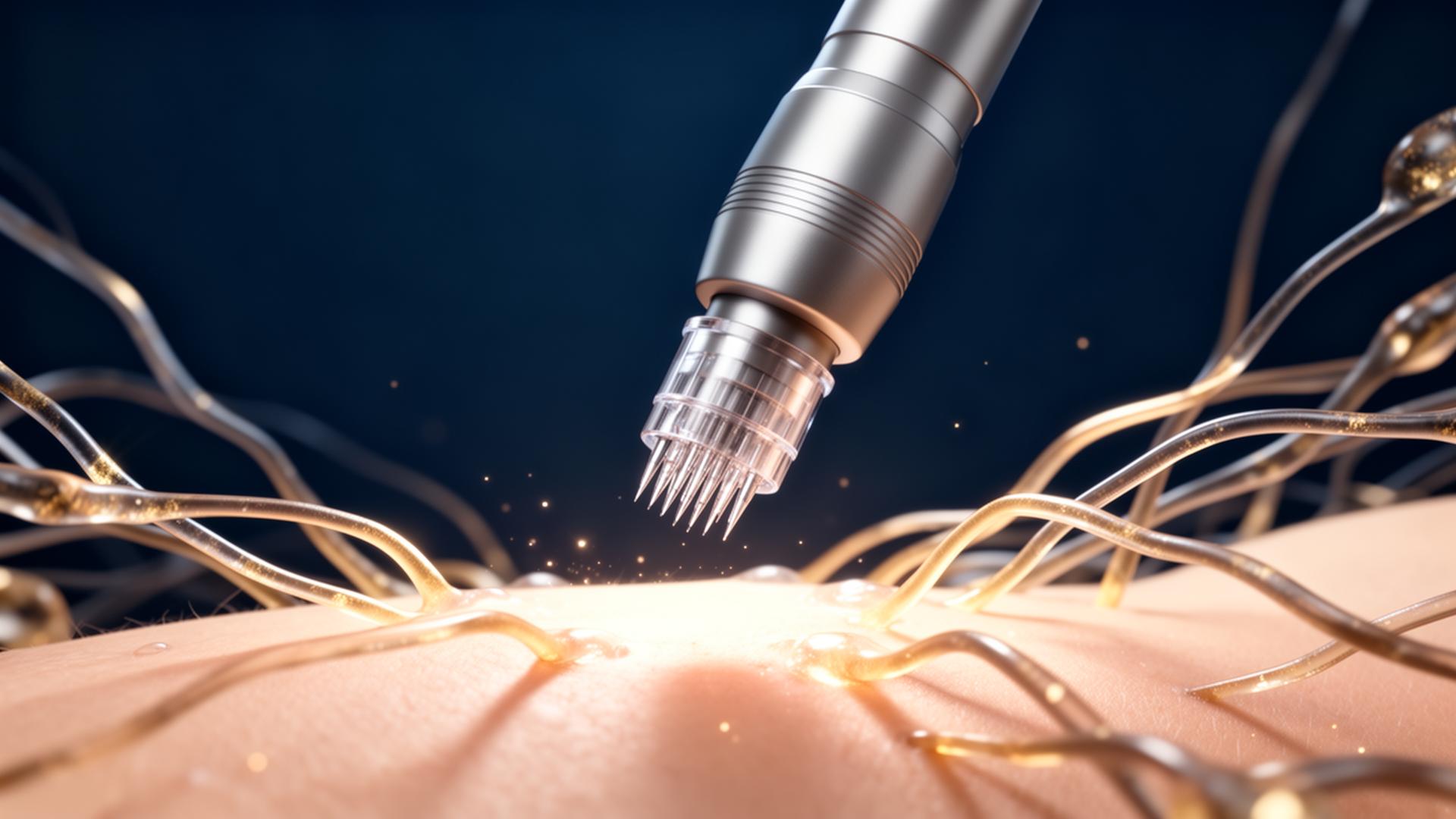
High-end render of a microneedling pen above luminous skin with regenerating collagen fibres
    Online Skin Rejuvenation Course

    Microneedling Online Course

    A precise, evidence-led online course on collagen induction therapy with dermastamp and motorised devices — depth selection, vector planning, combination protocols and complication avoidance, all delivered by the HSI clinical faculty.

    Duration5–7 hours
    AiCE Points6
    CPD6 hours
    ForMedical & skin pros

    Why microneedling deserves a serious online course

    Microneedling has suffered from being too easy to buy and too hard to do well. The barrier to entering the treatment is a low-cost device. The barrier to performing it competently is a precise understanding of skin anatomy, depth selection, vector control and the post-treatment cascade. This course closes that gap. It is unapologetically clinical, taught by injectors who use microneedling as a primary skin tool and who have built their reputations correcting other people’s outcomes.

    You will learn the difference between a rolled, dragged or tracked treatment that leaves linear marks for weeks, and a clean, even-coverage treatment that initiates collagen remodelling without visible downtime beyond the expected 24-hour erythema. You will learn how to talk a patient out of a microneedling treatment when their barrier is too compromised to tolerate it — and how to repair that barrier first using the principles taught in our companion Skin Health Restoration course.

    The course is delivered as HD video, slide demonstrations and on-skin technique films. It is fully online, self-paced, lifetime access. You may pause and resume on any device and there is a final assessment with a downloadable certificate carrying AiCE / CPD points.

    Learning Outcomes

    What you will be able to do after this course

    Explain the wound-healing cascade triggered by microneedling.
    Select the correct device and depth for each indication.
    Plan a multi-vector treatment that delivers even coverage without tracking.
    Combine microneedling safely with topical actives and adjunct injectables.
    Recognise and manage common and rare complications.
    Build a 3–4 session treatment plan with measurable end-points.
    Curriculum

    Module-by-module breakdown

    1

    Microneedling: what it actually does

    The cellular cascade of controlled wounding — platelet release, growth factors, fibroblast stimulation and collagen remodelling.

    2

    Devices compared: stamps, rollers, pens

    Why CE-certified motorised devices and dermastamps outperform unregulated rollers, with cost-versus-outcome analysis.

    3

    Needle depth and indication mapping

    How to choose 0.25–2.5 mm depths by indication, anatomy and skin thickness, with practical zone-by-zone maps.

    4

    Patient selection and consent

    Contraindications, expectation-setting and consent that withstands regulator scrutiny.

    5

    Topical anaesthesia and asepsis

    Cream choice, application time, lidocaine safety, sterile field and single-use cartridge discipline.

    6

    Treatment technique step-by-step

    Vector planning, pass count, end-points, pressure control and how to avoid tracking and bleeding.

    7

    Combination protocols

    Microneedling with PRP, polynucleotides, exosome-style topicals, retinaldehyde priming and chemical peels.

    8

    Aftercare and complication management

    Day 0–14 aftercare protocol, infection prevention, post-inflammatory hyperpigmentation and tram-tracking.

    Devices, depths and the science of controlled wounding

    Not all microneedling is the same. The course opens with a clinical comparison of dermastamp, motorised pen and roller devices, including hygienic single-use cartridges, vibration frequency, needle gauge and the practical implications of each on outcome and complication rate. We make a clear, evidence-anchored recommendation in favour of CE-certified motorised devices and dermastamps for clinical practice.

    Depth selection is the single most underestimated variable in microneedling. We provide zone-by-zone depth maps for forehead, periorbital, midface, perioral, jawline, neck and décolletage, and we teach you why a 1.0 mm depth on the cheek and a 0.5 mm depth on the lower eyelid can produce identical clinical aims with very different safety profiles. The maps are downloadable as a one-page clinical reference for your treatment room.

    You will work through indication-led protocols for atrophic acne scarring, periorbital fine lines, post-pigmentation diffuse texture, traumatic and surgical scars, stretch marks and overall skin quality. Each protocol is timed across 3–4 sessions and includes the realistic photographic milestones at which improvement becomes visible.

    Combination protocols and complication avoidance

    Microneedling unlocks the skin to receive topical actives more efficiently. That is also what makes incorrect combinations dangerous. The course gives you a clear list of what may be applied immediately post-treatment, what must wait 24–72 hours, and what should never be combined with microneedling at all. We cover PRP, polynucleotides, retinaldehyde priming, vitamin C, peptide concentrates and the marketing-driven topicals you should be cautious about.

    Complication management is taught as a structured pathway: prevention, early recognition, escalation and resolution. We cover infection control, post-inflammatory hyperpigmentation, milia, granulomatous reactions, tram-tracking and the rare cases that require referral. You will leave with a printable complications protocol that mirrors the one used inside HSI clinics.

    The course pairs particularly well with the Sensitive Skin Repair Course for understanding how to choose patients whose barrier can tolerate the procedure, with the Aesthetic Facial Assessment course for treatment planning, and with the in-clinic Microneedling masterclass for those who want supervised hands-on practice afterwards.

    Eligibility

    Who this course is for

    • Doctors, dentists, nurses, prescribing pharmacists and aesthetic therapists.
    • Practitioners moving from rollers to motorised devices and needing a clinical reset.
    • Clinicians building combination protocols with PRP, polynucleotides or peels.
    • Trainees on the Skin Certificate Programme and the Certificate in Aesthetic Dermatology.
    FAQs

    Frequently asked questions

    Is this course practical or theoretical?

    It is a theoretical and protocol-level course with detailed on-skin technique films. For supervised hands-on practice, complete this course first and then book the in-clinic Microneedling masterclass.

    Which device do you teach with?

    We teach principles that apply to any CE-certified motorised microneedling pen and dermastamp, with explicit guidance on which device categories we recommend and why.

    Can non-medics enrol?

    Yes. Aesthetic therapists and skin specialists can enrol and benefit. Some sections assume baseline anatomy.

    How long does the course take?

    Five to seven hours of focused study, plus the end-of-module quizzes and final assessment.

    Do you cover combination with PRP and polynucleotides?

    Yes. There is a dedicated module on combination protocols including timing, dosing and contraindications.

    Is the certificate CPD-recognised?

    Yes. AiCE and CPD points are awarded on completion and recognised across UK appraisal portfolios.

    Will this prepare me for the Certificate in Aesthetic Dermatology?

    Yes. The microneedling module of CAD assumes the depth, vector and combination knowledge taught here.

    Do you offer refunds?

    Yes, within 14 days provided less than 20% of the content has been viewed.

    Ready to enrol?

    Join clinicians worldwide upgrading their skin science. Lifetime access, certificate on completion, instant access to your learning portal.

    Hey? What skill
    to learn!? 🎯

    AI