
Abstract
Hyaluronic acid fillers are water-rich implants whose clinical behaviour emerges from the interaction between a manufactured gel, living tissue and the way treatment is performed. Rheology offers a language for understanding that interaction, but familiar labels such as “high G′”, “soft”, “monophasic” and “low swelling” are frequently asked to predict more than the evidence supports. This narrative review and clinical opinion examines hydrogel structure, deformation and recovery, water uptake, tissue resistance, product placement, moulding and the interpretation of visible irregularities. Published laboratory comparisons are considered alongside regional tissue measurements and the author’s practical observations. The central argument is that product selection should be matched to a defined task within a specific tissue environment, rather than to a single numerical ranking. Particular attention is paid to the difference between maximum laboratory water uptake and clinical oedema, between tissue elastic modulus and filler storage modulus, and between clinician moulding and patient-directed aftercare. Rheology can sharpen judgement and identify plausible mismatches. It cannot independently establish an injection plane, guarantee symmetry, predict every complication or replace anatomical competence.
Scope: Educational narrative review and clinical opinion. Prepared September 2026. No original patient dataset or comparative intervention is reported.
Measure precisely
Keep formulation, frequency, strain and method attached to every laboratory value.
Plan in three dimensions
Define projection, transition, movement and distribution before choosing the syringe.
Preserve uncertainty
Do not turn laboratory capacity, personal observation or a memorable label into clinical proof.
1 / The brochure is the dating profile
Rheology is the filler’s personality profile. The brochure is its dating profile. You would be wise to learn the difference.
A product can appear charming in a photograph and become considerably more complicated when asked to live in a moving face. The useful questions are practical. Does the gel resist deformation?
Does it yield when the tissue moves? Does it recover after that movement? How does it distribute, how much additional water can it accommodate, and what does it feel like when the patient returns?
These questions connect laboratory language with the decisions an injector actually makes. Experience eventually teaches some of this. A clinician notices that one formulation moulds readily, another maintains a more distinct contour, and a third behaves differently in a lip than expected from its reputation elsewhere.
Rheology gives those observations a vocabulary. It also helps prevent an isolated experience becoming a universal rule about an entire brand. The purpose of learning the science early is not to replace judgement with a spreadsheet.
It is to ask better questions before experience supplies the answer through a patient who would rather not have been the lesson. The desired outcome is a more deliberate choice, not a more elaborate justification for a favourite syringe. This article is a narrative review with clinical opinion, not a systematic review, comparative treatment trial or validated prescribing algorithm.
Sources were selected for relevance to material testing, tissue mechanics and practical interpretation; no exhaustive search or formal risk-of-bias assessment was undertaken. Laboratory findings, clinical evidence and author observations are distinguished throughout. Product values describe the tested formulations and conditions, not necessarily every current market variant.
“Personality” is therefore a teaching metaphor. A gel is not angry, happy or cooperative. It has measurable properties whose expression depends on its surroundings.
The injector contributes another variable: the goal, amount, location and distribution of treatment. A disappointing result cannot automatically be blamed on the product’s temperament. Sometimes the wrong material has been asked to do the wrong job.
Sometimes the plan itself needs reconsideration.
| Level | Example | How to present it |
|---|---|---|
| Measured finding | G′ at a specified frequency | State formulation, method and source. |
| Clinical interpretation | A material may suit a support task | Explain the reasoning and its limits. |
| Author observation | More moulding with one product | Do not present it as comparative proof. |
2 / A hydrogel is already wet
A hydrogel is a three-dimensional polymer network containing a substantial amount of water. In the products discussed here, hyaluronic acid forms the network. Crosslinks connect chains and help the gel retain structure rather than behave like an unmodified HA solution.
The finished syringe already contains hydrated material; it is not a dry sponge waiting for its first drink. Commercial manufacture commonly begins with microbial production and purification of HA. Crosslinking, often using BDDE, is followed by processing steps that can include washing, hydration, sizing or homogenisation, filling and sterilisation.
Molecular weight, reaction conditions and subsequent processing influence the finished material. Equal HA concentrations therefore do not establish equivalent gels. [1] The traditional distinction between biphasic and monophasic products concerns gel organisation and processing.
Biphasic describes crosslinked gel particles within a carrier containing soluble HA. Monophasic describes a more homogeneous processed gel, but does not establish that the material contains no particles or fragments. Particle-size distribution and HA molecular weight are separate concepts.
[1] This matters because terminology can quietly become a quality ranking. “Monophasic” sounds reassuringly unified; “biphasic” can sound unnecessarily complicated. Neither impression is evidence.
A clinician needs the exact formulation and its measured behaviour, rather than an adjective that happens to fit neatly on a training slide. The practical interpretation is to ask what the network permits and restrains. A gel can occupy space immediately, deform under force, exchange water with its surroundings and change over time.
These processes are related but should not be collapsed into a single claim such as “it integrates beautifully”. Integration itself requires a definition: visible blending, microscopic distribution, comfortable palpability and persistence are not interchangeable endpoints. For consultation and teaching, I would explain the implant in ordinary language first: this is a water-rich material designed to create a particular effect in tissue.
Then I would specify the effect. Is the objective projection, a smoother transition, local definition or a change in skin appearance? Calling all of these “hydration” obscures the differences that matter when selecting a product and evaluating whether treatment worked.

| Term | Meaning |
|---|---|
| Phase terminology | Traditional description of gel organisation and processing. |
| Particle-size distribution | The spread of finished particle or fragment sizes. |
| Molecular weight | Length of HA polymer chains. |
| HA concentration | Amount of HA per volume; not a complete mechanical profile. |
3 / One number cannot describe a personality
Storage modulus, G′, describes the elastic component of the response to oscillatory shear. Loss modulus, G″, describes its dissipative component. Their ratio, tan δ = G″/G′, describes the balance between those components at the stated test conditions.
The ratio does not reveal their absolute magnitude: two gels can share a tan δ while differing substantially in both moduli. [2] These measurements need their conditions. Frequency, strain, temperature and instrument geometry matter.
A 1 Hz manufacturer result cannot be dropped into a 5 Hz comparison and treated as part of a single stiffness league table. Small-strain measurements also do not establish what happens after the network is subjected to much greater deformation. Resistance to deformation and recovery are separate questions.
A gel can deform substantially and then recover; another can resist an initial force yet respond differently once a threshold is exceeded. “High G′ springs back, low G′ stays flat” is an attractive cartoon that asks one measurement to answer two questions. It should not become the reader’s permanent mental model.
[3] Cohesion adds another dimension, but its interpretation depends on how it is tested. A visual dispersion assay and a quantitative mechanical measurement are not automatically interchangeable. Published work has examined relationships between cohesion and other physicochemical characteristics; that does not make any one cohesion score a universal guarantee against displacement or migration.
[4] More recent research examining 24 commercial fillers combined oscillatory testing with nonlinear mechanical behaviour, tensile testing and degradation assessment. Its value is the broader framework: conventional shear moduli alone do not fully describe the material. It does not supply a clinically validated equation that selects a filler for every face.
[5] For the injector, this is a reason to become more specific rather than more intimidated. Ask whether a reported property is relevant to the intended task. A product intended to maintain a contour under compression needs more consideration than a familiar G′ value.
A product intended for a mobile lip needs consideration of movement beyond the tiny oscillations used in some laboratory measurements. The number is useful when it answers a defined question. Without that question, it is merely a confident-looking accessory.
Lasting deformation
Shape remains altered after force is removed.
Elastic recovery
Recovery is distinct from small-strain stiffness.
4 / Compare products without inventing a winner
Product tables are useful because memory is vulnerable to branding. The name of a familiar family can create the impression that all its members behave alike. They do not.
Equally, increasing numbers in a product name should not be assumed to describe a linear increase in stiffness, flexibility, swelling or any other property. Table 2 presents selected values from one published 5 Hz framework. Redensity II and Ultra Deep have been retained by their tested PureSense names.
Their values belong beside the other products in that dataset; they should not silently be transferred to differently named or reformulated versions. The original authors had manufacturer affiliations. That disclosure is relevant context, not a reason to discard the measurements.
[2] Stylage requires a separate panel. The cited manufacturer poster reports 1 Hz results for M, XL and XXL. Special Lips is included as an explicit data gap, rather than supplied with a plausible-looking estimate.
“Not verified” is a more useful entry than a number borrowed from Lips Plus or inferred from another product in the family. [6] The table should support questions, not end them. If two formulations have similar G′ values, what differs in recovery, compression, cohesion, swelling or clinical evidence?
If their reported values differ markedly, were the methods comparable? If a product performs well in one clinician’s hands, how much of that result depends on their selection, placement and follow-up rather than the gel alone? I would use these comparisons as an educational starting point, not a purchasing recommendation.
The relevant question is not whether one brand has won the table. It is whether the product’s full profile and evidence fit a specific treatment objective. A technically impressive material may still be unsuitable for the particular patient or concern in front of the injector.
There is also a publication discipline here. A review should preserve uncertainty in the body of the table, not hide it in a footnote that nobody reads. State the test frequency, identify the formulation, retain the source and leave missing information visibly missing.
The rep may bring coffee. The paper still needs reading.
Selected 5 Hz storage modulus values
Visual comparison within the 5 Hz source framework only. A longer bar is not a clinical winner.
| Product / dataset | G′ (Pa) | G″ (Pa) | tan δ |
|---|---|---|---|
| Belotero Soft+ | 40 | 42 | 1.050 |
| Belotero Balance+ | 128 | 82 | 0.641 |
| Belotero Volume+ | 438 | 103 | 0.235 |
| Juvéderm Volbella with lidocaine | 271 | 39 | 0.144 |
| Juvéderm Voluma with lidocaine | 398 | 41 | 0.103 |
| Juvéderm Volux | 665 | 49 | 0.074 |
| Restylane Refyne | 116 | 50 | 0.431 |
| Restylane Kysse | 236 | 50 | 0.212 |
| Restylane Lyft | 977 | 198 | 0.203 |
| Teosyal PureSense Redensity II | 114 | 43 | 0.372 |
| Teosyal PureSense Ultra Deep | 348 | 54 | 0.155 |
| Teosyal RHA2 | 319 | 99 | 0.310 |
| Teosyal RHA3 | 264 | 67 | 0.254 |
| Teosyal RHA4 | 346 | 62 | 0.179 |
| Product / dataset | G′ (Pa) | G″ (Pa) | tan δ |
|---|---|---|---|
| Stylage M | 195 | NR | 0.18 |
| Stylage XL | 290 | NR | 0.16 |
| Stylage XXL | 290 | NR | 0.13 |
| Stylage Special Lips | NV | NV | NV |
NR = not separately reported. NV = not verified for Special Lips and not interchangeable with Lips Plus. Poster data: cone-plate, 0.8% strain; anaesthetic variant unspecified. Do not rank this panel against the 5 Hz panel.
5 / Swelling: one word, several mechanisms
“Swelling” can refer to different events. The gel may take up additional water. The surrounding tissue may accumulate inflammatory fluid after trauma.
Drainage may be impaired. A delayed inflammatory process may arise after an initially settled interval. These mechanisms can coexist, and the photograph immediately after treatment cannot reliably separate them.
[7] This distinction is clinically useful because the explanation changes the next question. A contour that appears fuller during treatment does not prove rapid gel hydration. Persistent lower-eyelid puffiness should not automatically be described as an implant still “settling”.
New tenderness, redness or nodules after a quiet interval require assessment of their cause rather than a generic reassurance about HA attracting water. The material is already hydrated at injection. Additional uptake depends on the network and the test environment; within comparable networks, crosslinking can restrain expansion.
Commercial products differ in several interacting characteristics, so neither HA concentration nor G′ alone determines the complete swelling profile. Laboratory water-dynamics research further illustrates that the interaction between water and the gel is more complex than a simple dry-sponge analogy. [8] In the dataset reproduced here, maximum uptake for Redensity II and Ultra Deep was similar, while RHA2 was higher.
Restylane products also differed substantially from one another. Those findings are about the unconstrained assay, not the percentage by which a patient’s lip or chin will enlarge. They do not establish the time required to reach a settled clinical contour.
[2] In my practice, Redensity II often produces little noticeable swelling in appropriately selected patients. That is a useful observation to disclose, not a promise of zero oedema. The EYELIGHT observational study recorded swelling and a device-related oedema event, and the product instructions recognise swelling as a potential reaction.
A good experience with a product should sharpen patient selection, not abolish the consent conversation. [9,10] The practical endpoint is therefore the settled contour, comfort and tissue response, not the maximum amount of water a sample can absorb in a laboratory. Desirable volume and unwanted oedema can look deceptively similar in a still photograph.
Time, symptoms and examination help distinguish them. The syringe contains a measured volume; the face is under no obligation to present it unchanged.
| Tested product | Reported maximum |
|---|---|
| PureSense Redensity II / Ultra Deep | 239% / 250% |
| Teosyal RHA2 / RHA3 / RHA4 | 420% / 427% / 366% |
| Restylane / Lyft | <100% / <100% |
| Restylane Refyne / Kysse / Defyne | 516% / 373% / 318% |
Unconstrained laboratory maxima, not clinical swelling percentages or predicted in-vivo volume increase.
6 / Placement is three-dimensional
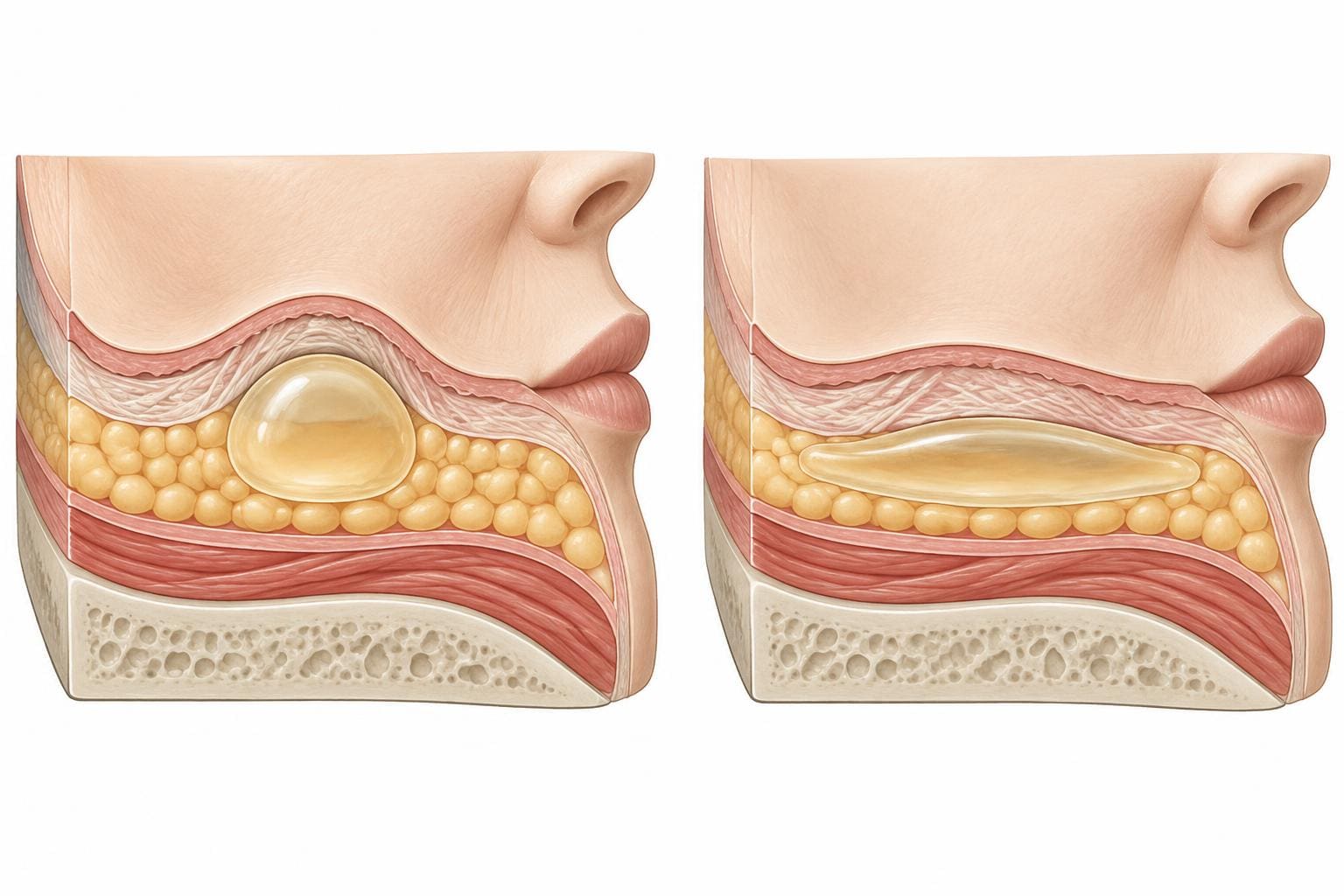
We place a hydrogel in three dimensions. Its location, distribution and potential for additional hydration contribute to the result. The surrounding tissue limits and redirects what the implant can do.
A two-dimensional dot on an injection diagram is therefore a reminder of a plan, not a complete description of the final shape. My practical question is where more support or fullness is wanted and where it is not. A focused deposit and a broader distribution can create different local geometries.
Additional hydration may contribute, but the implant already occupies space and displaces tissue. Contouring should not be described as simply hydrating one region more than another. The treatment plane matters because the desired effect belongs to a particular anatomical and mechanical environment.
“Which layer should I hydrate?” is less precise than “which tissue effect am I trying to achieve, and where can this product appropriately achieve it?” This wording also discourages the assumption that every layer or region needs treatment merely because it can be named.
Symmetry requires the same discipline. Equal volumes placed in mirror-image positions do not guarantee balanced contours when baseline anatomy differs. Conversely, different volumes or distributions do not necessarily represent poor symmetry if they address different starting conditions.
The endpoint should be the face at rest and in movement, with a documented objective, rather than identical syringe readings. This is a clinical planning principle, not a licence to improvise anatomy. Product indication, tissue assessment and regional competence remain decisive.
A pleasing contour on the treatment couch cannot establish that the implant occupies the intended plane or that the technique was safe. Visual appearance and anatomical correctness are different forms of evidence. For teaching, I favour asking the trainee to describe the intended three-dimensional change before naming the product.
What should project? What should blend? What should remain mobile?
What should be left alone? The answers make a later discussion of stiffness, swelling and mouldability relevant. Starting with the favourite syringe reverses that sequence and encourages every concern to look like a suitable use for the material already in the drawer.
7 / The tissue has a personality too
A gel does not operate in empty space. Skin, fat, muscle, fibrous attachments, bone and previous treatment contribute to its mechanical environment. Clinicians often use “tight”, “thick”, “dense” and “firm” as shorthand, but these words describe different features.
Tissue thickness is not stiffness; pre-existing tension is not the same thing as material density. Elastic modulus, E, describes resistance to tensile or compressive strain under a stated model. Structural stiffness, k, is the change in force per displacement and depends on geometry as well as material.
Compliance describes ease of deformation. A volume compliance can be expressed as dV/dP, while its inverse describes how pressure changes with added volume. The last relationship is conceptually close to the injector’s question: how much does this local tissue environment resist accommodating additional material?
However, it is not an established bedside score. It cannot be reliably calculated from a regional modulus, and it should not be used to infer a safe injected volume or product requirement. Martelly and colleagues estimated regional elastic moduli by indentation in 28 participants.
The chin mean was 53.04 kPa, compared with 16.20 kPa at the cheek, with substantial variation. Their work concerned personalised facial modelling and CPAP-mask fit, not filler selection. These are useful demonstrations of regional differences, not calibrated readings of each injection plane.
[11] Luboz and colleagues used a different method: suction with inverse modelling in 16 young participants. They estimated an initial lower-lip Young’s modulus of 33.7 kPa. That value should not be combined with the indentation study to construct a precise chin-to-lip ratio.
The population, loading and assumptions differ. [12] Most importantly, tissue E and filler G′ are not interchangeable just because both use pascals. The former describes a tensile or compressive response under a model; the latter describes elastic behaviour in oscillatory shear.
A chin value of 53 kPa does not prescribe a filler with G′ of 53,000 Pa. The shared unit does not make the experiments equivalent. Tissue measurements enrich our understanding, but they do not yet provide a validated conversion from facial resistance to syringe selection.
| Study and site | Estimated E, kPa |
|---|---|
| Indentation, n = 28 [11] | Mean ± SD |
| Chin | 53.0 ± 21.0 |
| Cheekbone / below cheekbone | 64.8 ± 17.1 / 27.1 ± 11.4 |
| Cheek / cheek near lip | 16.2 ± 5.1 / 16.3 ± 8.4 |
| Suction and modelling, n = 16 [12] | Separate method |
| Lower lip | 33.7 ± 7.3 |
These studies used different populations, loading methods and models. Filler G′ and tissue E must not be matched numerically.
8 / Chin, jawline and lips: different jobs
Mechanical compatibility means choosing behaviour suited to the intended task, not necessarily reproducing the stiffness of untreated tissue. An implant used to create projection may deliberately add support. An implant used to refine a mobile lip must coexist with repeated movement and an acceptable feel.
These goals overlap, but they are not identical. For chin projection, relevant considerations include support under compression, shape retention, deformation tolerance, swelling and the constraints of the soft-tissue envelope. A recent laboratory study of four chin fillers demonstrated different rheological and swelling profiles despite shared clinical purposes.
The authors acknowledged that clinical trials were needed to establish whether those measured characteristics translate into superiority. [13] For the jawline, the task may change along the region. A local structural effect, a smoother transition and reduction of a visible contour discrepancy are different objectives.
Calling the entire jawline one compartment encourages the mistaken belief that one mechanical profile, distribution and endpoint should be repeated everywhere. For the lips, the treated tissue should remain comfortable during speech, smiling and ordinary function. Product flexibility and recovery matter, but so do the amount, distribution, placement and existing tissue.
A formulation described as soft does not guarantee an inconspicuous result, especially if the treatment geometry creates focal fullness or an unwanted ridge. These are interpretations of mechanical principles, not numerical thresholds validated in clinical trials. They should sit alongside product-specific evidence and instructions.
Rheology can help identify a mismatch between a proposed task and a material profile; it cannot establish an anatomical plane or make a particular region risk-free. This distinction is especially valuable in training. Instead of teaching “high G′ for the chin, low G′ for the lips” as a sufficient rule, ask what the treatment needs to withstand and what the patient needs to feel.
The answer may involve compression, movement, tissue coverage, local definition or a need to avoid additional fullness. The product choice should emerge from that conversation. A memorable rule is useful only while its limitations remain memorable too.
| Task | Questions beyond G′ |
|---|---|
| Chin projection | Compression, shape retention, swelling, tissue constraints? |
| Jawline transition | Distribution, mouldability, coverage, palpable edges? |
| Mobile lip volume | Deformation tolerance, recovery, comfort, swelling? |
| Lip border definition | Local support without unwanted rigidity or fullness? |
9 / Moulding is a skill, not a closing gesture
In my practice, I often spend more time moulding than injecting. Depositing material and refining its contour are related but distinct tasks. I use deliberate moulding, sometimes firm, when appropriate to the product, region and intended result.
The endpoint is the shape and feel of the treated area, not a prescribed number of movements. In the lips, my aim is distribution within the intended treatment area rather than conspicuous tracks or unwanted focal fullness. That does not mean uniformly filling the whole lip or flattening its natural tubercles.
Uneven distribution may contribute to an irregular appearance, but volume, placement, swelling, existing anatomy and inflammatory complications can also produce apparent lumps. I have found that Ultra Deep often needs more moulding along the jawline in my hands, whereas RHA2 commonly needs less. These are author observations without controlled comparison.
They do not establish a general difference in hydration speed, and an immediately improved contour does not prove that massage has increased water uptake. Redistribution is the more direct explanation for a visible change during moulding. Altering deposit geometry might affect water exchange, but that remains a hypothesis here.
Maximum laboratory uptake cannot validate it. Refyne’s instructions describe gentle clinician massage for contour and even distribution; they do not establish a protocol for accelerating hydration. [14] Home massage is a separate intervention.
When I judge it appropriate, one routine I use is approximately 20 seconds daily for two weeks. I demonstrate the movement through clean gauze, then watch the patient reproduce the location, direction and intended pressure. Purposeful contact must be demonstrated rather than guessed from the word “firm”.
This schedule is personal practice, not an evidence-validated regimen for every filler or lip. It requires an individual indication, start time, limits and reconciliation with the exact product instructions. It should not automatically be extended to the under-eye or other regions.
Increasing pain, redness, heat, swelling, skin injury or new lumps require review; blanching, dusky skin or visual symptoms require urgent assessment. Gauze does not make excessive pressure safe, and a complication should not be managed by simply telling a patient to massage harder.
| Step | Required distinction |
|---|---|
| Demonstrate | Specify site, movement, pressure and timing. |
| Observe | Ask the patient to reproduce the technique. |
| Limit | Clarify duration and when to stop; do not generalise across sites. |
| Review | New or worsening symptoms need assessment, not increased pressure. |
Safety checkpoint. Increasing pain, redness, heat, swelling, skin injury or new lumps require review. Blanching, dusky skin or visual symptoms require urgent assessment.
10 / Blue is a finding, not a diagnosis
Superficially visible HA filler can be associated with a blue-grey appearance, particularly beneath thin tissue. Clinicians often call this the Tyndall effect. The conventional explanation involves wavelength-dependent scattering, but the accuracy of applying that label to every filler-related blue hue has been questioned in the literature.
[15] The physics needs careful language. In the ideal Rayleigh regime, scattering depends approximately on the inverse fourth power of wavelength, favouring shorter wavelengths. That model assumes scatterers much smaller than the wavelength.
A commercial gel inside living tissue is not adequately described by drawing a large particle and announcing that it reflects blue light. The useful clinical message is that appearance depends on the optical interaction of gel and tissue, including depth, rather than blue pigment appearing in the syringe. Visible vessels, bruising and pigment may also produce blue or dark appearances.
A new dusky change accompanied by pain or perfusion abnormalities must not be dismissed as a cosmetic optical effect. [7] This example illustrates a wider problem in aesthetic teaching: a memorable label can replace the examination it was meant to support. “Tyndall”, “migration”, “water retention” and “poor integration” can become explanations before the underlying finding has been defined.
A review should resist that shortcut, even when the shorthand makes the prose easier to write. The same restraint applies to claims that rheology predicts complications. Material properties can inform the anticipation of swelling, palpable behaviour or a mismatch with a treatment objective.
They do not supply a validated individual probability of vascular occlusion, delayed inflammation or an unacceptable contour. A material description should never be mistaken for a complication-prevention guarantee. For the reader, the practical sequence is to describe the finding, establish its timing and associated symptoms, examine the tissue and consider the treatment history.
Product characteristics can then contribute to the explanation. They should not be recruited first to defend a preferred theory. The gel has a personality, but it is not obliged to explain everything that happens after treatment.
11 / What the paper can claim
The defensible claim is that rheology improves the structure of clinical reasoning. It helps identify the questions to ask about a product and prevents some category errors: phase terminology is not particle-size distribution; maximum water uptake is not clinical oedema; G′ is not compression resistance; tissue modulus is not a direct filler prescription. The stronger claims remain unproven.
There is no validated formula in the evidence reviewed here that converts a patient’s chin stiffness into a required product G′. There is no demonstrated hydration benefit for the author’s firm moulding approach, and no trial evidence supplied here validating the described two-week home-massage schedule. Those limitations should remain visible when the article is shortened for teaching or adapted into a lecture.
Future studies could make the connection more useful. Product comparisons should report exact formulations, conditions and repeatability. Tissue measurements should specify site, layer sensitivity, muscle state and modelling assumptions.
Clinical studies should record actual treatment geometry, volume, baseline anatomy and relevant previous procedures instead of attributing the outcome solely to the brand. A prospective study of moulding could compare clearly specified approaches using appropriate ethical oversight, standardised photography, palpability assessment and patient-reported outcomes. Imaging might help assess distribution.
Any hydration claim would require a measurement capable of separating implant water uptake from surrounding oedema; a photograph alone cannot do that work. For current practice, the sequence is simpler: define the concern, establish the intended tissue effect, choose an appropriately supported material, place it competently, evaluate the immediate response and review the settled result. Where moulding or home care is prescribed, specify why and how the endpoint will be judged.
Document what is observation and what is inference. The personality metaphor earns its place if it encourages curiosity rather than certainty. Experience teaches the injector what often happens.
Research tests whether that impression survives comparison. Neither should be used to silence the other. Know the personality of the filler and the environment you are asking it to live in.
Then remember that the patient is a person, not a rheometer with a booking deposit.
Practical sequence
- 1. Define the concern.
- 2. Establish the intended tissue effect.
- 3. Choose an appropriately supported material.
- 4. Place it competently.
- 5. Evaluate the immediate response.
- 6. Review the settled result.
References and declarations
Author context and disclosure. The author is founder of Cosmedocs, Harley Street Institute and Harley Street Formulations and has commercial interests in aesthetic treatment, education and skincare. Filler-brand relationships, funding and any additional disclosures should be confirmed by the author before journal submission. No manufacturer endorsement is implied.
Editorial status. Prepared with AI-assisted drafting and layout. This is an author-review manuscript, not a peer-reviewed publication. The author should verify the final interpretation, references, affiliations and disclosures before submission. Numerical tables are historical source-specific comparisons. Local product instructions govern clinical use.
- Manufacturing Process of Hyaluronic Acid Dermal Fillers. Polymers. 2024;16:2739. Verified source
- de la Guardia et al. Rheologic and physicochemical characteristics of HA fillers. 2022. Manufacturer-affiliated authors. Verified source
- La Gatta et al. Hyaluronan dermal fillers: wider biophysical characterization and correlation with clinical outcome. 2020.
- Edsman and Öhrlund. Cohesion of hyaluronic acid fillers: correlation between cohesion and other physicochemical properties. 2018.
- Zhu et al. Integrated mechanical and structural characterisation of 24 commercial hyaluronic acid fillers. J Colloid Interface Sci. 2026;713:140085.
- Bigand et al. Mechanical characterization of Stylage dermal fillers versus clinical performances and injection plans. WBC2020 poster 4410. VIVACY authors.
- Complication Management Following Rejuvenation Procedures with Hyaluronic Acid Fillers: An Algorithm-Based Approach. 2019.
- Kruk et al. Mechanism of water dynamics in hyaluronic dermal fillers revealed by nuclear magnetic resonance relaxometry. 2019.
- Bhojani-Lynch et al. Real-world evidence on the routine use, efficacy and safety of an HA-based dermal filler in the periorbital region. 2025.
- Teoxane. TEOSYAL PureSense Redensity 2 instructions for use. Product-specific information; consult the current local version.
- Martelly et al. Development of a novel soft tissue measurement device for individualized finite element modeling in custom-fit CPAP mask evaluation. 2024.
- Luboz, Promayon and Payan. Linear elastic properties of facial soft tissues using an aspiration device: towards patient specific characterization. 2014.
- Carbone et al. Rheological and structural analysis of hyaluronic acid fillers used for chin augmentation. 2026.
- Galderma. Restylane Refyne, US instructions for use. Revision September 2023. Local indications and instructions may differ.
- Does the Tyndall effect describe the blue hue periodically observed in subdermal hyaluronic acid gel placement? 2014. Verified source