
Dual Wavelength
Fat + skin in one pass
FDA / UKCA Devices
Trained on certified systems
Machine Finance
3 months no payment · lease-per-use
Harley Street Faculty
1:1 supervised hands-on
Why a single wavelength is no longer enough
Most early endolaser systems used one wavelength and forced the practitioner to choose between fat reduction or skin tightening. A dual-wavelength fibre lift does both — sequentially or blended — in a single session. That is the clinical difference patients pay a premium for.
| Wavelength | Primary chromophore | Clinical effect | Where it’s used |
|---|---|---|---|
| 980 nm | Adipose tissue | Selective lipolysis · debulking | Jowls, submentum, buccal area |
| 1470 nm | Water (dermis) | Immediate collagen contraction · neocollagenesis | Brow, midface, jawline, neck skin |
| Dual (980 + 1470) | Both | Lift + tighten + selective fat reduction | Full-face contouring in a single session |
Treatment areas, time & income
UK market averages observed across London and major-city aesthetic clinics. A single full-face client typically covers your monthly machine lease.
| Treatment area | Average UK price | Time in chair | Repeat interval |
|---|---|---|---|
| Full face & neck | £2,000 – £3,500 | 60–90 min | 12–18 months |
| Jowls only | £900 – £1,200 | 30–45 min | 12–18 months |
| Jawline contouring | £1,200 – £1,800 | 45–60 min | 12–18 months |
| Chin contouring / definition | £800 – £1,200 | 30–45 min | 12–18 months |
| Submental (double chin) | £900 – £1,500 | 30–45 min | 12–18 months |
| Brow lift | £700 – £1,000 | 20–30 min | 12–18 months |
| Cheek lift | £900 – £1,400 | 30–45 min | 12–18 months |
Prices observed across UK aesthetic clinic public price lists. Individual clinics may price higher or lower depending on positioning, location and practitioner seniority.
FDA-approved, UKCA-certified dual-laser systems
We train on dual-wavelength endolaser systems that are FDA-cleared and UKCA-certified for subdermal aesthetic use. Through our finance partners, delegates can lease a machine on the following terms:
- Monthly lease payments — no large upfront capital required
- No payment for the first 3 months while you build a patient list
- Lease-per-use options available for low-volume early adopters
- A single full-face client (≈£3,500) typically pays back one month of lease
- Clinical and aftercare device support included
Finance terms are provided by independent third-party finance partners and are subject to status and individual approval.
Engineered for precision, not guesswork
Three engineering details separate a serious endolaser platform from the rest. We train delegates on the XL EndoLaser specifically because each one removes a known source of clinical error.
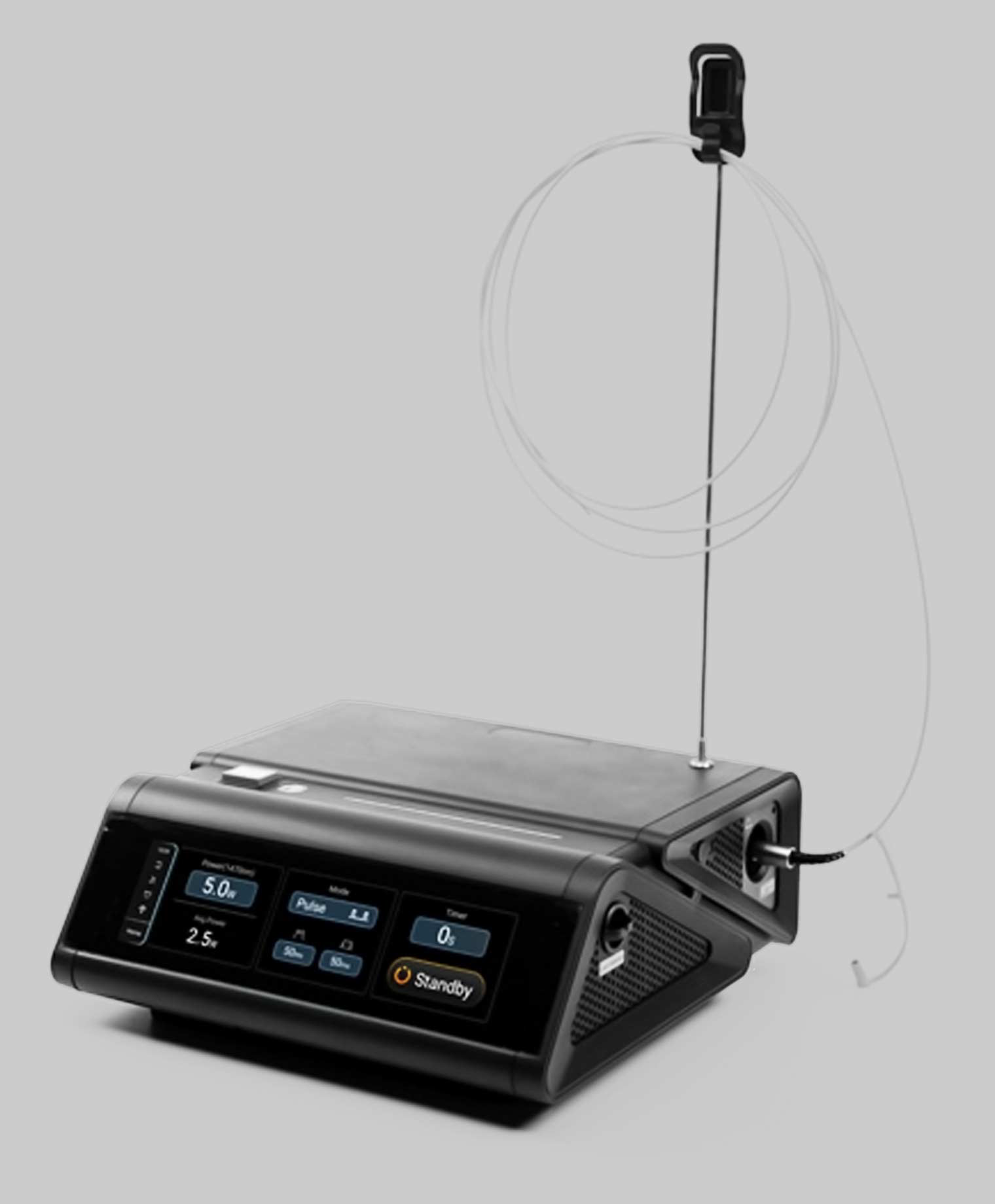
Real-time laser power meter
A world-first built-in power meter measures the actual energy leaving the fibre tip and self-calibrates to the value you set. What you dial in is what the patient receives — no drift, no surprises, no over- or under-treatment from a fibre that has degraded mid-case.
520 nm green aiming beam
A 520 nm green pilot light is far easier for the human eye to track than the conventional 650 nm red — particularly against the red of perfused tissue. The result: less eye fatigue across a long treatment list and a clearer view of exactly where the fibre tip is sitting under the skin.
SMA905 + NFC fibre recognition
The NFC-enabled SMA905 connector recognises only certified, manufacturer-traceable fibres and silently logs every use. It blocks counterfeit consumables, protects the patient, and gives you a defensible audit trail if a complication is ever queried.
Power precision. Target precision. Usage precision. Three quiet pieces of engineering that, together, take the guesswork out of subdermal laser work — and that is the platform we put in your hands during the course.
Device walkthrough — see the power meter, green aiming beam and NFC fibre recognition in operation.
The only Endolaser at Harley Street that is UKCA & CE approved
Many endolaser devices in circulation across UK clinics carry only a CE mark — the EU conformity standard. After Brexit, the UK introduced the UKCA (UK Conformity Assessed) marking, independently assessed against MHRA regulations for the Great Britain market. Our endolaser holds both.
UKCA Approved
UK Conformity Assessed
Independently certified for the UK market against MHRA medical device regulations. Required by law for Class IIb devices placed on the GB market.
CE Marked
European Conformity
Conforms to EU Medical Device Regulation (MDR 2017/745). Recognised across the European Union and the UK.
CQC-Registered Partner
PrivaDr Ltd
We work with PrivaDr Ltd, 10 Harley Street, London W1G 9PF — CQC-registered for all CQC-required treatments. Full clinical governance, safeguarding and complaints framework.
Why this matters before you book any endolaser
Endolaser is a Class IIb medical device — it cuts and delivers thermal energy beneath the skin. A clinic offering this treatment without a UKCA-marked device, a CQC-regulated facility, and a doctor trained on the specific platform is operating outside the UK regulatory framework.
Ask any provider for their device's UKCA certificate and the CQC registration number of the facility. We will show you both on request.
A serious one-day curriculum
Endolaser is not a beginner treatment. The standards we train to are deliberately high — physics, anatomy, technique, complications and clinic integration in a single intensive day.
Dual-Wavelength Laser Science
Why two wavelengths beat one: 980 nm targets adipose tissue (lipolysis), 1470 nm targets water in the dermis (collagen contraction & neocollagenesis). Tissue interaction, energy density (J/cm³) and safety thresholds.
Patient Selection & Consultation
Identifying ideal candidates for fibre lift vs surgical lift, vs HIFU, vs RF microneedling. Skin laxity grading, fat-pad assessment, contraindications, written consent and standardised photography.
Anatomy for Subdermal Laser
Layered facial anatomy, SMAS, retaining ligaments, danger zones, vascular and nerve mapping for the brow, midface, jowls, jawline and submentum.
Tumescent Anaesthesia & Access
Tumescent infiltration protocol, micro-cannula entry points, fibre depth control and aiming-beam verification.
Live Demonstration — Full Face & Neck
Step-by-step: brow lift, midface, jowls, jawline contouring, chin definition and submental tightening on a live model with both wavelengths.
Hands-On Practical
Each delegate performs supervised treatment on a model under 1:1 trainer ratio. Endpoint assessment, energy logging and finishing protocol.
Post-Care, Complications & Recovery
Compression garments, oedema management, recognition and management of burns, asymmetry, nodules and pigmentary change.
Clinic Integration & Pricing
Treatment menu design, lease-per-use machine economics, marketing the dual-laser advantage and patient pathways for repeat revenue.
Who can take this course?
An advanced revenue-generating treatment, taught only to those with the clinical foundation to deliver it safely.
Junior plastic surgeons
A non-surgical adjunct that complements your surgical menu and captures patients not yet ready for a facelift.
Dermatologists
A natural extension of cutaneous laser practice with high-margin aesthetic positioning.
Training doctors building side income
A premium treatment that needs only one client per month to cover machine lease.
Aesthetic doctors & nurse prescribers
For experienced injectors ready to add a non-injectable lifting and contouring treatment to the clinic.
Endolaser vs other lifting treatments
Where dual-wavelength fibre lift sits in the modern non-surgical lifting menu.
| Treatment | Targets fat? | Skin tightening | Downtime | Typical price |
|---|---|---|---|---|
| Dual-wavelength endolaser fibre lift | Yes (980 nm) | Strong (1470 nm) | 3–7 days | £2,000–£3,500 |
| Single-wavelength endolaser | Limited | Moderate | 3–7 days | £1,500–£2,000 |
| HIFU | No | Moderate | None | £800–£1,500 |
| RF microneedling | No | Mild–moderate | 1–2 days | £500–£1,200 |
| Surgical facelift | Yes (excision) | Maximal | 2–6 weeks | £10,000+ |
Many endolaser devices sold in the UK are not CE or UKCA approved
A growing number of subdermal fibre lasers — and full endolaser systems — are being marketed to UK clinics without valid UKCA or recognised CE marking, and without MHRA manufacturer registration. Using such a device on a paying patient is unlawful, uninsurable and a fast route to a fitness-to-practise referral. Before you buy any endolaser machine, verify the device is legal in the UK.
Grey-import devices
Cheap units rebadged from unregulated markets often carry a fake CE logo (the wider-spaced "China Export" lookalike) and no Notified Body number. They are not legal medical devices in the UK.
No Declaration of Conformity
A legitimate device ships with a written EU/UK Declaration of Conformity naming the device, its risk class and the Notified Body. If a supplier cannot produce one in writing, walk away.
No MHRA registration
Manufacturers placing medical devices on the UK market must register with the MHRA. The register is public. If the manufacturer is not on it, the device cannot be lawfully used clinically.
Pre-purchase checklist we teach on the course
- Valid UKCA mark, or CE mark recognised under MHRA transitional arrangements
- Notified Body four-digit number printed alongside the conformity mark
- Written Declaration of Conformity naming the exact model and risk class (typically Class IIb)
- Manufacturer entry visible on the public MHRA Device Registration database
- Instructions for Use (IFU) supplied in English with claimed indications
- Post-market surveillance and serious-incident reporting route in writing
- Local Authority laser registration (England) or HIS / HIW notification (Scotland / Wales)
- Clinic insurer confirms the specific make and model is covered, in writing
HSI trains delegates only on dual-wavelength endolaser systems that satisfy the full checklist above. We have no commercial obligation to any single manufacturer — our recommendation follows the regulation, not the discount.
Frequently asked questions
What is endolaser fibre lift?+
Endolaser fibre lift is a minimally invasive subdermal laser treatment delivered through a fine optical fibre. It contracts collagen, tightens the SMAS-adjacent tissues and selectively reduces stubborn fat — producing a measurable lift of the brow, midface, jawline and submentum without surgery.
Why dual laser instead of a single wavelength?+
A single wavelength compromises. 980 nm is absorbed by adipose tissue (precise fat reduction), while 1470 nm is preferentially absorbed by water in the dermis (collagen tightening). Using both — sequentially or blended — allows the practitioner to debulk fat and tighten skin in the same pass, which is why dual-wavelength fibre lift commands a premium price.
Who is the course for?+
The course is restricted to registered healthcare professionals. It is ideally suited to junior plastic surgeons, dermatologists, training doctors building a side income, and experienced aesthetic doctors and nurse prescribers seeking an advanced revenue-generating treatment.
Is this a beginner course?+
No. This is an advanced one-day training. Delegates should already be comfortable with subdermal cannula work and tumescent anaesthesia. Standards are deliberately high — endolaser is a serious treatment and we train it as such.
Do you supply the machine?+
We train on FDA-approved, UKCA-certified dual-wavelength endolaser systems and can introduce delegates to finance partners offering monthly lease deals with no payment for the first three months. In practice a single full-face client pays back the monthly lease.
How much can I charge for the treatment?+
Market rates in the UK are approximately £2,000–£3,500 for a full face and neck treatment, and around £1,000 for a focused jowl-only treatment. Pricing varies by city and clinic positioning — see the income table on this page.
How long does a treatment take?+
A focused jowl or chin treatment typically takes 30–45 minutes. A full-face and neck dual-laser session takes 60–90 minutes including tumescent infiltration.
What certificate is awarded?+
Delegates receive an HSI Advanced Endolaser Fibre Lift Certificate carrying CPD-equivalent learning hours, valid for clinic insurance documentation.
Is endolaser the same as Endolift?+
Endolift is a brand name for one specific subdermal fibre laser system; endolaser is the generic clinical term for any minimally invasive subdermal laser fibre treatment. The technique, anatomy and complications are the same. This course trains the underlying clinical skill on a dual-wavelength platform, so the training transfers across compliant devices.
Are all endolaser devices in the UK legal to use?+
No. A medical laser used on patients in the UK must carry a valid UKCA mark (or a recognised CE mark under the current MHRA transitional arrangements) and the manufacturer must be registered with the MHRA. A worrying number of devices being sold to UK clinics — particularly grey imports and rebranded units from unregulated markets — carry neither, which means using them clinically is unlawful and uninsurable. We teach delegates exactly how to verify markings, manufacturer registration and conformity documentation before they buy.
How do I check if a laser device is CE / UKCA approved?+
Ask the supplier for: (1) the UKCA or CE Declaration of Conformity naming the device and its medical device class, (2) the Notified Body number printed alongside the mark, (3) the MHRA manufacturer registration entry, and (4) the IFU (Instructions for Use) in English. If any of these are missing, the device should not be used on patients. We walk through real examples — including failed ones — during the course.
What does the built-in laser power meter actually do?+
It measures, in real time, the energy actually leaving the fibre tip and compares it to the value you have dialled in on the console. If the fibre has degraded mid-case, if the connector is contaminated, or if the source has drifted, the system self-calibrates and warns you. The clinical consequence is simple: the dose the patient receives is the dose you intended — not 30% less because the fibre is tired, and not 30% more because it has been over-cleaved. Most endolaser complications come from unknown delivered energy; an integrated power meter removes that variable.
Why does the 520 nm green aiming beam matter clinically?+
Conventional aiming beams use 650 nm red light, which is poorly distinguished against perfused, erythematous skin and against blood at the cannula entry point — exactly where you need to see it most. The human eye is roughly four times more sensitive to 520 nm green at typical clinic illumination, so the pilot dot stays crisp and locatable through the dermis even on darker skin types. Across a long treatment list this means less eye strain for the operator and, more importantly, a more confident read of where the live fibre tip is sitting subdermally.
How do the SMA905 connector and NFC fibre recognition improve safety and record-keeping?+
The SMA905 is a precision optical connector that locks the fibre into the source with sub-micron alignment — poor coupling is a common cause of unpredictable output and connector burn-back. The NFC chip embedded at the connector then performs three jobs: (1) it authenticates the fibre as a certified, manufacturer-traceable consumable and refuses to fire on counterfeit or expired ones, (2) it logs every use — date, duration, energy delivered — to a private record only the practitioner can read, and (3) that log becomes a defensible audit trail if a complication is ever queried by an insurer, the MHRA, or a regulator. In short: you cannot accidentally use a fake fibre, and you can always prove what you did.