
The Epidermis
Layers, skin cycle & sensitized skin turnover
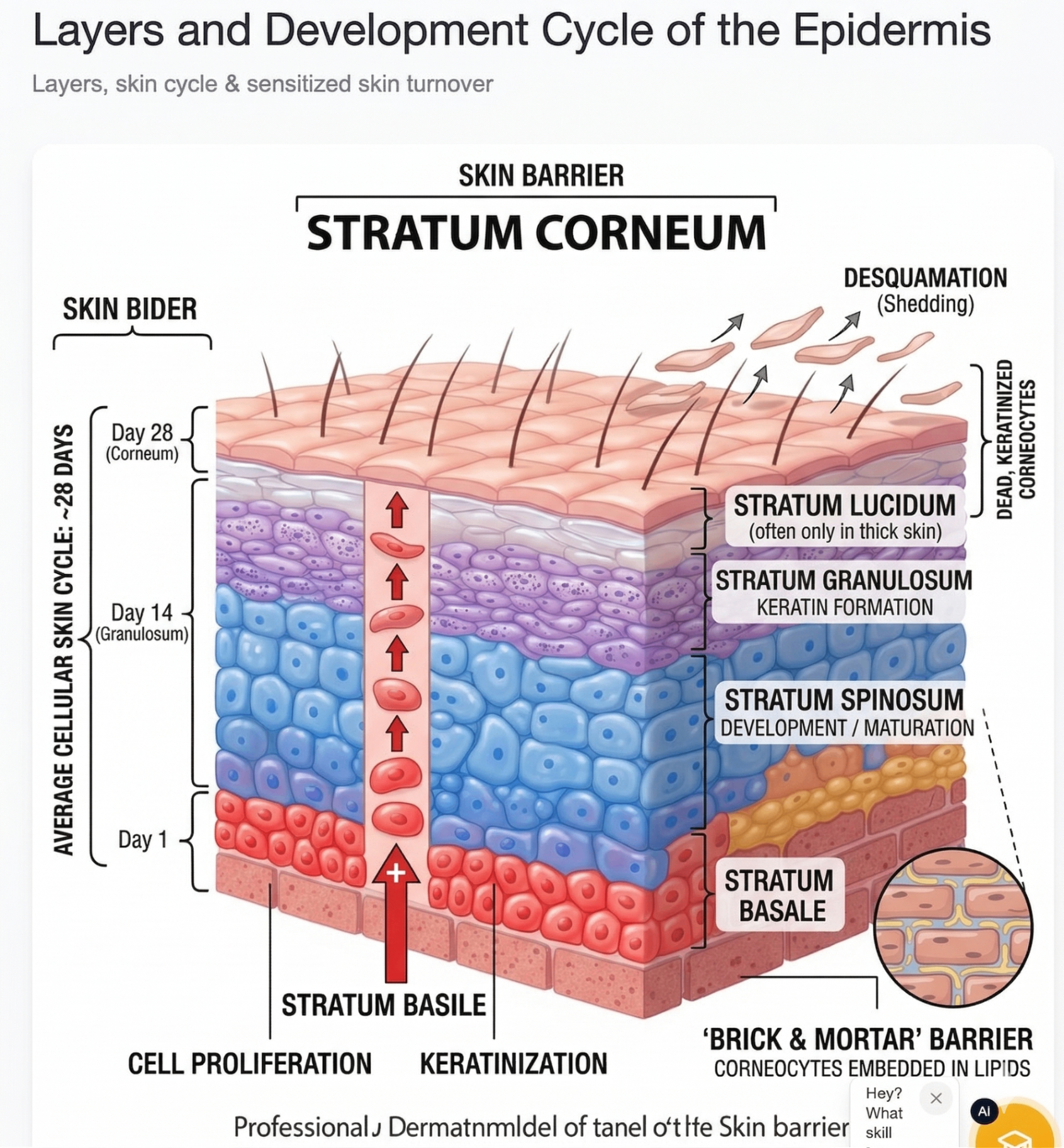
The epidermis is the outermost layer of the skin and serves as the primary barrier between the body and the external environment. It is composed of four key sublayers, each with a distinct role in skin health and renewal.
The stratum basale (basal layer) is the deepest layer of the epidermis. It contains stem cells that continuously divide to produce new keratinocytes, as well as melanocytes — the cells responsible for pigment production. This is where the skin renewal cycle begins.
Above it lies the stratum spinosum (spiny layer), which provides structural strength through intercellular connections called desmosomes. Langerhans cells, part of the skin's immune defence, are also found here.
The stratum granulosum (granular layer) is where cells begin to flatten, lose their nuclei, and release lipids that will form part of the barrier. This is the transition zone between living and dead cells.
The stratum corneum is the outermost layer — composed of dead, flattened cells (corneocytes) embedded in a lipid matrix. This is the primary protective barrier that prevents water loss and blocks harmful substances. Many aesthetic treatments, including exfoliation and chemical peels, directly target this layer.
The skin renewal cycle — also called epidermal turnover or desquamation — is the process by which new cells form at the basal layer, migrate upward through each sublayer, and are eventually shed from the surface. In young, healthy skin, this cycle takes approximately 28 days. The skin appears fresh, smooth, and evenly toned because cell turnover is efficient.
With age, the skin cycle slows significantly. By the age of 40–50, turnover may take 45–60 days or longer. This results in a dull, uneven complexion, rough texture, and accumulation of dead cells on the surface. Collagen production also declines, compounding the visible signs of ageing.
In sensitized skin — whether from over-treatment, product overuse, or barrier damage — the renewal cycle becomes disrupted in a different way. The barrier is compromised, so the skin attempts to repair itself by accelerating cell production. However, because the barrier is damaged, these new cells are often immature and poorly formed. They reach the surface before they are fully developed, resulting in a thinner, weaker stratum corneum that is more permeable and reactive. This creates a vicious cycle: the skin tries to heal, but the repair is incomplete, leading to ongoing sensitivity, dryness, and inflammation.
Understanding these dynamics allows you to make better clinical decisions — knowing when to stimulate turnover, when to protect the barrier, and when to pause treatment entirely.
Clinical Takeaway
Understanding the skin cycle — and how it changes with age and sensitization — is essential for timing treatments correctly and avoiding over-treatment.
Frequently Asked Questions
What are the layers of the epidermis?
From deepest to most superficial: the stratum basale (stem cells and melanocytes), stratum spinosum (structural strength and immune cells), stratum granulosum (lipid release and cell flattening), and stratum corneum (dead-cell barrier).
How long is the skin renewal cycle?
In young, healthy skin, the cycle takes approximately 28 days. With age, this slows to 45–60 days or longer, leading to dull, uneven skin and accumulation of dead cells.
How does sensitized skin affect the skin cycle?
Sensitized skin accelerates cell production to repair barrier damage, but the new cells are immature and poorly formed. This results in a thinner, weaker stratum corneum that remains reactive and permeable — creating an ongoing cycle of sensitivity.
Can chemical peels damage the epidermis?
Yes — while controlled disruption improves skin texture, excessive or too-frequent peels can compromise the epidermal barrier and disrupt the natural renewal cycle, worsening sensitivity.
Key Points
- Four sublayers: stratum basale, spinosum, granulosum, and corneum
- Skin cycle is ~28 days in youth, slowing to 45–60+ days with age
- Sensitized skin produces immature cells that form a weaker barrier
- Over-treatment disrupts the renewal cycle — creating a vicious cycle of damage
Clinical Tip
In sensitized patients, the goal is not to accelerate turnover but to allow the barrier to mature. Pause active treatments and let the skin complete its natural cycle.
Continue Your Clinical Dermatology Training
This page is part of the CAD – Certificate in Aesthetic Dermatology by Harley Street Institute. Unlock the full structured programme to build clinical confidence in dermatological assessment.